
The Forgotten GM V8 That Beat Ford’s Flathead By Two Years
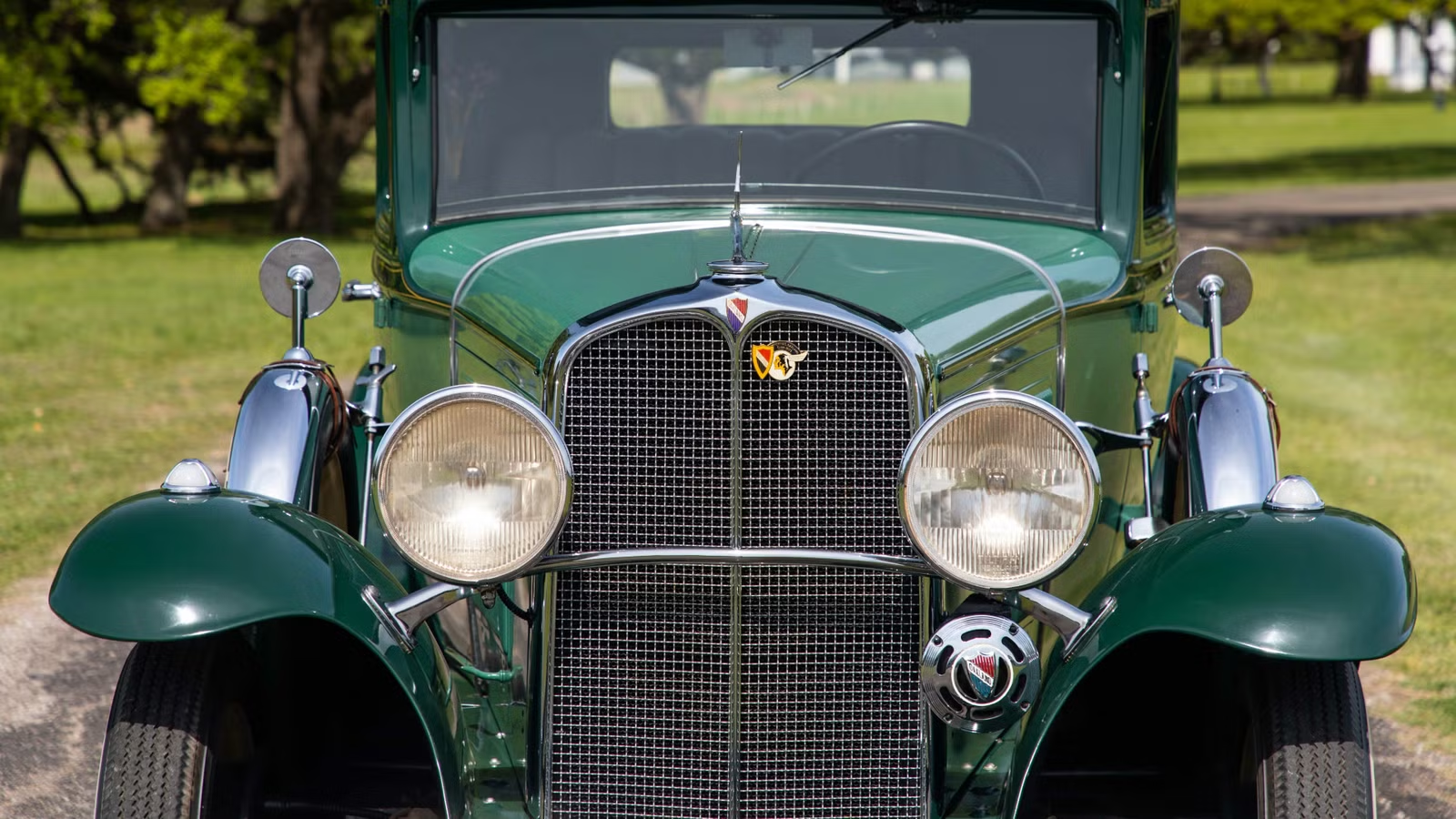
Someone tell Ford fans to hold their horses! Sure, the automaker delivered an epic flathead engine that changed the game. However, General Motors beat it to market by two whole years. Remember y’all, if you’re not first, you’re last. The GM option that’s living in Ford’s shadow was actually a bit more refined than rivaling alternatives. It deserves more respect as an iconic piece of General Motors engineering history. However, the engine quickly ran into a few problems beyond its control as a short-lived option.
Ford Gets All The Credit For Prewar V8s

Henry Ford’s spirit is out there laughing at General Motors because the Ford 1932 Flathead engine is highly credited for the birth of V8 power and hot rods. The 221 cubic-inch (3.6-liter) engine was the first mass-produced V8 option, and it made its famous debut in the Model 18. Before the Ford flathead arrived, V8 power was reserved for luxury cars.
The 221 V8 delivers 65 horsepower and 130 lb-ft of torque. It helps the Model 18 accelerate from 0 to 60 mph in about 13 seconds and complete a quarter-mile in roughly 18.4 seconds with a top speed of 85 mph. It was incredibly fast for the era and quickly became popular among hot rodders and police cruisers.
This engine is pretty innovative with a compact L-head design and monobloc build. The valves are placed directly in the block next to the pistons to save space. It cuts weight by using a cast-aluminum intake manifold that’s paired with a rigid counterweight forged-steel crankshaft. Also, the cylinder bores are offset by 3/16th of an inch to reduce internal friction.


The engine has full-floating piston pins made of seamless steel tubing fitting into a bronze busing in the connecting rod to enhance durability. Plus, the aluminum oil pan also reduces weight and assists with cooling the engine oil. 1932-only components include dual water pumps with tall outlets and a U-shaped dipstick placed under the straight exhaust manifold.
But General Motors Got There First

Oakland Motor Car Company, a division of General Motors, introduced the monobloc 251 cubic-inch (4.1-liter) V8 engine in 1930, a whole two years before Ford. It also features an L-head design with horizontal valves positioned directly in the block. They’re controlled by a centrally locked, chain-driven camshaft and rocker arms.
This 90-degree engine pumps out 85 hp and 155 lb-ft of torque. It debuted in the 1930 Oakland Model 301. Unfortunately, it doesn’t have an official 0 to 60 mph or quarter-mile time. But it does have an estimated top speed of 70 mph. The engine was built for luxury touring instead of rapid acceleration.
General Motors engineer Caleb E. Summers developed the Synchronizer articulated engine mount to solve the engine’s flat-crank shake. A four-lobe cam runs at half of the engine speed from the camshaft and operates at a level with its fulcrum down near the crank centerline. It drives a spring-loaded shaft attached to the leaf-spring engine support.

The advanced vibration damping engineering is paired with a more sophisticated valve layout, allowing the engine to be much more refined than the Ford flathead. The operating mechanical smoothness was developed to provide a performance that matched high luxury standards of the pre-war period.
But Oakland Couldn’t Compete Against Pontiac

General Motors introduced Pontiac in 1926 as a lower-priced companion brand to Oakland. It turns out that a lot of drivers were attracted to more affordable cars over luxury options. Pontiac cars immediately started to outsell Oakland models. In fact, by 1928, Pontiac was outselling Oakland by nearly five to one.
This trend only intensified as the Great Depression struck in 1929. Pontiac was the only companion brand under General Motors to survive the depression. As a result, brand cannibalism struck hard as Oakland Motor Car Company was discontinued in 1931 and absorbed by Pontiac.
However, the Oakland flathead V8 managed to survive for an entire production year after the brand met its death. It survived under the Pontiac name until 1932. The V8 powered the Series 302, which includes coupe and sedan body styles while providing more affordable access to V8 power. The engine was replaced when all of the leftover Oakland engine parts were used up.
What Replaced The Oakland Monobloc V8?

The Oakland monobloc V8 engine was replaced by the 1933 Pontiac Straight Eight, which is also referred to as the ‘Economy Eight’ that was introduced to save the brand during the Great Depression. It worked, as the Pontiac Straight Eight became the most affordable car with V8 power available. Pontiac sales nearly doubled that year.
Pricing ranged from $585 for the base Roadster to $695 for four-door sedans. The 223.4 cubic-inch (3.4-liter) inline-eight L-head engine delivers 77 hp and 116 lb-ft of torque with a top speed of about 78 mph. Plus, it’s noted for having an incredibly smooth and comfortable performance for the time.
It has a fully counterbalanced 71-pound, five main-bearing crankshaft with harmonic balancing built into the fan pulley. The short bore stroke of 3.188 by 3.50 inches provides low piston travel, and it has full-pressure lubrication to all bearings, even the piston pins. It’s delivered through rifle-drilled connecting rods.
Here’s Why Gearheads Should Look For The Monobloc 251
The Oakland monobloc 251 is an incredibly rare engine. Only about 6,291units were built under Pontiac before it was replaced by the straight eight. This engine has nearly gone extinct and is difficult to find. It primarily survives in pre-war antique cars. But it didn’t get discontinued due to any mechanical faults. Instead, it faced internal brand cannibalization.yout
It stands out as a true piece of historic General Motors engineering that beat the famous 1932 Ford flathead V8 to market. This engine featured a monobloc single-unit design first! Plus, the design eliminated head gaskets with a unique horizontal valve configuration on top. As a result, it provides tons of reliability.
The engine doesn’t deserve to be forgotten in Ford’s shadow. In fact, Ford fans should honor it for inspiring Ford engineers to develop a unique monobloc variant to compete against it. While the Ford engine provided affordable access to more power, it was notably less refined than the Oakland 251, with significant vibration and oil consumption issues.
Source: Engine Builder Mag, Mac’s Motor City Garage, General Motors, Ford, Pontiac

Related posts




Latest Post


No Comments