
The Cheapest Boss Mustang Quietly Became Ford’s Entire 5.0 Identity
The Boss Mustangs are among some of the most legendary muscle cars of all time. There’s a very good reason for that. They helped to re-define what American muscle car performance could be. They were also part of the special golden era of American muscle, before big American engines were strangled by the oil crisis and emissions regulations.

One “Boss” model in particular became incredibly influential. But it’s not the one you might think.
The Golden Era Of Muscle Cars Was Full Of Special Models With Crazy Engines
Like quite a few periods across automotive history, the golden era of Muscle Cars was defined by the creation of special models with outlandish engines. These were often designed so that the automakers who built them could install a high-output engine and get it homologated for racing. These homologation special cars were intended to rule the roost in NASCAR (which had homologation regulations at the time), Trans Am or the NHRA Super Stock class of drag racing.

The Ford Mustang Had Several Special High-Performance Models Early On

One of those muscle cars that got special high-performance models with crazy engines was the original version of the Ford Mustang. The Mustang had a lot of different engine options during that golden era period. This included the “Boss” models, which were among the upper echelon of muscle car performance. The Boss model that everyone knows the best is the Boss 429, a NASCAR homologation special which initially came with the 429 cubic-inch Boss V8. But there were other Boss models that don’t get as much attention as the Boss 429. One of them was seen as the lowest-ranking model in the “Boss” lineup, but it is actually the one that had the most long-term impact.
The Ford Mustang Boss 302 Is A Homologation Special Designed To Take On General Motors

Like its Boss 351 and Boss 429 siblings, the Ford Mustang Boss 302 was made explicitly as a homologation special. It was intended to compete in the Trans Am series, which had grown increasingly popular. One of the dominant cars in that Trans Am series was the Chevrolet Camaro Z/28. Ford wanted to compete directly, so the Mustang Boss 302 was developed to meet Trans Am regulations and bring the fight to its Detroit rival.
Its Engine Is Unique Compared To Every Other Small-Block Mustang

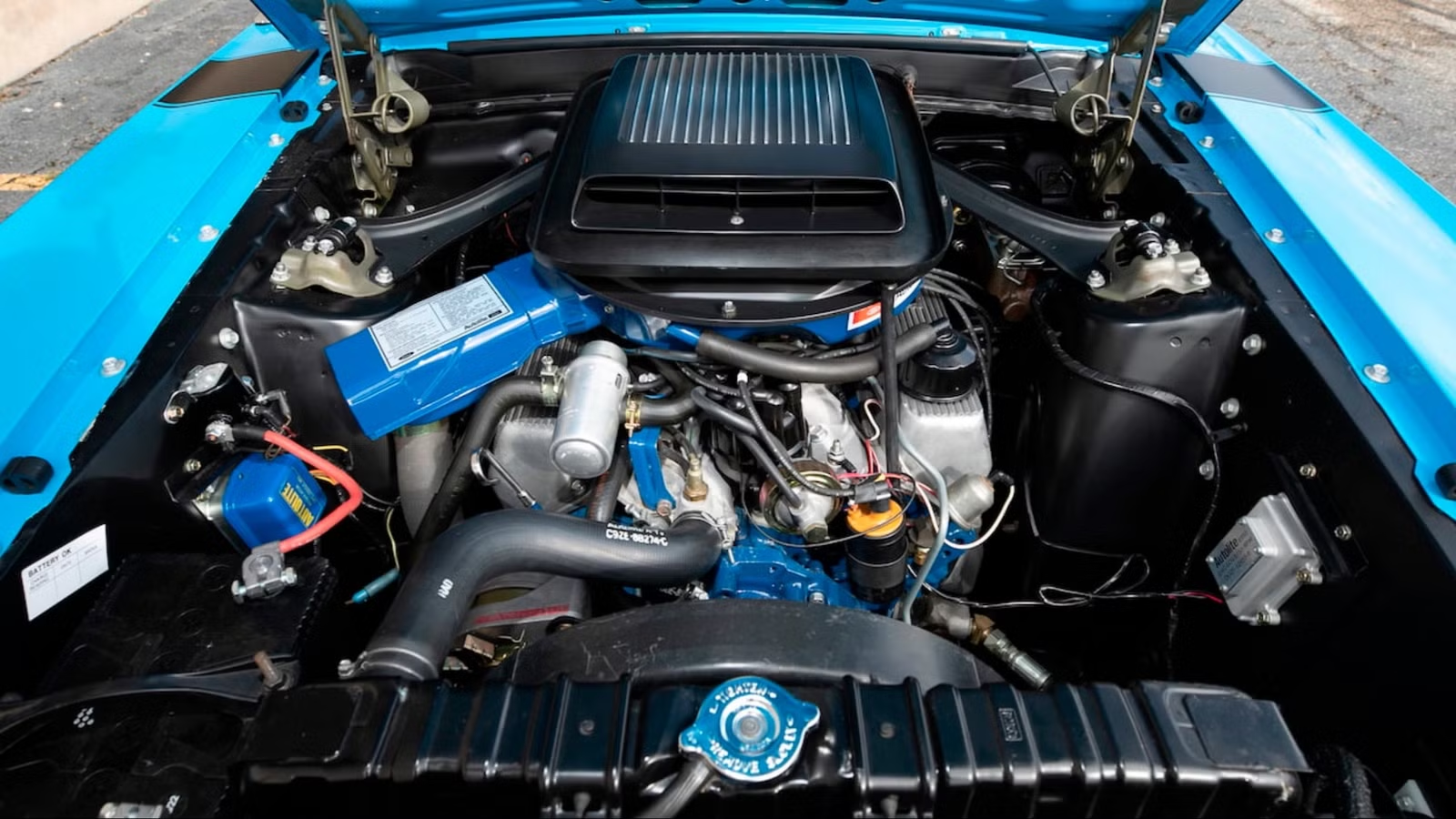
As part of the modifications Ford did to make the Boss 302 competitive in the Trans Am series, it got given an engine that’s unlike any other in any classic Ford. It has the block of the 302 Windsor V8, modified to use stronger 4-bolt main crankshaft bearings instead of the 2-bolt ones standard on the Windsor. But it has the large-port, canted-valve cylinder heads from the 351 Cleveland V8. This was possible because both engines share a common cylinder head bolt pattern. Only minor modifications to the coolant passages were needed to adapt the bigger cylinder heads from the Cleveland to the Windsor’s block. Those Cleveland cylinder heads actually appeared on the production Boss 302’s engine first, as the production 351 didn’t debut until a year after the Boss 302’s launch.
The unusual combination of parts from two different V8s created an engine that was surprisingly powerful for a small-block. The “G Code” engine, as it was known internally, produces 290 horsepower and 290 lb-ft of torque. Of course, that’s nowhere near as impressive as the 375–425 hp and 450 lb-ft of torque its Boss 429 sibling was rated to produce from the factory. But it was enough to make the Boss 302 very competitive.
It Was Very Successful In The Short Time It Raced
The Boss 302 did end up going into the racing series it was designed for. Not only did it slot in immediately, but it proved consistently competitive. There was no better demonstration of that than in 1970, when Parnelli Jones (driving for Bud Moore) won the Trans Am championship driving a Boss 302. That success was short-lived, however. Ford ended up dropping the Boss 302 after that year, pulling manufacturer support for the Boss 302s in the Trans Am series in the process. That meant that Bud Moore’s team switched to using AMC Javelins in 1971.
It Got A Mercury Cougar Sibling

You might think that, due to its nature as a homologation special, the Ford Mustang Boss 302 was the only car to receive the G Code V8. That’s actually not the case at all. The Mustang’s more upmarket Mercury Cougar sibling also got a variant powered by the G Code engine. It’s called the Mercury Cougar Eliminator, and it was a “gentleman’s hot rod” alternative to the Ford Mustang Boss 302. It was produced at the same time as the Ford Mustang Boss 302, but it wasn’t a Trans Am homologation special like the Mustang Boss 302 was.
The G Code V8 also wasn’t the only engine that was available in the Mercury Cougar Eliminator. According to sales material from the time, Mercury did allow customers to spec the Boss 429 engine in it. But no Boss 429-powered Cougar Eliminators were ever sold to the general public as new vehicles. The two sole Boss 429-engined eliminators were special orders built for “Fast Eddie” Schartman and “Dyno Don” Nicholson, and were factory drag cars that were never supposed to be street-legal.
Its Influence Is Still Felt In Mustangs Today

When it was around in that muscle car golden era, the Boss 302 was the cheapest of all the homologation special Mustangs. It is also not discussed anywhere near as much as the Boss 429. But, paradoxically, the Boss 429 was a developmental dead end while the Boss 302 ended up having the biggest influence on the Mustang as it exists today.
It might not be immediately obvious. But when you look at a few developments that occurred later in the Mustang’s history, it becomes clear that the Boss 302 was the most influential Mustang variant to emerge from the golden era of muscle cars.
It Was The First Mustang To Adopt The “5.0” Branding

Part of the Boss 302’s branding was that, in an unusual move for an American car of the era, its engine size was expressed in liters instead of cubic inches. While 302 cubic inches is technically 4.9 liters, 5 liters is a round number that’s catchier as a branding tagline. This is not only something that stuck with the Mustang once engine displacements began to be advertised in metric units from around 1978, but it is also something you still see on V8-powered Mustangs to this day.
The 302 Pushrod Windsor V8 Was Used In The Mustang Until The 1990s

Another part of the Boss 302’s legacy is that 302 engine we’ve already talked a fair bit about. While it wasn’t a pure Windsor V8, the Windsor V8 block lasted much longer than the Boss 302 variant did. In fact, the old pushrod Windsor lasted all the way through the controversial Fox Body generation and through the early years of the SN95. It didn’t get replaced by the 4.6-liter Modular V8 until 1996. When the Modular V8’s life cycle ended, Ford decided to bring the displacement of V8 Mustangs back to a similar size to the Windsor block with the Coyote V8.
Sources: Ford, Mercury

Related posts



Latest Post


No Comments