
The Performance Legend That Slipped Through The Cracks
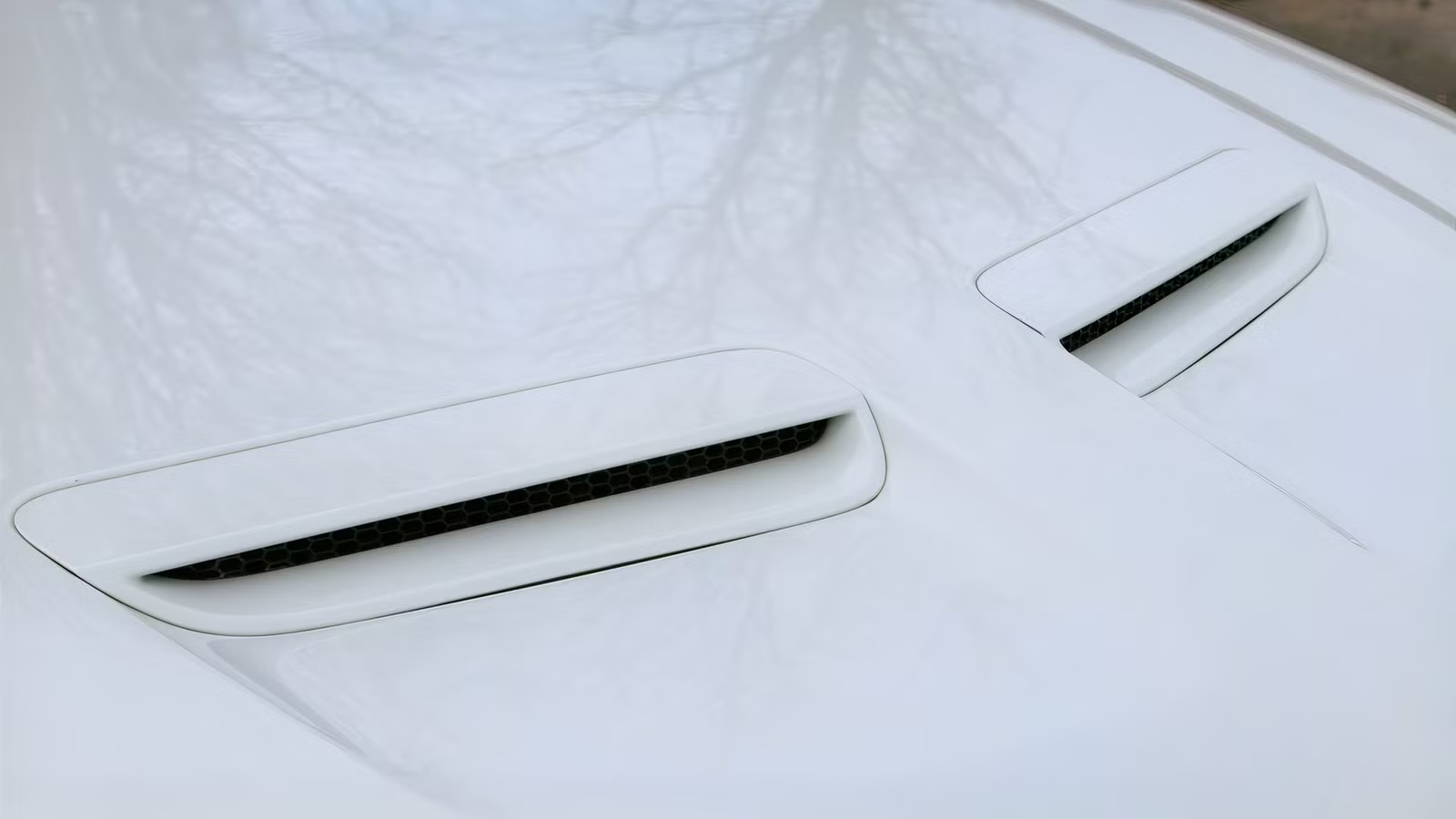
Muscle royalty is supposed to be born in Detroit. But sometimes a genuine American performance icon comes from somewhere nobody would guess, like the original GT40 built in England, or modern Challengers rolling off the line in Canada. Globalization turned auto manufacturing into one giant assembly line of parts, plants, and badges swapped across borders. Yet one vicious Pontiac V8 sedan wore a classic American badge while being engineered and built entirely on the other side of the planet, and almost nobody noticed. The clues were sitting right there in the spec sheet the whole time.
American Performance Sedans Were Already Running Out Of Time By The Late 2000s

The landscape of the American auto industry flipped upside down by the mid-2000s. Decades earlier, the golden era of high-compression, fire-breathing V8s got strangled by emissions mandates and two brutal fuel crises. Automakers spent the next twenty years quietly detuning everything with a V8 badge on it. Then came the second gut punch. Buyers started migrating from sedans, and SUVs and light trucks ate the market alive. A four-door with a big engine started to feel like a museum piece next to a crossover with cupholders and a screen in every headrest.

Detroit’s answer was to keep chasing the crossover money, and it is hard to blame them for it. Margins on a jacked-up people mover beat margins on a sedan. Nobody under sixty wanted to be caught driving one. The rear-drive performance sedan, once the backbone of every American lineup, started looking like a rounding error on a spreadsheet somewhere in Michigan. Nobody wanted to bet real development money on a niche that kept shrinking every quarter.
Building one from scratch, in an American plant, made less and less financial sense with every passing year. Global platforms and shared architecture became the workaround, letting one good chassis get badged a dozen different ways across a dozen different markets. It was cheaper, faster, and if buyers never noticed the difference, nobody at headquarters was going to point it out. Traditional rear-drive muscle sedans were rapidly running out of runway, and the handful that survived would have to come from somewhere nobody expected.

The Chassis Was Telling A Different Story Than The Badge On The Trunk

While the market chased high-riding crossovers, a handful of product planners quietly green lit a sedan built to fight Europe’s best. On paper, it was pitched as an accessible, full-sized American four-door. The moment test drivers actually turned the wheel, it became obvious this chassis didn’t share the floaty, numb road manners of a typical domestic cruiser. The steering was crisp, precise, and unusually communicative for something this size. Instead of wallowing through sweeping bends or scrubbing its front tires through tight corners, it rotated with a neutral balance that had no business belonging to a full-size sedan.

Reviewers at the time kept reaching for BMW 5 Series comparisons, which is not a phrase anyone expected to write about an American four-door with a bench seat option. Even the ones who showed up ready to mock it walked away impressed. None of this fit the profile of a mass market family sedan built to a strict cost target. Suspension tuning like this usually meant an engineering team with a much bigger budget and a much longer leash than anything coming out of a typical domestic product cycle.
Underneath the aggressive front fascia sat a rear-drive platform with a stiffness and suspension geometry that belonged on a track-day build sheet, not a rental fleet order form. Nothing about the badge gave it away, and nothing in the marketing copy gave it away either. The chassis was whispering something to anyone paying close enough attention. Its roots were planted about as far from Michigan as a car could get.
The Pontiac G8 GXP Was Actually Born In Australia, Not Detroit

The cat was finally out of the bag when GM revealed the crown jewel of its performance lineup, the Pontiac G8 GXP. Despite wearing the iconic red dart on its grille, this was not a Detroit product. The G8 GXP was engineered, tested, and assembled entirely in Elizabeth, South Australia, by GM’s Australian subsidiary, Holden.
Down Under, Holden had spent decades building rear-wheel-drive, V8-powered machines tough enough for outback roads and dominant enough to win touring car championships against Ford’s own local lineup. The G8 GXP was, underneath the fresh sheet metal, a US-bound version of the acclaimed Holden Commodore, riding on the same global rear-wheel drive Zeta platform. Holden’s engineers had been sorting out big, powerful, rear-drive sedans since long before anyone in Detroit thought to ask them for help.

This was not GM’s first attempt at Australian muscle either. Former GM product chief Bob Lutz had already tried once before, bringing over the Holden Monaro as the 2004 to 2006 Pontiac GTO. Lutz had a reputation for this kind of move; for him, the rear-wheel-drive project car from Holden was an untapped resource for North America.
That first Holden import, the GTO, arrived on an aging platform and never found much of an audience. When the newer, sharper VE Commodore came along a few years later, Lutz pushed it through as the G8 instead, and this time the timing and the styling both worked in its favor. Tragically, the GXP arrived just as Pontiac reached the end of its own line. As a 2009 model, it stood as the ultimate performance swan song for the brand, unveiled only months before General Motors marked Pontiac for discontinuation during its bankruptcy restructuring.
The LS3 V8 And Six-Speed Manual Holden Built Into It

Holden didn’t just give the G8 GXP a slightly stiffer sway bar and a couple of sporty new badges. They dropped a genuine monster under the hood. Nestled between the front strut towers was a 6.2-liter, 376-cubic-inch LS3 V8 straight out of the Chevrolet Corvette. Pre-production estimates floated around 402 horsepower, but final SAE certification bumped the official rating to a proper 415 horsepower and 415 lb-ft of torque. The whole car, even with the manual gearbox, started at $37,610, less than half of what a BMW M5 of the same era commanded for similar power and a nearly identical back seat.
To tame that power, Holden equipped the GXP with its track-validated FE3 suspension package, tuned on the Nürburgring with stiffer springs, a beefed-up anti-roll bar, and quicker steering than the standard G8 got. Complemented by massive 14-inch Brembo front brakes, the roughly 4,050-pound sedan sprinted from 0 to 60 mph in about 4.5 seconds and blasted through the quarter mile in 13.0 seconds flat.
The Manual Transmission That Makes This One Rare

A heavy-duty six-speed automatic came standard, and it did the job well. But the real magic happened when a buyer checked the box for the optional Tremec TR-6060 six-speed manual, the same unit found in cars like the Dodge Viper and the Ford Shelby GT500. Ordering the row-your-own gearbox in a 415-horsepower four-door was a genuinely bold move, and it turned a great sport sedan into an immediate enthusiast grail. A Tremec shifter poking up between two front seats in a car built to haul the whole family was the kind of detail that made total strangers ask to pop the hood at a gas station.
It also turned out to be rare almost by accident. Out of 1,829 total GXPs built across the car’s single model year, only 846 left the factory with three pedals. That works out to under half of total production, a smaller slice than most people assume when picturing a Pontiac built during a down year for the brand. Track one down today with a clutch pedal and a Tremec badge on the shifter, and you are holding one of the rarer factory manual sedans General Motors built this century.
Why The G8 GXP’s Australian Roots Matter More Today Than They Did In 2009

The GM bankruptcy that ended Pontiac moved fast once it got started. GM confirmed on April 27, 2009 that it would wind the brand down entirely, with the formal Chapter 11 filing following roughly five weeks later that June. The GXP had not even made it through a full model year before that announcement landed, which meant most dealers were still trying to move showroom stock while the brand’s own obituary was already being written.
GM did let the idea live on for one more act. A few years later, Chevrolet brought the next-generation Commodore over as the Chevy SS, a rear-wheel-drive four-door running the same LS3 V8 and keeping the Tremec manual as an option. It found an even smaller audience and quietly disappeared again by 2017, proof that America never quite figured out what to do with a proper Holden sedan, even on the second try.

These days, the G8 GXP is finally getting the respect it missed the first time around. A fair-condition example asks $17,200 and a genuinely excellent one asks $38,400, with the manual transmission adding a real premium on top of either number. Former GM Vice Chairman Bob Lutz once reflected on what might have happened had Pontiac survived. It never got the chance to.
Collectors get it now, even if the market never did back in 2009. This was never really an American sedan. It was a Holden wearing a Pontiac badge, built on the other side of the planet, and it took the rest of us a while to catch on.
Sources: Mecum, Bring a Trailer, Hagerty, General Motors

Related posts




Latest Post


No Comments