
The Royal Enfield That Makes Every Mile Memorable
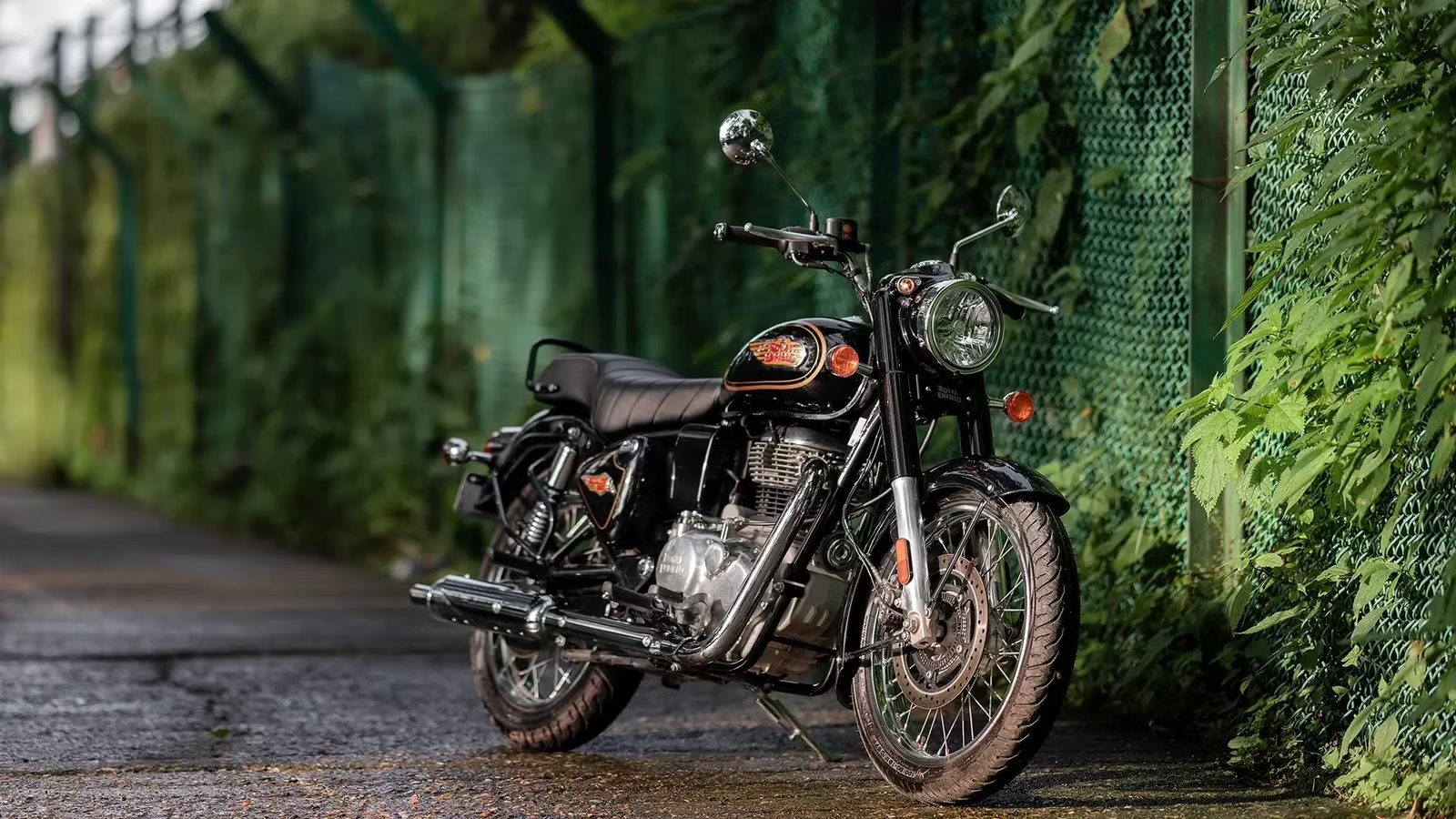
Royal Enfield isn’t just a well-known brand in the world of motorcycles; it is an icon. It has built its reputation over a century of continuous production and sales of its products. Products which have been known for their thumping exhaust note, classic styling, and simple construction that nevertheless engage the rider. These products offered one of the few completely unadulterated experiences on two wheels – even if that experience used to include making friends on the trip because you broke down a few times. The joy of owning a Royal Enfield was like marriage: there were always going to be low points, but you became better for it if you had the ability to deal with them.
There Is A Gap Between Technology And Soul In Motorcycles

Progress is both a blessing and a curse. It means things get better, but everyone’s definition of ‘better’ doesn’t always align. In the case of motorcycle manufacturers, they chased progress by building quicker or more reliable machines; sometimes both things appeared together in the same model. They achieved this through technology, of course. When metallurgy improved and new materials were discovered and became viable for production, manufacturers pivoted to them. But when electronics made an appearance, not only did safety take a leap forward, it seemed like the soul of most motorcycles took a step back.
Simplicity Can Also Be A Great Way To Have A Fun Time

We aren’t challenging the claim that electronics have made motorcycles faster and increased our ability to use them in non-perfect weather with greater safety. But in the search for spec-sheet domination and lap times, the products often become clinical tools to achieve those goals rather than a coming together of components that add up to more than the sum of their parts. Royal Enfield goes against the grain here; its products have changed over the last three decades, including modern products that are better than anyone expected, but it hasn’t let go of what made it worm its way into our hearts – the mechanical simplicity and genuine involvement riding an RE offers.
You Don’t Need Much To Create Memories

Royal Enfield’s philosophy of keeping it simple is very evident when you look at its products across the range. No matter the displacement, it targets simplicity with minimal electronic intervention wherever possible. What it focuses on is a pure mechanical feel where the bike communicates with the rider without any filters. Some might not like this, but you cannot deny that it is the purest form of experiencing two wheels. And the Royal Enfield that makes every mile memorable can claim that it has been the author of more memories than any other Royal Enfield in history. Here’s why.

The Bullet 350 Is The Royal Enfield That Makes Every Mile Memorable

The Bullet 350 is usually known for being the world’s longest-running, continuously produced motorcycle. In its near-century of existence, it has seen everything from world wars to racing in trials to becoming the default choice for exploring in its adopted home market. Today’s Bullet 350 is a product that straddles old and new, with a timeless design that echoes its heritage — complete with hand-painted pinstripes on the tank — but coupled with modern features like ABS and fuel injection. Even with the new J-series or the 650 cc engine, it remains an old-school cruiser, which is why, whether you’re riding to the store or attempting to go across state lines, it’ll make every mile memorable.
Value Pricing Is A Given For This Product

Royal Enfield has priced the Bullet 350 at $4,799, which places it between the Classic 350 and the Meteor 350, with the Goan Classic the most expensive 350, even though it is a budget bobber for the masses. The Bullet 350 has no variants or even different colors to pick from — this is the standard Bullet 350 in the form that we’ve always known it, and that’s all right. There are the other models mentioned here and some others if you want different takes on a 350 cc Royal Enfield. At $4,799, the Bullet 350’s price is easy to justify — but only if the experience delivers. And that depends almost entirely on what powers it.
J-Series Engine Is All-New, But You Wouldn’t Know It

Royal Enfield is a legacy brand, somewhat like Harley-Davidson, and just like The Motor Company, it has steadfast loyalists that it cannot afford to alienate, which explains why the new J-series engine, despite being a completely new engine, looks and feels a lot like the older engines that used to power 350 cc models. This engine is capable of meeting emission norms anywhere in the world, and with its relaxed power output, that really shouldn’t be a bother. It is also an extremely fuel-efficient engine, and the Meteor 350 powered by it is the most fuel-efficient cruiser in the market.
This engine has a single cylinder, is air-cooled, and has two valves. It displaces 349 cc and is a long-stroke design. It has a relaxed compression ratio of 9.5:1. It generates 20 horsepower at 6,100 RPM and 19.9 pound-feet at 4,000 RPM. This is fed through a five-speed manual gearbox and a drive chain to the wheel. The only nod to modernity here is the fuel injection system. This remains the only Royal Enfield without an assist-and-slipper clutch, despite the rest of the 350 cc models using the same engine in the same state of tune. However, it is expected that the slipper clutch will make it to the Bullet in the next model refresh, or you could just fit one yourself if you are so inclined.
Traditional Chassis Is Revamped, Just Like The Engine

The chassis is a twin downtube frame, and that hasn’t changed on the new one. It has had improvements, just like the engine, and it rides and handles like a modern version of a Bullet 350. Everything is kept simple, because with it being one of the least powerful cruiser bikes among all the popular brands, more wasn’t needed.
There are 41 mm telescopic forks at the front, and twin-tube emulsion shock absorbers at the rear with preload adjustability. There is 5.1 inches of travel at the front and 3.1 inches at the rear. Stopping power is via single 300 mm front disc with a two-piston floating caliper and a 270 mm disc with a single-piston caliper at the rear. Spoke wheel rims are present (obviously), with a 19/18-inch front/rear diameter. Tube-type tires are required.
This Is Not A Very Compact Bike – And It Is Heavy
The Bullet 350’s dimensions have followed the same trend as automobiles – it has remained broadly the same size but has grown incrementally over the decades. It is 83.1 inches long and 30.9 inches wide with a wheelbase of 54.7 inches. The seat height is 31.7 inches, which seems high, but this is a narrow single-cylinder motorcycle, so it feels a lot easier to handle. The fuel tank can hold 3.43 gallons of fuel. This is a heavy motorcycle for the power, with the curb weight coming in at 430 pounds.
No Traction Control, No TFT Screen — The Bullet 350’s Feature Omissions Are A Feature

The Bullet 350 is positioned as the retro, simple entry to the traditional Royal Enfield range (the Hunter 350 costs less because it is positioned as a beginner motorcycle that won’t break the bank but is a modern interpretation of what an RE should be). As such, the brand has not given it anything that we perceive as features today on a motorcycle. Royal Enfield has even retained halogen lighting! The instrument cluster mimics the vintage Smiths meters it once had and has added a digital component at the bottom that displays fuel level and the odometer/trip readings.

You can get the Tripper TFT pod installed as an accessory on the bottom right in some markets. We like the symmetry of the design, with the ignition key on the left and the Tripper pod on the right. There is dual-channel ABS, thanks to the rear disc brake, but there is no traction control. The usual accessories are present: seat upgrades, engine and sump guards, black wheel rims, and a pillion backrest.
Neither Rival Has A Soul Like The Bullet 350

There seems to be a real lack of models at the budget end of the cruiser market. If you want a modern beginner cruiser, the Honda Rebel 300 offers a liquid-cooled engine with a four-valve head. It even has the E-Clutch system as standard, but it can feel a little soulless despite being an entry-level cruiser with high-tech features.

The Yamaha V-Star 250 is quite like the Bullet 350 in many ways that matter: it offers simplicity, and it hasn’t changed for a while. The distinct advantages it offers are the feeling of a V-twin, carburetion that is easy and inexpensive to maintain, and a history of being bulletproof, if you’ll allow us the pun. All of this makes it the perfect beginner cruiser you can still buy new. It doesn’t have ABS even as an option, which is where it lags behind the other two cruisers here.
Source: Royal Enfield USA

Related posts



Latest Post


No Comments