The Toyota SUV That Feels Like It Was Built To Last Forever
8 minutes reading
Saturday, 1 Aug 2026 16:00 0 63 autotech
Modern car culture loves novelty, bigger screens, quicker 0-60 times, another “revolutionary” redesign every few years. Then there’s this Toyota SUV, a vehicle that has spent four decades doing the opposite by staying stubbornly, deliberately the same. While rivals chased trends and unibody refinement, this SUV kept its body-on-frame bones and a philosophy that borders on defiance. The result isn’t just a capable off-roader. It’s an SUV owners routinely drive past 300,000 miles, then hand down rather than trade in. This is the story of why that reputation exists, and why it still holds up.
Reputation in the automotive world is usually manufactured, a marketing department’s fingerprint on a press release. The kind of reputation this SUV carries is different. It wasn’t built in a boardroom; it was built in driveways, on forums, and in the accumulated testimony of owners who kept the same vehicle for a decade or more and never had a reason to complain.
That’s a rare thing in 2026. Most modern vehicles are engineered around a refresh cycle, designed to feel dated the moment a replacement lands showroom-ready. This SUV never played that game. It arrived with a simple mechanical promise, durability over drama, and it kept that promise so consistently that word of mouth did more marketing than any ad campaign could. J.D. Power named it the most reliable midsize SUV in its 2020 Vehicle Dependability Study, and Consumer Reports has ranked it first in predicted reliability among midsize SUVs, ahead of luxury examples like the BMW X5.
Close-up shot of 2017 Toyota 4Runner engine bayToyota
None of that happened by accident. It happened because one automaker refused to fix what wasn’t broken, even as the rest of the industry insisted that standing still was the same as falling behind.
How The Toyota 4Runner’s Engineering Became Its Greatest Strength
Front 3/4 shot of 2017 Toyota 4Runner parked off-roadToyota
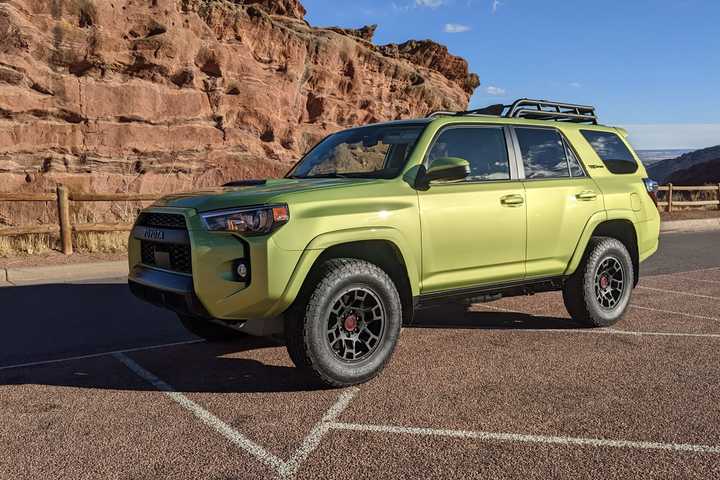
The Toyota 4Runner is the SUV in question, and its engineering philosophy is almost anti-modern. The fifth-generation 4Runner, launched in 2010, was built on a body-on-frame chassis and powered by a naturally aspirated V6 paired with a five-speed automatic, mechanically unglamorous by design, and that’s precisely the point.
Where competitors added complexity in pursuit of efficiency gains and cabin refinement, Toyota largely resisted. The 4Runner’s 4.0-liter V6 produces 270 horsepower and 278 pound-feet of torque, numbers that look modest against turbocharged four-cylinders doing more with less displacement. But that naturally aspirated engine has no turbo to fail, no direct-injection carbon buildup running rampant, and none of the small-displacement strain that comes from asking a smaller engine to work harder for years on end.
Rear 3/4 shot of 2017 Toyota 4Runner parked off-roadToyota
The straightforward mechanical layout delivers extraordinarily few reports of catastrophic engine or transmission failures, even in high-mileage examples. It’s a case study in engineering restraint: fewer parts to fail, fewer systems to diagnose, and a powertrain that owners and independent mechanics alike can service without specialized tools or dealership-only diagnostics. In an era where new vehicles are increasingly software-defined, that mechanical simplicity has become a competitive advantage nobody saw coming.
Body-On-Frame Chassis, And Off-Road Hardware That Keep Owners Coming Back
Front action shot of 2017 Toyota 4Runner driving on trailToyota
Body-on-frame construction is the automotive equivalent of building a house on a steel foundation instead of gluing the walls together. In a unibody vehicle, the body panels and structure are one integrated piece, lighter, quieter, and better suited to on-road manners, but also less forgiving of hard off-road impacts and much costlier to repair after serious structural stress. Body-on-frame separates the two: a rigid steel ladder frame underneath, with the body mounted on top. It’s heavier and less refined, but it absorbs punishment the way a unibody simply can’t, and it ages differently, components wear and get replaced rather than the whole structure fatiguing at once.
That Distinction Matters Enormously For Long-Term Ownership
2023 Toyota 4Runner DashboardToyota
The 4Runner’s body-on-frame construction has been providing enhanced durability on rough terrain since its release in 1984, and that architecture is still the backbone of the current lineup. Add genuine off-road hardware, locking rear differentials, available Kinetic Dynamic Suspension System (KDSS) for articulation on uneven trails, and TRD Pro trims running Fox-tuned suspension, and you get a vehicle that isn’t just marketed as rugged. It’s mechanically built for the job.
The frame’s robustness is exactly why the 4Runner shows up so often in overlanding builds, hill-climb projects, and desert-adventure rigs. It can absorb modification and abuse that would compromise a unibody SUV’s structural integrity. Owners aren’t just buying a badge; they’re buying a chassis that tolerates being pushed hard for years without punishing them for it later.
What Long-Term Ownership Really Looks Like, From Reliability To Running Costs
2012 Toyota 4Runner Front 3/4Toyota
This is where the 4Runner stops being a good story and starts being a good spreadsheet. iSeeCars data places the 4Runner’s average lifespan at 196,455 miles, or roughly 14.2 years, based on an analysis of over 300 million data points, and that’s an average, not a ceiling. The same dataset gives it a 48.1 percent chance of reaching at least 200,000 miles, which is a remarkable figure for a mainstream midsize SUV.
The high-mileage anecdotes back up the statistics rather than contradicting them. One Glen Burnie-area owner reported a 2007 V8 4Runner passing 511,500 miles on its original drivetrain, while another documented a 2005 SR5 crossing 381,900 miles with nothing more than an alternator, a catalytic converter, and an air conditioning repair over 20 years. These aren’t outliers cherry-picked for a press release, they’re the kind of stories that circulate organically in 4Runner owner forums precisely because they’re common enough to be unremarkable within that community.
Running Costs Track The Same Story
2023 Toyota 4Runner EngineToyota
Annual maintenance costs average around $514, well below the midsize SUV segment average, and the 4Runner’s average annual repair cost after four to five years sits at just over $500. On the maintenance schedule itself, owners report the transmission comfortably running 100,000 to 120,000 miles before needing attention, with Toyota recommending spark plug replacement around the 120,000-mile mark.
It isn’t flawless. Earlier 4Runners, particularly 2003-2005 models, were notorious for frame rust in salt-belt regions, prompting Toyota to extend corrosion warranty coverage by 14 years on 2005-2010 models. Some 2014-2017 examples have also seen front brake caliper seizures and rotor warping after roughly 60,000 miles of demanding off-road use, typically costing $400 to $700 to correct. These are real, documented weak points, not dealbreakers, but the kind of maintenance items a buyer should budget for and inspect before purchase, especially on used examples from colder climates.
Side shot of 2015 Toyota 4Runner Trail Premium in red parked on roadToyota
Taken together, the picture is unambiguous. This isn’t a vehicle that avoids problems entirely, it’s one whose problems are well-known, well-documented, and cheap to manage relative to the alternative of financing a new SUV every five years.
Why The 4Runner Continues To Outlast Newer Rivals In A World Obsessed With Constant Change
Interiors and infotainment system of the 2023 Toyota 4Runner 40th Anniversary EditionToyota
A shot of the optional third-row seats in the Toyota 4RunnerToyota
The broader SUV market has spent the last fifteen years consolidating around unibody platforms, and the casualties tell their own story. The Nissan Xterra, once a genuine body-on-frame rival with real trail credibility, was discontinued in 2015 as Nissan shifted its SUV lineup toward crossover architecture and never replaced it with anything comparable. The Ford Bronco Sport, despite trading on the Bronco name’s rugged image, runs a unibody platform shared with the Escape, a trade-off that buys better on-road manners and fuel economy at the cost of the structural resilience serious off-roaders actually want. Even Toyota’s own lineup has drifted this direction in places, making the 4Runner’s continued commitment to its original formula increasingly rare rather than redundant.
Despite being “ancient” compared to modern rivals in its final model year, the outgoing generation still sold around 92,000 units and totaled 1.5 million sales over its production run, proof that a meaningful share of buyers still value mechanical simplicity and proven durability over next year’s feature list.
2023 Toyota 4Runner Front Seat AreaToyota
There’s an argument to be made that constant change isn’t actually progress if it comes at the cost of longevity, repairability, and trust built over decades. The 4Runner has quietly made that argument for over forty years, without ever raising its voice. In a market obsessed with reinvention, sometimes the most radical thing a vehicle can do is simply refuse to change, and keep running long after everything around it has been redesigned twice over.














No Comments