
The Forgotten Ford Big-Block Engine That Deserves More Respect
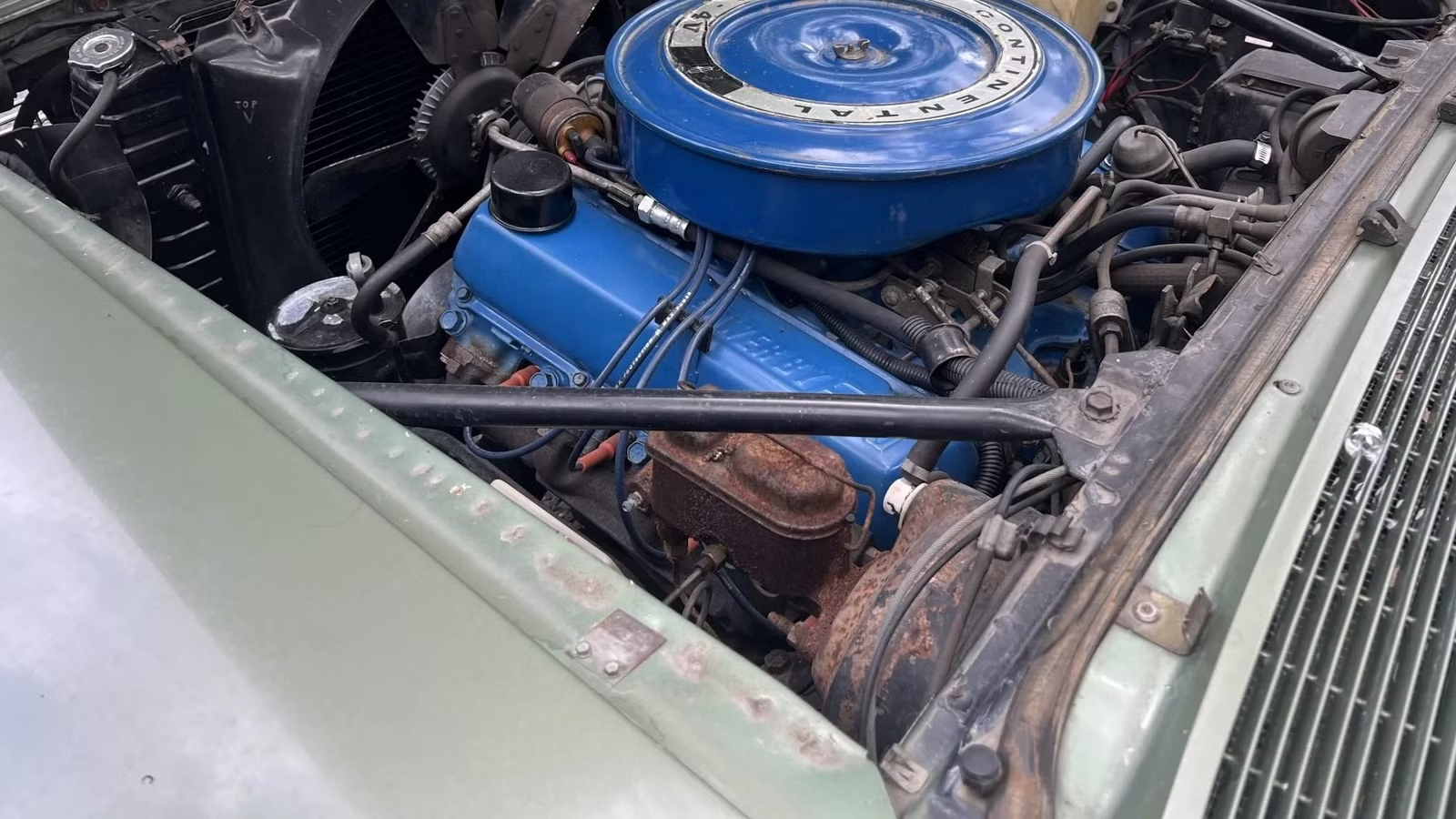
This is a little unfair. There is one Ford big-block engine that doesn’t get the same amount of respect as its siblings that are tied to muscle car glory. This massive V8 shouldn’t be left on the sidelines — it’s a durable, low-end torque beast that has blossomed into a tuner’s dream. It’s an important piece of Ford’s engineering history as it led to the design of modern heavy-duty performance, advanced engine casting techniques, and high-displacement aftermarket stoker builds.
Ford Needed To Replace The FE And MEL Engine Families

In the mid to late 1960s, Ford needed to replace its older big-block engines. The 462 MEL and 390/428 FE families were running into design and factory limitations and needed a few different improvements. They faced increasing manufacturing costs, they were extremely heavy, and they needed to meet rising emission standards.
The 462 MEL was an outsized engine. The large big-block engine led to poor vehicle handling, and it was time for muscle cars to get more agile instead of being designed for straight-line acceleration. Plus, its massive displacement is paired with immense heat, and the engine is prone to vapor lock and fuel boiling.
In Lincoln models, it required three-port fuel pumps with return lines and extra line insulation to prevent stalling. The unique three-thermostat design makes finding leaks and maintaining proper temperatures a bit tricky. The 390 and 428 FE engines also struggled with overheating due to thin cylinder walls on bored blocks.


They also had a competitive disadvantage due to their excessive weight. The FE requires distinct external balancing with matching flywheels or flex plates, leading to mismatched parts and severe vibrations. On top of that, oil supply to the rocker shafts may be starved if sludge builds up or the engine sits dormant, leading to bent pushrods and seized rockers.
The 385-series 460 V8 Solved A Lot Of Problems

When the Ford 385-series 460 V8 debuted in 1968, it introduced several crucial innovations to address multiple issues. The engine shares a foundational bore design with the 429 cubic-inch engine, so Ford was able to build multiple displacements on a single engine line to lower production costs.
This Lima powerhouse pairs a 4.36-inch bore with a 3.85-inch stroke, which led to the naming structure of the engine family. It also features a wide 4.900-inch center-to-center boring space to deliver a rigid and secure foundation. The tall deck design includes a 10.300-inch to 10.322-inch height to house the long-stroke rotating assembly.
The heavy-duty cast-iron crankshaft is supported by 3.0-inch main-bearing journals with two-bolt main caps. It also features a thin-wall casting and skirtless block design to reduce weight while improving breathing and high-performance potential compared to the older big-block V8 engines.

It was engineered to deliver smooth, quiet power to effortlessly move massive Lincoln land yachts. The 460 V8 produces between 208 and 365 horsepower and 350 to 500 lb-ft of torque depending on the year. It also has an excellent reputation for delivering low-end torque and being incredibly reliable for heavy-duty vehicle applications.
Here’s Why The 460 V8 Gets Overlooked
Enthusiasts and hot rodders often overlook the 385-series 460 V8 because of its considerable weight — it tips the scales at 720 pounds. Due to its robust cast-iron construction, it’s notably heavier than small-block engines. Unfortunately, this weight impacts front-end vehicle handling and balance. For example, the stock 302 small-block V8 only weighs between 460 and 500 lbs when dressed with cast-iron components.
The 460 engine also gained a luxury reputation by being developed for Lincoln models instead of high-performance muscle cars. Meanwhile, the 429 Boss gets plenty of fame and glory for powering the Ford Mustang. The 460 was also used to power heavy-duty F-250 and F-350 trucks and commercial motorhomes.
Unfortunately, this engine was choked during the malaise era. Increasing government regulations and emission rules combined with the 1973 oil crisis caused Ford to reduce compression ratios and drop factory ratings to sluggish levels by the late 1970s. These factors significantly hindered efforts to tune the 460 to its full potential.
But The 385-Series 460 Is Actually A Tuner’s Dream

Because the 385-series 460 V8 lives in the shadow of other engines, hot rodders may be missing out on significant untapped potential. This durable engine, famous for its massive torque and smooth acceleration, lasted in production until 1998. It outlived nearly every other American big block engine. The engine was discontinued as market demand shifted toward smaller, more fuel-efficient options.
The stock iron block has a remarkably high output ceiling. It can safely handle significant power levels up to 800 to 900 hp without requiring aftermarket block reinforcement. It is also easy to pair with stroker kits to boost displacement beyond 500 cubic inches for extreme power outputs.
Also, the architecture is easy to upgrade. The engine can be fitted with off-the-shelf roller camshafts and lifters without requiring complex block modifications. Its extensive production history across multiple vehicles means a large supply of used parts is available. It is more widely available and significantly more affordable than comparable engines.
It’s A Historic Legend Like Its Siblings

The 385 series and its legacy deserve recognition. The 460 V8 shares its innovative design and durable construction with the 429, with the ability to deliver impressive performance. It’s highly adaptable, as it started as a luxury powerhouse for high-end models before expanding into the workhorse era with an unmatched towing capacity.
In 1988, it transitioned to multi-port electronic fuel injection, with a standard output of approximately 245 hp and 400 lb-ft of torque until production ended. As Ford’s longest-running traditional big-block engine, it bridged the gap between luxury cars, high-performance crate motors, and commercial medium-duty trucks.
It provided the blueprint that shaped decades of high-output V8 design with skirtless thin-wall casting, high-flow canted valves, and deep displacement. The innovative metallurgy led to thinner yet stronger cylinder walls, setting the trusted template for developing lighter V8 engines.
Source: Ford, Automotive History Preservation Society

Related posts





Latest Post


No Comments