
Is Genesis Doing Mercedes Design Better Than Mercedes?
What’s been the best era for Mercedes design? Some argue it was Friedrich Geiger’s work between the 50s and 70s, like the 300SL and W113 Pagodas which redefined what “elegance” stood for, transforming Mercedes into an elegant luxury car brand. While others have praised his successor, Bruno Sacco, who turned this into “function” during the 80s and early 90s with his over-engineered, tank-like, box sedans. Bruno’s move to aerodynamic, diverse shapes during the mid-to-late 90s all appeared different, but they carried distinct design elements which were consistent across the range to ensure they remained a Mercedes—Sacco’s “Horizontal Homogeneity” design principle. Today, though, the firm’s designs have been criticized for their shapelessness and lack of road presence, which has left them vulnerable to a new premium entrant who has made inroads in markets across the globe, praised for their minimalistic, elegant exteriors — the foundations of a timeless Mercedes design.
Genesis: The Rising Star Who’s Hunting Down The Competition

Since Genesis formed as a stand-alone brand from the Hyundai Motor Group conglomerate in 2015, it has expanded from a single model in 2017 to a lineup of sedans, wagons, crossovers, and full-sized SUVs. The impact of the brand’s entry has significantly disrupted the luxury car market for buyers. Over recent years, the brand has received high praise for its premium craftsmanship, strong warranty packages, value for money, and its designs.
Mercedes’ New Benchmark For Car Design

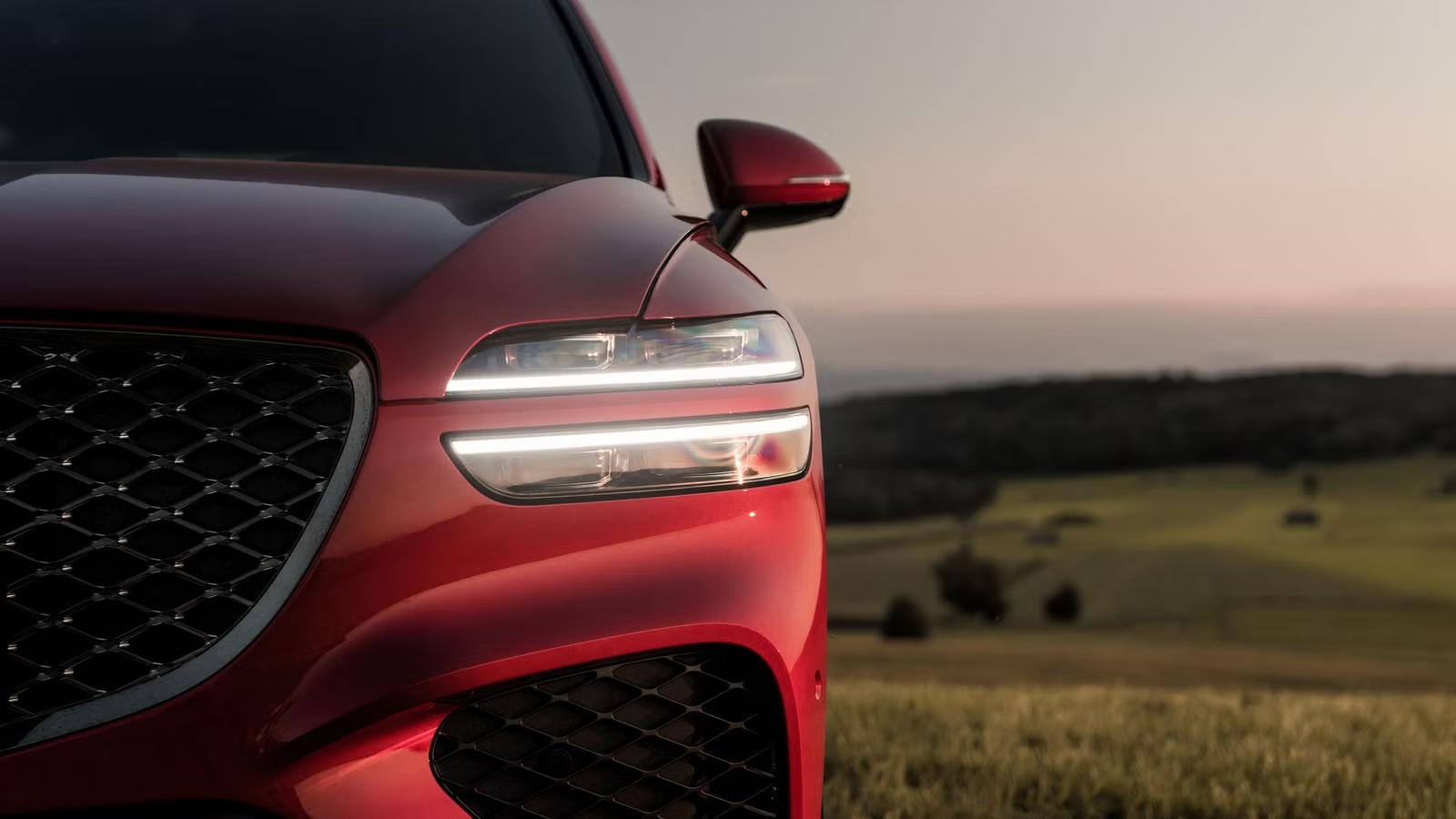
Built to serve as the Hyundai Group’s luxury brand, Genesis has injected a distinct, cohesive, and premium design language, employing top-tier designers from Lamborghini and Bentley to spearhead the range of designs. “Our approach was defined by ‘the design is the brand, and the brand is the design’…we wanted to have a consistent approach all the way through from the first sketch to the product on the road”, said Genesis’ Chief Creative Officer, Luc Donckerwolke. Today, all of Genesis’ current range embodies design elements dictated by its “Athletic Elegance” philosophy, consisting of clean surfaces with distinctive signatures highly recognizable to the brand, like the dual horizontal light strips that stretch from the quad headlamps at the front, across the bodywork, and wrap around to the taillights, and the shield-shaped grille that acts as the heart of the car’s face, as well as the sweeping, single-arc contours that run continuously along the vehicle’s side profile to provide an uncluttered and aerodynamic silhouette, and a clean, minimalistic, driver-centric interior.


As a result of the new language, the brand has received top accolades across both its production models and its prototype cars (including those for racing), which include multiple Red Dot awards, the iF Design Award, and the Car Design Awards, as well as those from leading automotive publications.
How The Current Designs Are On Par With Mercedes’ Golden Age Of Car Design

Studying the shaping of Genesis’ designs today indicates there are design similarities to Mercedes of old. The Bruno Sacco design era was defined by “cab-backward” proportions, creating long hoods to give a Mercedes a purposeful, yet majestic, land-yacht appearance, particularly for its sedans. Genesis has prioritized this today for its bigger sedans like the G80 and even its GV70 SUV. Genesis’ hallmark upright crest grille also harks back to the upright chrome grille found on the Mercedes sedans. Older Mercedes models were also famed for their “Vertical Affinity”—Sacco’s second design principle—where every new generation evolved over its predecessor, making the older generation less outdated. The G80 has followed this approach, evolving the Hyundai Genesis it replaced, as opposed to revolutionizing the design. Evolution is not yet applicable to the rest of the range, as they are in their first generation, but like the G80, we expect the next-generation models to follow the same evolutionary approach.
Does Genesis Outperform Mercedes In Design Today?

While Mercedes has a strong brand image to rely on, their latest designs have caused controversy. Under Gordon Wagner in the early 2010s, Mercedes’ first iteration of the “Sensual Purity” philosophy – which balances sleek, beautiful, seductive proportions that catch your eye with cutting edge technology and craftsmanship – introduced a new era for the brand’s designs with models like the W176 A-Class, W205 C-Class, and the C117 CLA, which were praised for their radical shift to bold, rakish profiles. Since then, subsequent generations haven’t evolved significantly except for modernizing design elements for the digital era through the company’s “Heritage Creates Future” concept, which currently works alongside “Sensual Purity.” Changes in market demands and management have contributed to Mercedes’ directional changes, like U-turning from an all-EV future to one that includes ICE and hybrids. This has resulted in design chaos for the brand, which has led it into an identity crisis over design, leaving it open to negative market feedback and its market share under threat from competitors like Genesis.

Ultimately, beauty is in the eye of the beholder, so whether Genesis outperforms Mercedes in design is down to you, but the current language of Genesis design remains closer to how a Mercedes should be designed than those of Mercedes today, whose designs for EVs have been dictated by aerodynamics, technology and battery capacity, while its ICE vehicles have also focused on tech-driven details including illuminated grilles and light bars, which can become a distraction over the car’s form in its raw state.
Can Mercedes Put Genesis Back in Its Place?

With cars heading towards a digital, carbon-free and automated future, design is having a lesser-priority role in their development. Sacco and Wagner’s design philosophies have evolved Mercedes’ image successfully over the years, but for the brand [Mercedes] to stay ahead of Genesis, it is time for it to establish the next design direction that excites and connects people’s emotions to the car’s design itself, as opposed to just the brand. The firm needs to remind itself what three-pointed-star design stands for and needs to approach with caution getting into a ‘world’s first’ for everything race. Only time will tell if it has its feet firmly on the ground with an established design direction that will follow its own lead.
Where Does This Leave Genesis Heading In The Future?

Today, Genesis’ design is evolving from “Athletic Elegance” into “Luxury High Performance”—its vision for the next 10 years, expanding its focus toward ultra-premium flagship, high-performance, motorsport-inspired designs along with bespoke coach building. This has come in line with the firm’s overall strategic shift towards performance with The Magma Performance Line.

Led by Donckerwolke and ex-BMW M chief Albert Biermann, Magma’s design language will focus on wider, lower stances and track-focused aerodynamics for the best driving dynamics, as opposed to hunting down lap times on the track. Speaking about Magma’s design direction, Donckerwolke said: “It’s a synchronization of form and function. Its design should never be overpowering the appearance of the car. It should always be a balance.” Concepts like the Magma GT3, which has served as a testing lab for its race-driven architectures, have also supported shifting the brand’s performance-driven design direction. The brand will also be investing time in its flagships, abandoning its less profitable models like the G70, and will be gearing up toward producing its own dedicated EV architectures from next year.
Sources: Autocar, Car Design Awards, Genesis, Hagerty, iF Awards, Mercedes-Benz, Red Dot Awards

Related posts






Latest Post


No Comments