
The Ford 4×4 That Sits Five Inches Taller Because Of One Engineering Quirk
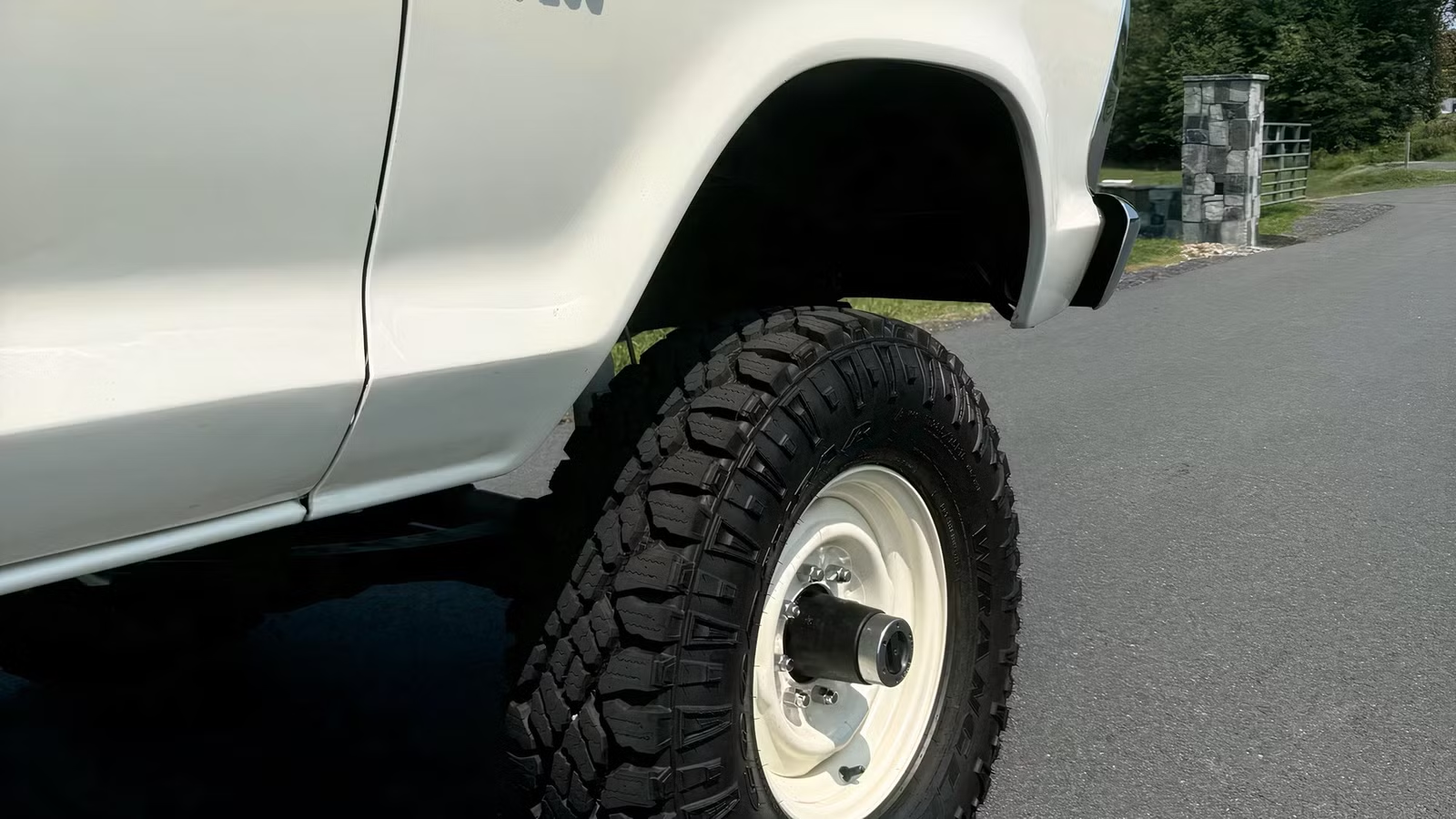
Most 4x4s that sit unusually tall got there with a lift kit, some spacers, and a trip to the tire shop. This one didn’t. It sits five inches taller than its own two-wheel-drive sibling, straight off the factory floor, and it looks so wrong that it’s almost funny, like somebody forgot to finish photoshopping the concept art before it hit the showroom. Nobody screwed up, though. Ford’s engineers built it exactly like this on purpose, and the real reason has nothing to do with looking tough and everything to do with one stubborn driveshaft that needed somewhere to go.
This Vintage 4×4 Never Saw a Lift Kit, So What Explains the Stance

By the early 1970s, Americans were falling out of love with the muscle car, and Uncle Sam basically played matchmaker for the breakup. Insurance companies jacked up premiums on anything packing a big engine, new taxes piled on, and the 1970 Clean Air Act pulled compression ratios down right when horsepower numbers were supposed to keep climbing. Engines built to run 11:1 compression on cheap high-octane gas suddenly had to survive on watered-down unleaded fuel, and the numbers on the window sticker cratered almost overnight.

Trucks and 4x4s swooped into that gap and never looked back. A family could still haul a boat, a load of lumber, or six kids to a ballgame, all without the insurance company treating them like Public Enemy Number One. Ford didn’t invent the automobile. What it actually nailed, starting with the moving assembly line in 1913, was building cars fast and cheap enough that regular people could actually afford one. That same scrappy instinct carried straight into trucks.
Ford’s first real truck was the Model TT, a beefed-up Model T rated to haul a full ton, introduced in 1917 for 600 dollars. It kept the same 20-horsepower four-cylinder engine as the passenger car, just bolted to a longer, tougher frame built to survive actual work. Farmers and shopkeepers snapped them up fast, and that scrappy little truck eventually grew into the F-Series in 1948.

The F-Series went on to take over American driveways, one work truck at a time. But buried somewhere deep in that decades-long lineup sits a single generation that looks like nothing else Ford has ever built, tall enough to make you do a full double take.
This Isn’t a Suspension Story, It’s a Drivetrain One

Ford wasn’t the only company chasing that shift. Chevy had the C/K, Dodge was building tough D-series 4x4s, and Toyota was quietly shipping over Hilux pickups that American buyers were starting to notice. Here’s the thing, though: trucks carried a plain, working-class image that kept them mostly clear of the insurance surcharges and dirty looks aimed at anything with a big-block under the hood, and buyers figured that out fast. A truck bought to haul lumber suddenly looked like the smartest purchase on the lot.

That kind of competition breeds shortcuts — the kind buyers rarely notice and manufacturers definitely never brag about. Every manufacturer was borrowing parts from somewhere else in the lineup to keep prices down: a bed from one truck, an axle from a heavier model, whatever kept the accountants happy. Most of the time nobody noticed. Every so often, though, one of those shortcuts left a mark so obvious a buyer would spot it from across a parking lot and immediately ask what happened.
Buried in Ford’s own truck lineup from that era sits exactly that kind of shortcut, and it still makes people do a double take decades later. One look and your brain assumes somebody’s been messing with the suspension in their driveway, adding blocks and spacers where Ford never intended them. Except nobody did. It left the factory looking exactly like that, warranty card and all, sold across Ford dealerships nationwide with a completely straight face and not one apology in the brochure.
It’s the Ford F-250 Highboy, and a Divorced Transfer Case Is Why

Say hello to the Ford F-250 Highboy, a four-wheel-drive pickup Ford built from 1967 to mid-1977. Ford never called it that officially; some enthusiast coined the nickname decades ago, but it stuck because it’s dead-on accurate. The Highboy sits five to six inches taller than its own two-wheel-drive F-250 sibling, straight off the assembly line. It sat in the middle of Ford’s truck lineup too, more serious than an F-100, one size down from an F-350, and here’s a fun wrinkle: Ford had already been building divorced-transfer-case 4x4s since 1959. Only this specific generation ever earned the nickname.
How the Divorced Transfer Case Actually Works

Here’s the actual answer. Ford used what’s called a divorced transfer case, a transfer case mounted separately from the transmission instead of bolted right to it, connected by its own short driveshaft. Over the Highboy’s run, three different units did the job — the Dana 24, the New Process 205, and the full-time New Process 203 — and none of them were cheap or lazy engineering, just older-school hardware built before anyone bothered marrying the two together.
Because that transfer case sat further back on the frame, the front driveshaft had to angle down steeply just to reach the front axle. At a normal ride height, that driveshaft would have bound up its own universal joints or slammed straight into the frame with every good bump in the road.
So Ford raised the front end. Steeper, more sharply arched leaf springs gave the driveshaft room to breathe, and that alone would have left the truck sitting crooked. Ford added a 4-inch lift block out back to level everything up. Nobody screwed up here. This was a genuine engineering fix for a genuine packaging headache, nothing more, and the tall stance was just the leftover evidence.
Ford Wouldn’t Even Offer a Camper Special on the Highboy

Highboys rolled on a narrower frame than other F-250s, borrowed straight from the heavier-duty F-350. Up front sat a Dana 44 or Dana 44HD, and out back a Dana 60 handled business with 4.10 gears no matter what engine or trim you picked. Power got to the ground through a New Process 435 four-speed manual, standard for the entire run, or starting in 1973, a three-speed C6 automatic built specifically for the divorced-case setup. Drum brakes covered all four corners well into the mid-1970s before front discs finally showed up, and power brakes joined the options sheet in 1973, better late than never.
Six Engines, Three of Them One Year Only

Six different engines saw duty under a Highboy’s hood over the years. The 240 and 300 cubic-inch inline sixes did the heavy lifting for buyers who wanted torque, not a stopwatch. On the V8 side, things get interesting fast. The 352 showed up for exactly one year, 1967, the 360 carried most of the load from 1968 through 1976, and the 351M and 400 arrived together for the Highboy’s swan song in 1977. The 390, despite what half of every truck forum insists, never once made it into a 4×4 Highboy. Not a single one.
That short-lived V8 lineup connects straight to one of the Highboy’s weirdest quirks. Ford wouldn’t sell you a factory Camper Special on one of these trucks, period. Makes sense once you think about it. The truck already stood five inches taller with stiffer front springs, and bolting a heavy slide-in camper on top of that pushed the center of gravity somewhere Ford’s engineers flat out didn’t trust on a winding road at highway speed. Salesmen steered camper buyers toward the lower, wider two-wheel-drive Camper Special instead, and that was that.
Why the Highboy Is Turning Into the Bronco Alternative Collectors Actually Want

The Highboy era ended fast, mid-1977, the moment Ford bolted the transfer case directly to the back of the transmission instead of mounting it separately. The steep driveshaft angle vanished overnight, the rear lift blocks disappeared, and the F-250 dropped several inches closer to the pavement almost immediately. Enthusiasts started calling anything built after that a Lowboy, and the 1977.5 split is about as clean a collector line as classic trucks ever get.
That matters more than it sounds like trivia. Most nicknames in the classic truck world are fuzzy, a rough decade here, a vague body style there, argued over at every single car show. Not this one. The Highboy-to-Lowboy switch happened on one specific factory changeover, partway through a single model year. A truck either has the divorced case and the tall stance, or it doesn’t, nothing to argue about.

That clean line matters even more right now, because the vintage Bronco market has priced plenty of buyers straight out. They want the same era, the same off-road pedigree, the same honest factory pickup feel, just without a second mortgage attached, and a real, unmodified unmodified Highboy delivers exactly that of what a comparable Bronco runs today. Looking at the auction numbers, the highest recorded sale reached $82,500 — still under six figures.
It’s funny how that works. The height that made this truck look like a factory mistake is the exact same thing making it worth real money today. Ford wasn’t trying to build a future collector’s item, it just needed somewhere to put a driveshaft, and fifty years later, that little compromise is the whole reason anybody cares.
Sources: Classic.com, Mecum, Bring A Trailer, Ford

Related posts

Latest Post


No Comments