
The Rarest Pontiac Engine Ever Produced
The golden era of American muscle was defined as much by what happened under the hood as on the street. While Ford, Dodge, and even GM stablemate Chevrolet were locked in a furious big block V8 arms race — each desperate to prove it built the most powerful muscle cars on the planet — a handful of engines emerged from that era as true legends. A few, however, were so rare, so specialized, or so ill-timed that they barely made it into the hands of customers at all. Those are the engines worth talking about. The horsepower wars of that period produced some of the greatest V8 engines of all time, and Pontiac contributed some of the most fascinating — and most elusive — of the bunch.

The brand pushed hard to develop its own winner, but this journey was not without its trials and errors. As part of General Motors in the late 1950s, Pontiac became one of the first marques to run fuel-injected engines in its products. As a result, some of the engines Pontiac developed are now a very uncommon sight. Here’s a look at the rarest engines Pontiac ever built and put in their models.
The Pontiac 421 V8 SD Was Built Specifically To Boss The Racetrack
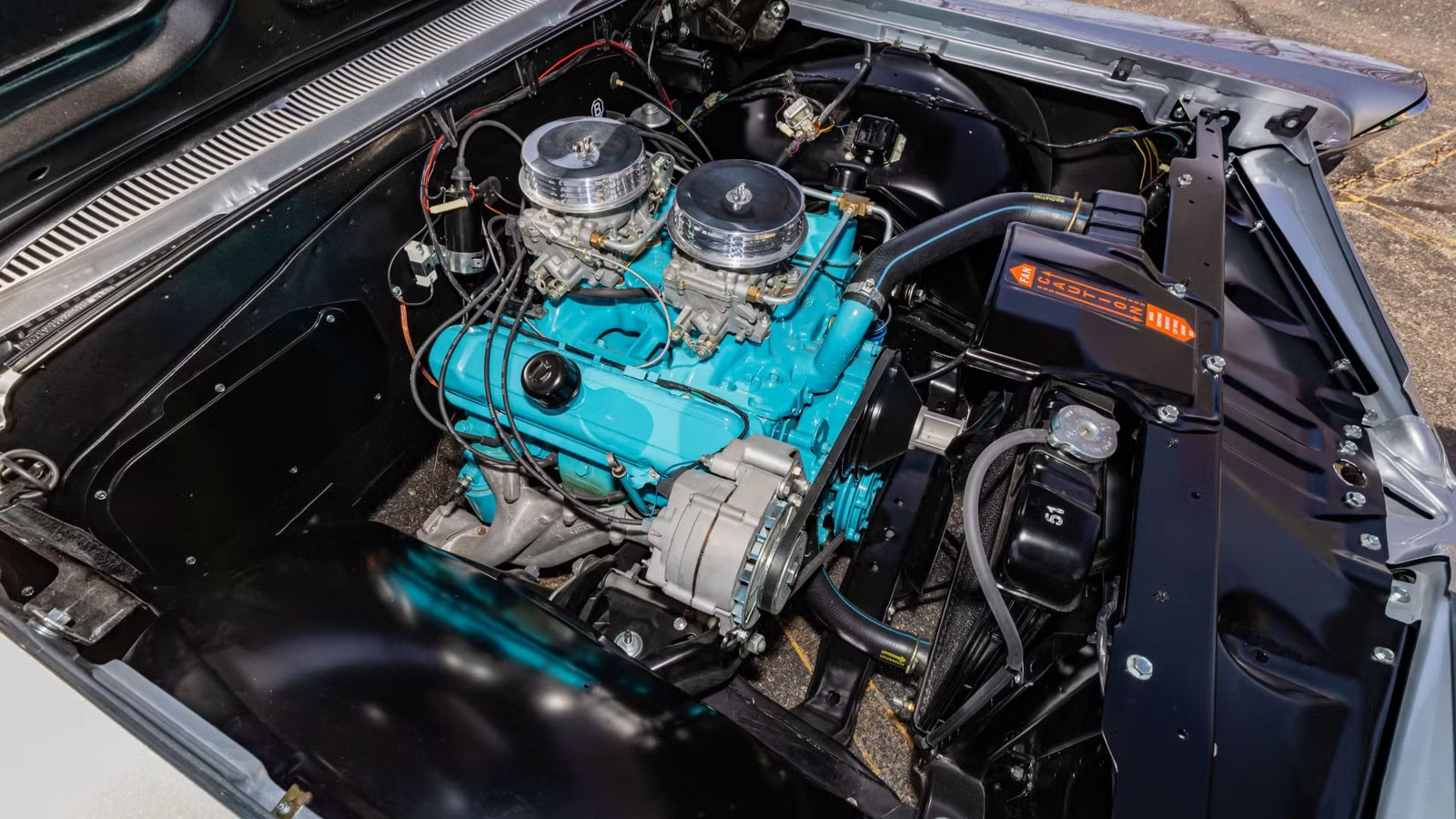
The rarest Pontiac engine that HotCars could find was the mighty Pontiac 421 Super Duty V8 featuring in the 1962 Pontiac Catalina. It was a display of Pontiac’s dominance in the early ’60s and could be purchased as a crate engine and used in racing.

According to the official NHRA championship drag racing website, the first 421 ci-engined Pontiac hit the strip in 1961. Going up against Fords and Dodges with smaller engines, Pontiac had high hopes for its new powertrain. Needing to homologate some of the engines for road use, a toned-down version was designed to be used in the Catalina, which HotCars has reimagined as a restomod, and Grand Prix two-door muscle cars. Make no mistake, though — the 421 engine’s true calling was racing.
Pontiac 421 Super Duty Production Numbers
|
Crate Racing 421 SD’s |
88 |
|
Catalina Super Duty |
155 |
|
Grand Prix Super Duty |
16 |
(Source: Hemmings)
Only 88 Super Duty crate engines were ever sold to customers, making it arguably the rarest production engine Pontiac ever made. A total of 155 of the ‘streetified’ 421 motors found homes in special 1962 Catalina Super Duty models, and just 16 ended up in ultra-rare Grand Prix coupes, according to Hemmings.
The Pontiac 421 Super Duty Took The Fight To The Track
1963 Super Duty Engine Specs
|
Displacement |
6.9-liter V8 |
|
Compression ratio |
12.0:1 |
|
Power |
468 hp |
|
Torque |
500 lb-ft |
Source (NHRA)
The 421 Super Duty powerplants were paired with three- or four-speed manual transmissions. The engine featured a 12.0:1 compression ratio, and its redline was raised by 500 rpm to 6,400 compared to its predecessor — though there were a couple of different specifications depending on the intended use.
A four-barrel carburetor version rated at 390 hp was offered for sustained high-speed running, such as on conventional road courses used in NASCAR competition. A dual-quad carburetor variant pushed output to 405 hp, and a later iteration of that dual-quad motor saw the compression ratio climb further to 13.0:1, with Pontiac rating it at around 410 hp.
According to NHRA, an internal memo from Vince Piggins — Chevrolet’s head of Economy, Safety, and Performance at the time — to famed Chevy engineer Zora Arkus-Duntov revealed the engine was putting out considerably more power than officially communicated. The 1963 version of the 421 could make 468 hp and 500 lb-ft of torque according to Piggins.
The racing engine featured an aluminum intake manifold as standard, and could also be purchased with lighter aluminum exhaust manifolds. These could melt under relentless use, however, with famed NASCAR crew chief Smokey Yunick reporting that the components were completely spent after just ten laps of a normal track.
The Super Duty engines ran for only around two years between 1961 and 1963, with the motors eventually being culled as GM came under pressure to abide by the so-called ‘AMA agreement’. This was established in 1957 to prevent manufacturers from pouring money into the development of racing parts that independent racing operations couldn’t compete with.
Pontiac 347 Rochester Fuel Injection Unit Found A Home In Less Than 1,000 Vehicles

Another fascinating project Pontiac pursued came just a few years before the potent Super Duty motors saw the light of day. Working with fuel-injection specialist Rochester, Pontiac helped bring a fuel-injected V8 to market in the late 1950s, with GM becoming the first mass-market automaker to do so.
Fuel injection offered greater precision over the fuel/air mixture than the traditional carburetor method, though it was also considerably more complex to service and maintain.
Fewer than 1,000 fuel-injected 347 ci Pontiac units found their way into vehicles across the two-year production run. ChevroletFuelInjection.com reports that 447 Bonnevilles were fitted with the powertrain, while 511 engines were installed in other models of the brand. This adds up to just 991 units — making it an ultra-rare setup to find, more than six decades since it fell out of production.
Specs
|
Displacement |
5.7-liter V8 |
|
Power |
315 hp |
(Source: EngineBuilderMagazine)
Keen to carve a new path, GM pushed ahead and started offering fuel injection in Chevrolet’s 283 ci V8 in 1957, according to the Austin-American Statesman. Pontiac soon followed suit using its trusty 347 ci V8, though the option was initially available only on the manufacturer’s Bonneville Convertible. Producing a healthy 315 hp, the engine proved troublesome in terms of reliability.
The increased cost of maintaining the system compared to a standard carburetor setup made it a headache for customers and mechanics alike, according to Hagerty. The fuel injection system ultimately provided more pitfalls than advantages, and the option was quickly killed off in 1959 across most Chevrolet and Pontiac models.
Rochester Fuel Injection GM-Partnership Numbers Breakdown
- 13,289 units fitted to Chevrolet vehicles
- 991 engines fitted in Pontiacs
- 544 manufactured for service and training
- 14,791 total between 1957 and 1959
The system did live on in the Chevrolet Corvette for another half-decade before GM decided to abandon the idea for good in 1965. Fuel injection wouldn’t become mainstream for well over a decade following Chevrolet’s return to carburetor technology, with manufacturers finally developing a more reliable setup during the 1980s.
Ram Air V Narrowly Missed Out On Production

Specs
|
Displacement |
6.0-liter V8 |
|
Power |
Approx 470 hp |
Source (MotorTrend)
Pontiac looked at following up its popular Ram Air III and IV engines — the brand’s performance flagships during the late 1960s — with a new unit intended to serve as the basis for several different racing programs. According to Hagerty, Pontiac envisioned four versions of the powertrain: one for road use and three tailored to different racing disciplines.
A 303 ci version of the Ram Air V V8 would be produced for the SCCA Trans Am series, a 366 ci variant was earmarked for NASCAR, and a high-output 428 ci was set for NHRA drag racing competition. A 400 ci version was also planned for production in road-going GTO and Firebird models. The company ultimately only moved forward with the 303 and 400 variations, though both proved short-lived.
Production Numbers Of Pontiac’s Rarest Engines
|
421 ci Super Duty V8 |
88 |
|
347 ci fuel-injected V8 |
991 |
|
Ram Air V V8 |
Between 80-225 |
(Sources: Hemmings, PontiacV8, Hagerty)
A rule change within the Trans Am series permitted larger engines for 1970, essentially rendering the 303 ci V8 obsolete before it ever turned a competitive lap. The road-going powerplant was killed off by a combination of rapidly rising insurance costs for muscle cars — which made them difficult sells in the early 1970s — and the bankruptcy of the supplier responsible for the Ram Air’s special engine rods. Pontiac elected to cancel the project before any examples reached customer hands.
Pontiac’s ambition consistently outpaced the financial realities and available technology of its era when it came to these unique designs. These failed projects, fortunately, didn’t prevent the brand from bringing some legendary vehicles to market — among them the GTO ‘The Judge’ and the Trans Am that found pop-culture immortality in Smokey and the Bandit in the years that followed.
Sources: Chevrolet Fuel Injection, Hagerty, PontiacV8, NHRA, Mecum Auctions, Engine Builder Magazine, Hemmings.

Related posts





Latest Post


No Comments