Toyota’s Fastest-Growing SUV Isn’t A RAV4, Highlander, Or Land Cruiser
10 minutes reading
Thursday, 30 Jul 2026 15:00 0 99 autotech
Few segments in the American market move as fast as the rugged SUV space, and Toyota’s latest sales data makes that point impossible to ignore. While the RAV4 and Highlander reliably dominate the brand’s volume charts, a different Toyota SUV quietly posted growth numbers in May 2026 that caught even corporate executives off guard — and it’s the one built for people who actually want to leave the pavement behind. One off-road midsize SUV Toyota’s RAV4 and Highlander grab headlines as America’s favorite SUVs, but dealers are struggling to keep a different Toyota SUV on lots after it posted growth numbers that surprised even corporate executives.
The off-road SUV segment has evolved from a niche enthusiast pursuit into a primary driver of automotive identity and manufacturer profit. While inventory levels have surged and affordability has become a significant hurdle for the average consumer, the segment’s popularity remains historically high, fueled by a post-pandemic cultural shift toward adventure tourism and lifestyle branding. Rugged capability is typically purchased as a symbol of personal freedom and outdoor readiness, even if it is rarely exercised on actual trails.
The target audience has broadened from hardcore overlanders to active families and suburban professionals who prioritize the perceived safety, high seating position, and versatility that body-on-frame construction and advanced suspension systems provide. Currently, the landscape is dominated by heavyweights like Jeep, Ford, Toyota, and Land Rover, though the market is seeing a major influx of competition as brands like Hyundai, Kia, and Subaru aggressively expand their lineups with more robust electrified offerings to meet the sustained demand for adventure-ready vehicles.
But Toyota’s advantage is not just that buyers want rugged SUVs again; it is that the brand has figured out how to make that toughness feel like a low-risk, high-value purchase.
Why Buyers Still Trust Toyota’s Toughest SUVs In 2026
Toyota’s dominance in the 2026 American off-roading SUV market is built on a decades-long legacy of over-engineered durability that began with its post-war efforts to create rugged, go-anywhere utility vehicles for demanding global environments. That heritage has fostered a unique level of loyalty among U.S. consumers, who consistently rank the brand as the gold standard for long-term reliability and low maintenance costs — factors that carry even more weight in 2026 as vehicle prices and repair complexity continue to climb.
While competitors often lean into fleeting design trends, Toyota has stuck to a mechanical-first philosophy, using robust body-on-frame architectures and specialized suspension tuning that prioritize trail survival over urban aesthetics. The brand has also successfully modernized its rugged image by integrating advanced hybrid powertrains and factory-developed overlanding trims that appeal to the growing adventure-ready demographic. For the American consumer, Toyota represents a safe financial and functional bet, combining high resale value with a proven track record of reaching high-mileage milestones that few rivals in the segment can match.
That reputation gives Toyota an edge before buyers even step into the showroom, but the 4Runner’s latest sales numbers show just how powerful that trust has become.
4Runner Sales Jump 122 Percent While Rivals Fight For Attention
Front 3/4 action shot of 2026 Toyota 4Runner driving off-roadToyota
Toyota’s May 2026 U.S. sales report shows it sold 14,116 4Runners, reflecting a 122.5 percent increase year-on-year. So far this year, the total has reached 59,339 examples, a 146.5-percent year‑on‑year increase.
The 2026 Toyota 4Runner is also available as a hybrid. Toyota confirms that it sold 3,626 units of this version in May alone, a 102 percent year-on-year improvement. That brings the hybrid’s year-to-date tally to 13,483 units — 248.3 percent ahead of the same period last year.
For context, Toyota sold 33,524 units of the RAV4, 14,692 units of the Highlander, and 3,016 units of the Land Cruiser. These results highlight how Toyota’s broad SUV catalog doesn’t result in cannibalization, as each of these models caters to completely different demographics.
Still, strong demand only tells part of the story, because Toyota’s pricing strategy reveals why buyers are choosing the 4Runner over so many capable alternatives.
Nine 4Runner Trims Give Buyers A $42,070 Starting Point
Shot of 2025 Toyota 4Runner front interiorToyota
The 2026 Toyota 4Runneris available in nine distinct trims, ranging from a base MSRP of $42,070 for the SR5 to $68,400 for the range-topping TRD Pro. The SR5 features an 8.0-inch touchscreen with wireless Apple CarPlay and Android Auto, a 7.0-inch digital gauge cluster, and fabric-trimmed seats. It is the only trim to offer an optional third row for seven-passenger seating.
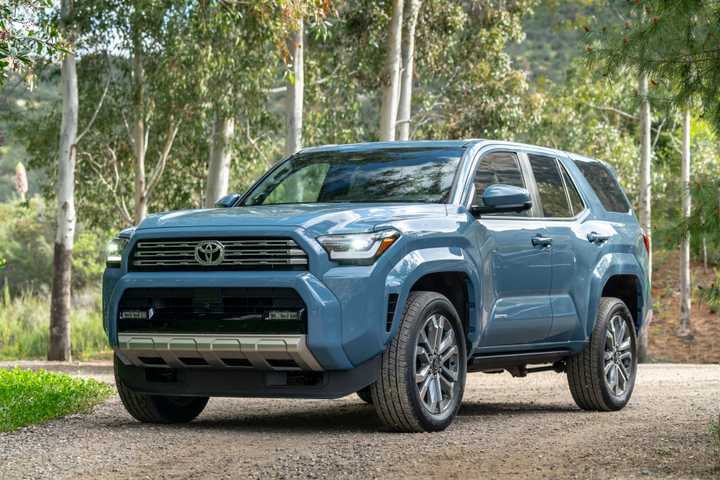
2025 Toyota 4RunnerTy Duffy | TopSpeed
Stepping up to the TRD Sport at $48,550 adds a sport-tuned suspension, 20-inch wheels, and a hood scoop. The $53,910 TRD Sport Premium includes SofTex-trimmed heated and ventilated front seats, a larger 14-inch touchscreen, a heated steering wheel, and a 14-speaker JBL audio system with a removable dash-mounted Bluetooth speaker.
Close-up shot of 2026 Toyota 4Runner TRD suspensionToyota
For trail enthusiasts, the $50,490 TRD Off-Road includes a locking rear differential, multi-terrain select, and crawl control. Upgrading to the Premium for $56,270 adds the 14-inch display, a 360-degree panoramic view monitor, and an optional stabilizer disconnect mechanism for increased articulation. The $68,200 TRD Pro comes standard with Fox QS3 adjustable shocks, a performance exhaust, and exclusive red or black SofTex interior with technical camouflage inserts.
Shocks of a 2025 Toyota 4Runner TrailhunterToyota
The $61,500 Limited features genuine leather-trimmed seats, a sunroof, and dual-zone climate control. The Platinum, priced at $64,160, adds heated second-row seats, a head-up display, rain-sensing wipers, and a digital rearview mirror. The Trailhunter costs $68,200 and includes factory-installed gear like an ARB roof rack, an onboard air compressor, and Old Man Emu forged shocks. Visually, it adds unique bronze accents and a high-mount air intake.
That wide trim spread makes the 4Runner appealing on paper, but its size and interior packaging explain why it works so well as both a trail SUV and a daily driver.
The 4Runner’s Size Advantage Shows Up Where Buyers Notice
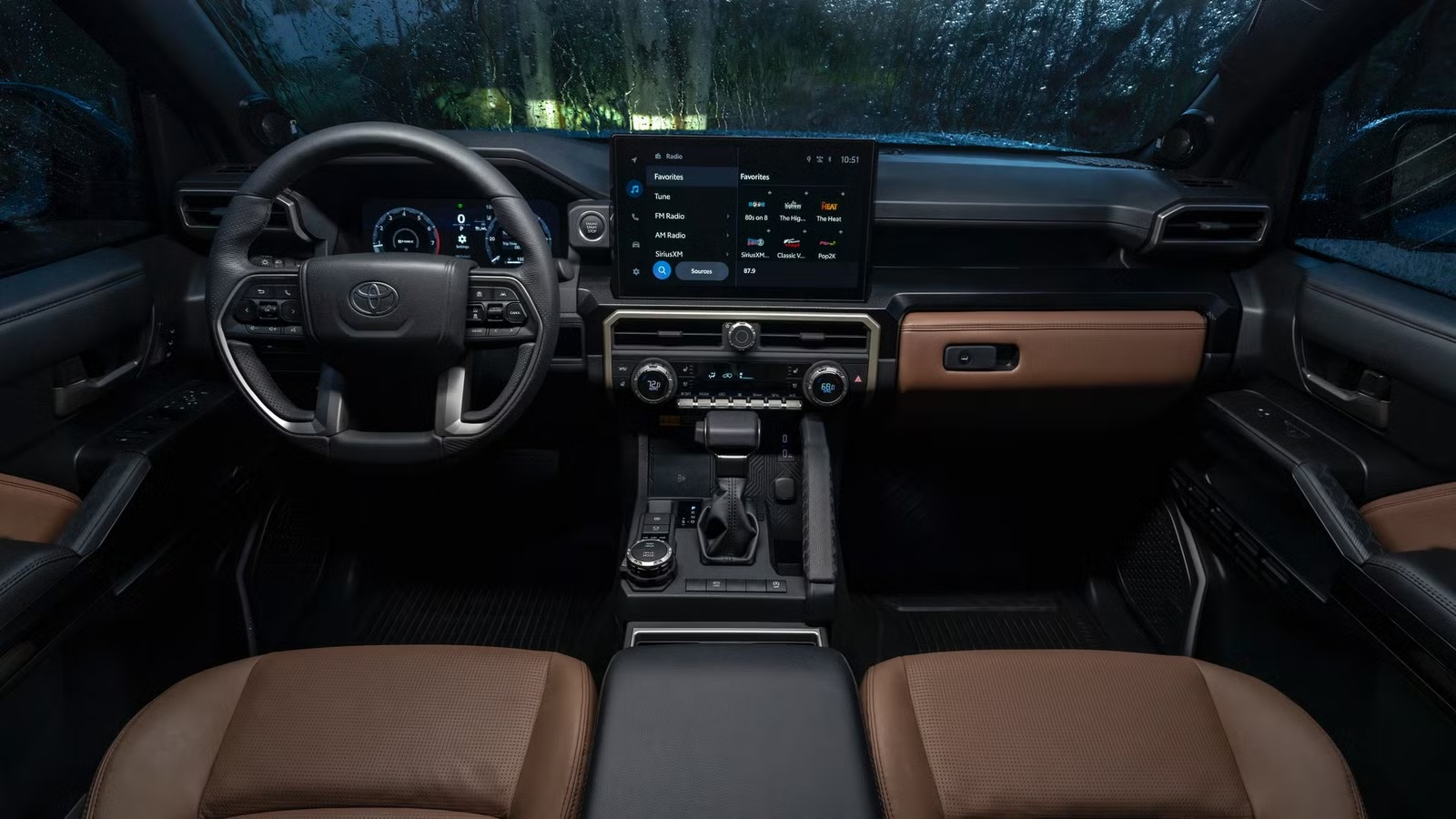
Shot of 2026 Toyota 4Runner interior showing cockpitToyota
Profile shot of 2026 Toyota 4Runner interior showing seatingToyota
The 4Runner is larger than its closest rivals, which include the four-door Ford Bronco and Jeep Wrangler. Exterior dimensions, save for height, are larger, which is most clearly reflected in cargo space. The 2026 4Runner has a length of 194.9 inches, a width of 78 inches, and a height of 72.6 inches. The wheelbase sits at 112.2 inches, with a ground clearance of 8.1 inches and an approach and departure angle of 18 and 22 degrees, respectively.
Dimension Comparison
Model
2026 Toyota 4Runner
2026 Ford Bronco (4-door)
2026 Jeep Wrangler (4-door)
Headroom (front/rear)
39.7 / 37.8 inches
43.3 / 41.1 inches
42.6 / 41.7 inches
Legroom (front/rear)
41.8 / 34.8 inches
43.1 / 36.3 inches
41.2 / 35.7 inches
Shoulder Room (front/rear)
58 / 57.8 inches
57.1 / 56.5 inches
55.8 / 57.7 inches
Max Cargo Volume (behind front row/behind second row)
90.2 / 48.4 cubic feet
83 / 38.3 cubic feet
72.4 / 31.7 cubic feet
While the mentioned rivals have more space for passengers in some key areas, the 4Runner remains competitive while offering more overall cabin space without sacrificing practicality or becoming too bulky for everyday navigation. That balance boosts daily usability — an area where many off-road-focused models traditionally struggle.
Yet the 4Runner’s real advantage becomes clearer once you look beyond the cabin, because Toyota’s powertrain choices give it the muscle to match its rugged image.
Toyota’s Hybrid 4Runner Delivers The Torque Buyers Were Waiting For
2025 Toyota 4RunnerTy Duffy | TopSpeed
For the 2026 4Runner, Toyota offers two high-output configurations of its turbocharged 2.4-liter four-cylinder engine, both paired with an eight-speed automatic transmission. The standard i-Force produces 278 horsepower and 317 pound-feet of torque. The advanced i-Force Max hybrid integrates a compact electric motor, lifting combined output to 326 hp and 465 lb-ft at just 1,700 RPM.
[The iForce Max] powertrain is excellent. It’s smooth. It’s potent. Peak torque comes on at just 1,700 RPM, allowing you to power up hills and past slower highway traffic with ease. The setup makes vehicles that felt quite effortful in the previous generation feel effortless by comparison.
Toyota’s T24A-FTS 2.4-liter four-cylinder features a single twin-scroll turbocharger that optimizes airflow to reduce lag and improve power delivery. The electric motor is integrated into the eight‑speed automatic and supplies low‑end torque for better acceleration and stronger towing performance.
Base Trim Engine
2.4L I-FORCE I4 ICE
Base Trim Transmission
8-speed automatic
Base Trim Drivetrain
Rear-Wheel Drive
Base Trim Horsepower
278 HP @6000 RPM
Base Trim Torque
317 lb.-ft. @ 1700 RPM
Make
Toyota
Model
4Runner
Segment
Midsize SUV
Drivetrain configurations include rear-wheel drive with an automatic limited-slip differential, part-time four-wheel drive with a two-speed electronic transfer case, or a full-time four-wheel drive system available on higher trims. Toyota electronically limits the 4Runner’s top speed to 112 mph. Additionally, the structural move to the TNGA-F boxed-steel frame has increased the maximum towing capacity to 6,000 pounds across the majority of the lineup.
Why Our Test Drive Picked The 4Runner Over The Land Cruiser
TopSpeed got a rare chance to not only put the sixth-gen 4Runner through its paces but also test the current Land Cruiser for a clear side-by-side comparison. The Land Cruiser is one of Toyota’s most legendary models and has been cemented in the history books thanks to its timeless reliability, off-road capability, and practicality. In other words, it’s a hard act to beat in any metric.
During our test of these two wonderful body-on-frame SUVs, we noted that, while the Land Cruiser is the more premium and iconic option, the 4Runner gives buyers more ways to customize and build their ideal vehicle — whether that means going off-road or not. The 4Runner strikes a more rewarding balance between efficiency, power, capability, affordability, and everyday usability. By the end of the testing period, we concluded that, if forced to choose between the two, we’d take the 4Runner TRD Off-Road over the Land Cruiser — which speaks directly to how well Toyota has brought the 4Runner into the modern era.
The 4Runner’s Fuel Economy Reveals Its Biggest Compromise
2026 Toyota TRD Pro Wave Maker Blue Paint 4Runner Profile DrivingToyota
The 2026 Toyota 4Runner remains a heavy body-on-frame SUV with EPA estimates to match. Models equipped with the standard engine achieve an EPA-estimated 20/26/22 MPG consumption on the city/highway/combined cycle in rear-wheel-drive configuration, while four-wheel-drive variants see a slight dip to 23/24/23 MPG. Trailhunter and Off-Road specifications return a 19/25/21 MPG estimate with a 399-mile range claim.
The hybrid further optimizes urban driving with estimates of 23/24/23 MPG. All models across the lineup feature a 19-gallon fuel tank, providing a maximum estimated driving range of 418 to 437 miles per fill-up, depending on the powertrain. The estimated annual fuel cost for a 2026 4Runner ranges from $2,280 to $2,500.
The Reliability Numbers That Make The 4Runner Hard To Ignore
Rear 3/4 shot of 2026 Toyota 4Runner parked off-roadToyota
The 2026 Toyota 4Runner earns high praise from both critics and owners. iSeeCars awards the model an 8/10 overall score, including 8.1/10 for reliability, 8.9/10 for retained value, and 7/10 for safety. On the reliability front, the publication indicates that owners can expect an average lifespan of 14.2 years or 195,788 miles, along with a 47.8 percent probability of reaching 200,000 miles.
Over five years, the SUV is estimated to lose $10,543 or 25.4 percent of its value — roughly half the depreciation of most competitors. CarEdge‘s ownership calculator puts the five-year depreciation figure at $13,442, with an additional $2,097 in projected maintenance costs and $10,045 in fuel expenses.
The 4Runner currently holds a 4.1/5 average consumer review score on Edmunds, based on 28 user-submitted entries. Key strengths that owners highlight include its visual presence, engine range, and interior, though it draws criticism for ride quality, its relatively high price, and fuel economy.
Sources: Toyota, EPA, iSeeCars, CarEdge, and Edmunds.











No Comments