
The Muscle Car That Redefined “Too Much Power”
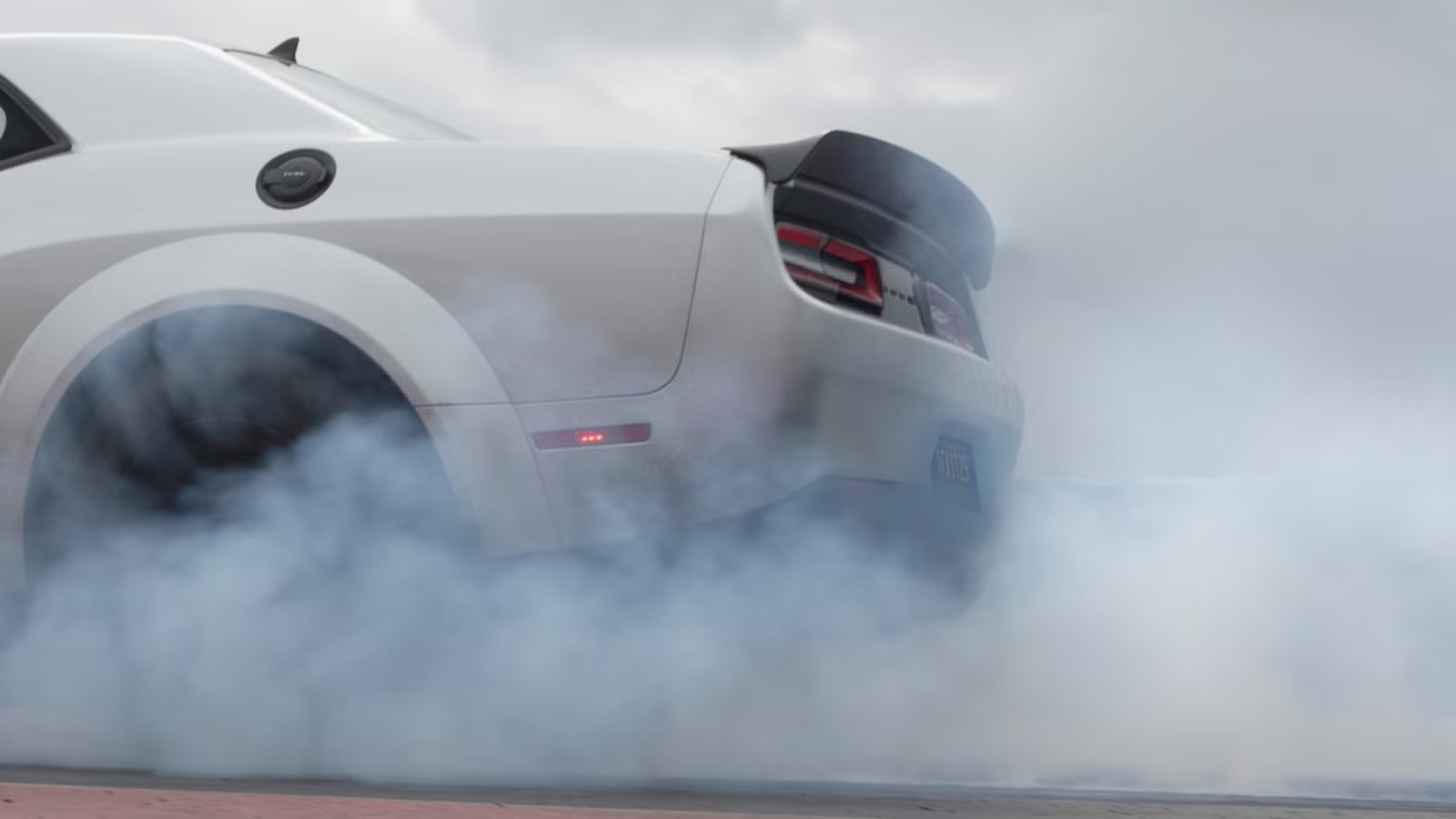
When it comes to automotive performance, the gearhead frame of mind is, the more the better, and that there’s no such thing as too much horsepower. Then, every so often, a car comes along with an ungodly amount of power that challenges that notion. For the average person, a 300 pony ride is the upper limit, while more skilled speed freaks can probably handle 500 or so, but anything over that threshold is for actual pros if the car’s full potential is going to be utilized. Since the Golden Age of American Muscle, there have been terrifyingly powerful cars that novices wrap around telephone poles because they are simply too much. Here at HotCars, we appreciate that Detroit keeps making these extraordinary rides, including a more recent entry that literally redefined how much is too much, with a set of wheels some aces might even be scared to drive.
Golden Age Horsepower Wars

The classic muscle car era, from 1964–1971, is often described as a horsepower war, and while it was, it was pretty one-sided. GM cars were under a self-imposed 400-cubic-inch displacement cap, and Ford didn’t offer big-blocks until late, and even then they were underwhelming entries. Meanwhile, Mopar started the Golden Age with a 425-horsepower 426 Max Wedge V8, and in 1966 unleashed the 425-hp 426 Street Hemi, which made Dodge and Plymouth muscle cars the most dominant of the era. Heck, the entry-level 335-hp Chrysler 383 was badder than almost everyone else’s top performance engine, and the 375-hp 440 Magnum beat all Ford and GM offerings until 1970. The ’70 Chevelle SS 454 LS6 produced 450 hp and 500 lb-ft of torque, surpassing the Hemi, but it was a technical win only. Yes, it had more horsepower, but the 454 LS6 was a 13.4-second car, while Hemis, and even 440 Six-Packs ran the quarter-mile in 13.1 seconds or less. It’s hard to claim victory when Chevy couldn’t even win on the streets.
New Millennium Ignites Modern Power Struggle

The Malaise Era of detuned engines consumed most of the 1970s and 1980s, with things slowly creeping back towards the 2000s. Chevy actually fired the first shot of the next-gen Horsepower Wars in the new millennium with the 325-hp Camaro SS 35th Anniversary and then ran away, canceling the Camaro. Ford charged ahead with the 390-hp 2003 Mustang SVT Cobra, packing a supercharged 4.6-liter V8, and it was suddenly on. In 2006, Dodge resurrected the Charger and paired it with the rebooted Hemi engine, which in the SRT8 and its 425-hp 6.1-liter V8 briefly reclaimed the streets. Chevy gained a slight advantage in 2010 with the relaunch of the Camaro, featuring a 426 hp 6.2-liter V8, which was the champion of the early naturally-aspirated battles. The war, however, would be won or lost when the supercharged engines entered the fray.
Once Again, Mopar is Victorious

Once again, Chevy struck first, but this time stood their ground with the 2012 Camaro ZL1, which was rocking a 580 hp 6.2-liter supercharged V8. Ford quickly responded and answered with the 2013 Mustang Shelby GT500, packing a 662-hp 5.8-liter supercharged V8, but that wasn’t enough. In 2015, Dodge dropped the M.O.A.B. (Mother Of All Bombs) with the 707-hp 6.2-liter Hemi Hellcat supercharged V8, which made both the Challenger and Charger the most dominant things the streets had ever seen. A couple of years later, Chevy would get the Camaro ZL1 up to 650 hp, but by then the war was over, and it was pretty much a waving the white flag gesture. Despite having achieved a decisive victory, Dodge continued to increase its cars’ output with even more power, in what can best be described as rubbing Chevy and Ford’s noses in their failures.

Unleashing Hellfire With The 2015 Hellcat

The 2015 Dodge Challenger SRT Hellcat, as well as the Charger SRT Hellcat, were the first modern rides that had too much damn power, and in reality, they were but a snowball that went off the slippery slope and started an avalanche of ferocious rides. With a 707-hp, 650 lb-ft of torque supercharged 6.2-liter Hemi V8, the ’15 Challenger SRT Hellcat could blast from 0–60 in 3.6 seconds, cover a quarter-mile in 11.2 seconds, and hit a top speed of nearly 200 mph. That kind of performance was, until that point, reserved for European supercars that cost anywhere from the hundreds of thousands to millions, but the SRT Hellcat started at around $60,000, which made it remarkably affordable given how fast the car was. Adjusted for inflation, that’s around $85,000, which is still a great price today for a factory 11-second car.
Challenger SRT Gets Demonically Powerful in 2018

For reasons that defy conventional logic but that we fully support here at HotCars, Dodge decided that the Hellcat wasn’t quite enough “too much,” and opened the Gates of Hell in 2018 to let the Challenger SRT Demon loose upon humanity. With a 2.7-liter supercharger, the 6.2-liter Hemi Hellcat V8 was boosted up to 808 hp on 91-octane premium gas, and 840 hp with high-octane racing fuel. The performance of this car was downright evil, with a 2.3-second 0-60 time and a 9.63-second quarter-mile, which is professional drag car acceleration, but this was a factory ride. Because it had a sub-10-second ET, the SRT Demon was actually banned by the NHRA, which requires a roll cage for cars that fast. The SRT Demon was designed for the track and had nearly everything unnecessary removed, but buyers could add a passenger bucket seat and rear seats for one dollar each.
Redeye Gives a Black Eye to Ford and Chevy

The 797-hp, 707 lb-ft of torque 6.2-liter supercharged Hemi Hellcat V8 might have seemed like a regression, but the Demon was a one-year wonder drag car, and Dodge needed to maintain pressure against any Ford or Chevy challenge. First introduced in the Challenger in 2019 and then the Charger in 2021, the Hellcat Redeye propelled a Charger from 0–60 in 3.4 seconds, down a quarter-mile in 10.6 seconds, and topped out at 203 mph, making it both the fastest and quickest regular production car ever built to that point. Incidentally, the reason the Redeye was rated at 797 hp is that Dodge didn’t want it to match or exceed the 808 hp of the Demon.
Supercharged Challenger SRT Demon 170 Supercar

When Dodge announced that 2023 would be the final year for gas-powered Chargers and Challengers because they were being replaced with an EV, it was like the ending of Old Yeller times a million for Mopar fans, in that it was hopelessly tragic. Dodge has since revised this outcome with a 550-hp twin-turbo I6 Charger, but it doesn’t make up for the loss of the Challenger or the Hemi V8. In an effort to ease the sting, Dodge came up with a series of “Last Call” vehicles that celebrated Mopar performance history, and the final entry completely rewrote Mopar performance history. The 2023 Challenger SRT Demon 170 took the supercharged 6.2-liter Hemi Hellcat V8 to a whole new level with 1,025 hp and 945 lb-ft of torque, making for the ultimate muscle car with too much power.
Blink of an Eye Acceleration

The Challenger Demon 170 gets its name from the 170-proof ethanol E-85 fuel required to unlock its full horsepower. With 91 octane, this car only gets a modest 900 hp and 810 lb-ft of torque — and to be clear, we were being facetious, as that’s still far more than anything the Camaro or Mustang offers. With all the power unleashed, the Demon 170 sprints from 0–60 in 1.66 seconds, which is so quick that if you blink, you’ll miss it. In the quarter-mile, this Stinger missile of a car devours 1,320 feet in 8.91 seconds at 151.17 MPH, which consequently is about its top speed. This car was made for drag racing, not road or closed-circuit racing, so there’s no point in a 200+ mph top end. Speaking of dragging, on launch, the Demon 170 pulls 2.004 Gs, which is only slightly less force felt from a Space Shuttle launch.
Instant Classic, Instant Collectible

Dodge only produced 3,300 Demon 170s, 3,000 for the U.S. and 300 that went to Canada, so it was a unicorn out of the gate, which combined with its otherworldly performance, made it an instant classic. Clearly, almost everyone who bought one intended to flip it quickly, so they made a couple of passes and then put them up for auction. Mecum has 65 listings for a 2023 Dodge Challenger SRT Demon 170, while Bring a Trailer has an astounding 153, all of which are low-mileage examples that sold for well over $100,000. The original MSRP for the Demon 170 was $96,666, and yes, that price was on purpose to play up the Demon theme, but there was also the destination charge as well as gas guzzler tax that brought the total cost up to $100,361. Still, even adjusting for inflation, the top-selling Demon 170, which brought the gavel down in 2023 for $247,500, made its owner a tidy profit.
Waiting For Horsepower WWIII

In a way, the next Horsepower Apocalypse has quietly already begun. When Dodge discontinued the Charger and Challenger in 2023 and Chevy shelved the Camaro in 2024, the Ford Mustang was the last muscle car standing. Ford crowned that victory in the Modern Age of American Muscle with the 500-hp Mustang Dark Horse, but then Dodge came right back with a surprise gas-powered eighth-gen Charger featuring a 3.0-liter twin-turbo I6 with 550 hp. Then, in 2025, Ford let loose with the Mustang GTD with an 815-hp 5.2-liter supercharged Predator V8, which is inviting a response. Dodge will almost certainly do a Hellcat version of the next-gen Charger, and given the Mustang GTD’s high output, it’s a guarantee that it will ramp up the pony count. Now, we just need Chevy to pull the Camaro out of retirement with a ZR1 update, and we’ll be squarely in the middle of a new Horsepower War.
Sources: Bring a Trailer, Mecum

Related posts


Latest Post


No Comments