
Toyota’s Fastest-Growing Compact SUV Isn’t A RAV4
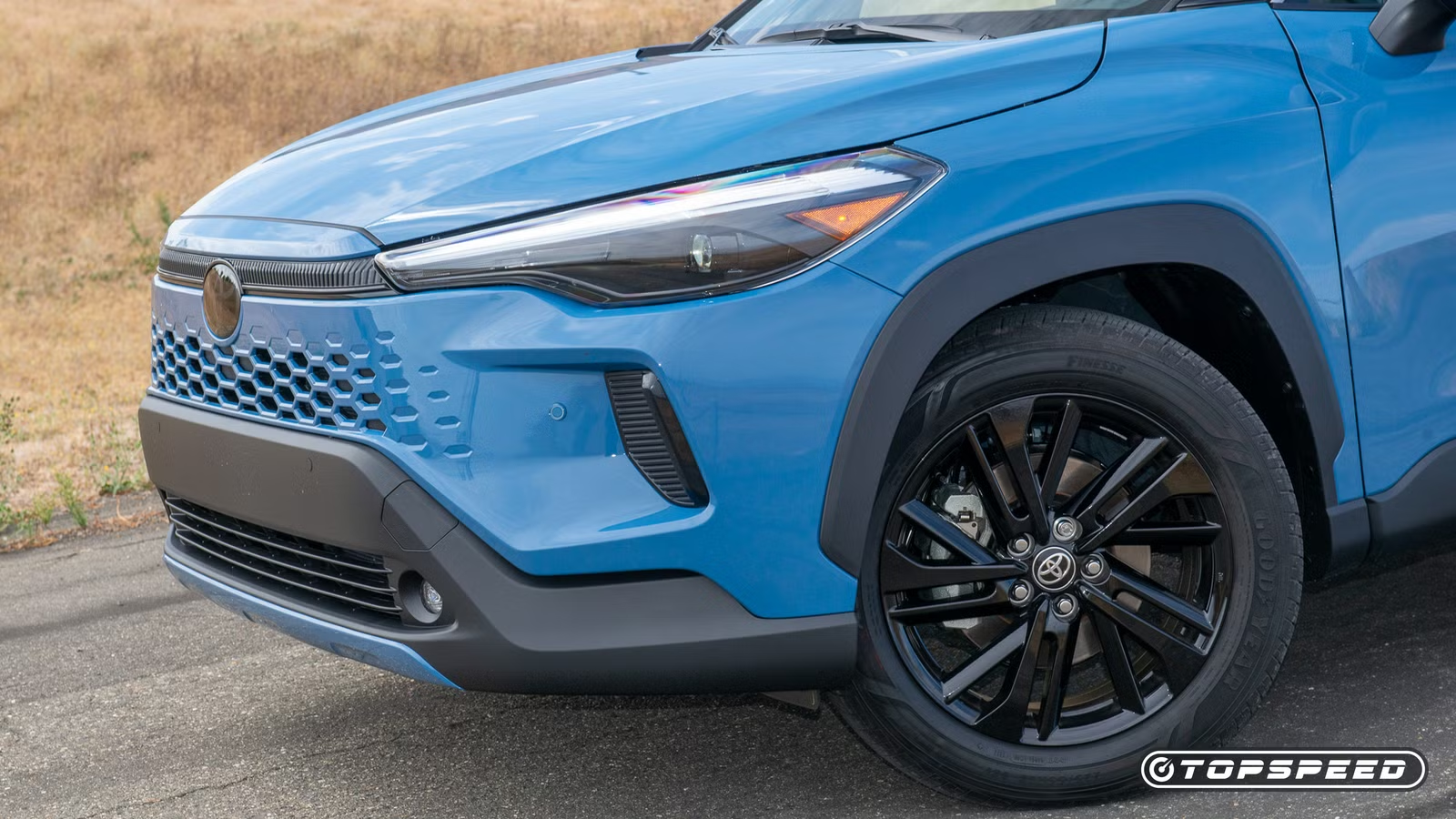
The Toyota RAV4 has long been the undisputed king of compact SUVs — a reliable, do-everything workhorse that has topped America’s best-seller charts year after year. But a quieter story is unfolding in Toyota’s own showrooms. Another compact SUV from the brand, one that only arrived in the U.S. in 2022, is now growing faster in sales than the RAV4 ever has in recent memory. If you haven’t been paying attention, it’s time to start.

This Toyota compact SUV is affordable, spacious, available with both hybrid and gas engines, and affordable to run. It’s easy to see why the RAV4 is facing stiff competition, so we’re taking a close look at what makes this stalwart-upsetting compact Toyota SUV such a popular buy right now.
The RAV4 May No Longer Be The Best Choice For Most People
The Toyota RAV4 has ridden the SUV wave ever since its inception, and that has made it America’s best-selling SUV for the past several years. It’s no doubt a terrific, do-it-all SUV that can suit multiple lifestyles, thanks to its practicality and versatility. It balances those qualities with efficiency, decent performance, a spacious cabin, and, of course, Toyota’s legendary dependability. However, that dominance may be shifting — or at least that’s what the latest numbers suggest.
SUVs And Changing Consumer Preferences


The SUV craze began because of changing consumer preferences. Buyers no longer wanted tiny econoboxes and sedans; instead, they saw more benefit in larger, spacious, and more versatile SUVs, some of which could even handle light off-roading. As a result, more and more buyers started picking up SUVs instead of sedans or hatchbacks, to the point where the SUV segment holds the biggest market share today. Compact SUVs were the obvious, more practical choice here as opposed to larger, full-size SUVs.

That consumer preference is evolving further, as noted by Kelley Blue Book’s parent company, Cox Automotive. In its market study, the firm found that midsize SUVs and pickup trucks are losing ground, while compact and subcompact SUVs are gaining — a trend that was already visible as far back as 2022. Statista’s report on SUVs shows a similar pattern. It tracks with what consumers are looking for: SUV practicality combined with urban agility.
Subcompact SUVs Are The Next Big Thing

Part of the broader compact SUV segment, subcompacts continue to grow in the market, especially with the latest updates. What were once seen as bottom-of-the-barrel compromises, lacking the latest features, now come equipped with modern technology and capable powertrains. At the same time, they are easier to park and drive in the city and consume considerably less fuel than larger SUVs. This market shift is precisely why Toyota’s fastest-growing compact SUV is no longer the RAV4.
The Compact Toyota SUV Quietly Beating Expectations

The 2026 Toyota Corolla Cross is the compact SUV taking on its larger cousin, the RAV4, at its own game. In 2025, Toyota reported that it sold just shy of 100,000 Corolla Cross models. Though this is well behind the number of RAV4 models sold in 2025, it still marks a massive year-on-year and month-on-month upturn compared to the stalwart Toyota SUV.
Why The Toyota Corolla Cross Is Surging In Popularity

The Toyota Corolla Cross was designed to bridge the gap between Toyota’s car lineup and the very model it is now outpacing in growth — the RAV4. Since its U.S. market debut in 2022, the Corolla Cross has posted year-on-year sales gains every single year.

Built on the platform of the long-beloved Toyota Corolla but larger and more versatile, the Corolla Cross brings the Corolla’s accessible pricing, Toyota’s rock-solid reputation, and the everyday usefulness of a crossover — while remaining compact enough to navigate city streets with ease. It isn’t hard to see why it is doing so well. Being a small but versatile model in an increasingly popular crossover segment, built by one of the most reliably dependable brands in the business, has only worked in the Corolla Cross’s favor.
Corolla Cross Sales Trends Compared To The RAV4


It’s not just that you might see more Corolla Cross models out on the road — Toyota’s sales figures tell the story clearly. In 2023, the Corolla Cross sold 71,100 models, up 25.5 percent from 56,666 in its inaugural model year. Over the same period, the RAV4 continued to grow, but at a more modest rate of 8.8 percent, selling 434,953 models. The sales growth gap widened again in 2024: the Corolla Cross jumped another 30.8 percent to 93,021 units, while RAV4 sales increased 9.3 percent to 475,193 units sold.

In 2025, the Corolla Cross again posted strong numbers, rising 7.3 percent year-on-year to 99,798 models. By contrast, RAV4 sales rose just 0.9 percent to 479,288 units. That means the Toyota Corolla Cross outpaced the Toyota RAV4 in sales percentage growth for three consecutive years.

Monthly figures tell a similar story. According to the most recent data released by Toyota for June 2026, RAV4 sales dropped 12.1 percent compared to June 2025 — from 36,810 copies down to 32,350. For the Toyota Corolla Cross, 7,595 units were sold in June 2025, but sales surged 27 percent to 9,644 units in June 2026. By some measures, the Corolla Cross is the fastest-growing Toyota compact SUV on the market in the U.S.
What Makes The Toyota Corolla Cross Stand Out

First things first, the 2026 Toyota Corolla Cross has a starting price of $25,035 and a top-end price of $33,430. In the grand scheme of new SUVs in the U.S., that makes it genuinely affordable. Secondly, the Corolla nameplate carries considerable weight in the market, having been a fixture in America since 1968 in one form or another.

Thirdly, the Toyota Corolla Cross has already been rated ‘Superior’ by the IIHS and has received one of the organization’s top awards, with past model years earning ‘Top Safety Pick+’ recognition. In a short time on the market, the Corolla Cross has generated plenty of buzz and given buyers compelling reasons to choose it over established names like the Toyota RAV4.
Corolla Cross Trims Explained: Three ICE Trims, Three Hybrid Trims

There are a total of six trims for the 2026 Toyota Corolla Cross: the Corolla Cross L, the Corolla Cross LE, the Corolla Cross XLE, the Corolla Cross Hybrid S, the Corolla Cross Hybrid SE, and the Corolla Cross Hybrid XSE. Pricing for the 2026 lineup includes:
- 2026 Toyota Corolla Cross L: $25,035
- 2026 Toyota Corolla Cross LE: $27,365
- 2026 Toyota Corolla Cross XLE: $29,960
- 2026 Toyota Corolla Cross Hybrid S: $29,395
- 2026 Toyota Corolla Cross Hybrid SE: $30,715
- 2026 Toyota Corolla Cross Hybrid XSE: $33,430
The Corolla Cross models wearing the Hybrid badge are equipped with a 2.0-liter DOHC inline-four paired with Toyota’s fifth-gen hybrid system, while the non-hybrid models use a naturally aspirated inline-four.
Lineup-Wide Features And Technology That Just Work

The Corolla Cross may be affordably priced, but it doesn’t feel like it inside. Toyota has equipped it with most of what you’ll need for comfortable everyday driving. There are two distinct front fascia designs: the Hybrid models get a sleek, color-matched grille, while the gas-powered Corolla Cross models wear a more rugged face. Both come with sharp LED running lights, and the interior is exactly the quality Toyota buyers expect.

A clean front console with practical storage — cupholders and nooks in all the right places — takes center stage, while an available 10.5-inch Toyota Audio Multimedia touchscreen makes this affordable compact SUV feel genuinely modern for its price point. Wireless Apple CarPlay and Android Auto are standard across all trims, and two USB-C ports up front come as standard. On higher trims, rear USB-C ports and Qi wireless charging are also available.

Toyota Safety Sense 3.0 is standard across all 2026 Corolla Cross models and includes Pre-Collision System with Pedestrian Detection, Full-Speed Range Dynamic Radar Cruise Control, Lane Departure Alert with Steering Assist and Lane Tracing Assist, automatic high beams, and Proactive Driving Assist. It comes as little surprise, given the Corolla Cross’s strong safety track record, that it has earned a ‘Top Safety Pick’ from the IIHS for the current model year. Premium extras are also available above the base grade, including ambient lighting, dual-zone climate control, a power liftgate, and a JBL audio system.
2026 Toyota Corolla Cross Vs 2026 Toyota RAV4: The Real Differences


So why is the Toyota Corolla Cross outpacing the Toyota RAV4 in sales growth? It can’t simply be the lower price, or the novelty of being a newer model in Toyota’s compact SUV lineup. The RAV4 offers more powerful engines and a larger interior. So what is driving buyers toward the Corolla Cross? It comes down to the Corolla Cross being a more usable small SUV for the majority of drivers — and that is saying something when you’re up against the RAV4.
|
Spec |
2026 Toyota Corolla Cross |
2026 Toyota Corolla Cross Hybrid |
2026 Toyota RAV4 |
2026 Toyota RAV4 PHEV |
|---|---|---|---|---|
|
Engine |
2.0-Liter Inline-Four |
2.0-Liter Hybrid Inline-Four |
2.5-Liter Hybrid Inline-Four |
2.5-Liter Inline-Four Plug-In Hybrid |
|
Transmission |
CVT |
eCVT |
eCVT |
eCVT |
|
Horsepower |
169 Horsepower |
196 Horsepower |
226 Horsepower – 236 Horsepower |
324 Horsepower |
|
Torque |
151 LB-FT |
139 LB-FT |
163 LB-FT |
172 LB-FT |
Price, Fuel Economy, And Everyday Practicality

The 2026 Toyota RAV4 starts at $31,900 — roughly $6,700 more than the Corolla Cross — and climbs to $43,300 for the RAV4 Limited hybrid. That price gap is the first thing most shoppers will notice. The 2026 RAV4 Plug-In Hybrid starts at $41,500 and tops out at $48,500 for the new RAV4 Plug-In Hybrid GR Sport, putting it in a significantly different financial bracket than the Cross.

Size is another factor. While the RAV4 is by no means a large SUV, it is noticeably bigger than the Corolla Cross. The Corolla Cross measures 176.1 inches long and 71.9 inches wide, while the RAV4 comes in at 180.9 inches long and 74 inches wide. The difference may sound modest on paper, but for buyers who prioritize an easy-to-drive, city-friendly SUV over outright bulk, the Corolla Cross is the more practical daily tool.

Then there is fuel efficiency. The RAV4 PHEV is hard to beat; Toyota rates it at up to 102 combined MPGe, a figure that would take something extraordinary to top — certainly more than a non-plug-in model like the Corolla Cross can manage. The 2026 RAV4 hybrid has also been estimated by FuelEconomy.gov to achieve up to 43 combined mpg, with an estimated annual fuel cost of around $1,000. Exceptional numbers by any measure.

The 2026 Toyota Corolla Cross is estimated by FuelEconomy.gov to achieve a maximum of 32 combined mpg on the standard gas model, with an estimated annual fuel cost of around $1,350. The hybrid Corolla Cross, meanwhile, can achieve up to 42 combined mpg at an estimated $1,050 per year in fuel — just $50 more annually than the most fuel-efficient Toyota RAV4 in 2026, but at a considerably lower purchase price.
2026 Corolla Cross Vs. 2026 RAV4 Interior Space And Cargo

There’s no escaping the fact that the Corolla Cross is outsized — both inside and out — by the RAV4. But how much space you actually need in a crossover SUV is relative. For buyers who don’t need acres of room but want enough for daily errands and the occasional road trip, the Corolla Cross delivers, and that’s likely a key reason why more drivers are gravitating toward the smaller option.
|
2026 Toyota Corolla Cross |
2026 Toyota RAV4 |
|
|---|---|---|
|
Maximum Cargo Space (Rear Seats Up) |
21.5 Cubic Feet |
37.8 Cubic Feet |
|
Maximum Cargo Space (Rear Seats Down) |
61.8 Cubic Feet |
70.4 Cubic Feet |
Perhaps surprisingly, given the size difference, the Corolla Cross actually offers more front legroom than the RAV4, though the RAV4 does provide more rear passenger space. That trade-off may help explain the shift: buyers are increasingly prioritizing ample everyday space at a lower price over maximum interior volume.
|
2026 Toyota Corolla Cross |
2026 Toyota RAV4 |
|
|---|---|---|
|
Maximum Headroom (Front / Rear) |
38.6 Inches / 39 Inches |
37.9 Inches / 39.5 Inches |
|
Maximum Shoulder Room (Front / Rear) |
52.7 Inches / 52.4 Inches |
57.8 Inches / 37.8 Inches |
|
Maximum Hip Room (Front / Rear) |
52.6 Inches / 43.8 Inches |
54.3 Inches / 49.6 Inches |
|
Maximum Legroom (Front / Rear) |
42.9 Inches / 32 Inches |
41 Inches / 37.8 Inches |
|
Total Passenger Volume (Front / Rear) |
94.9 Cubic Feet |
98.9 Cubic Feet |
The Bigger Picture For Toyota’s SUV Lineup

The Toyota SUV lineup is one of the most well-rounded in the U.S. market, with a large and loyal following. In today’s SUV-loving American market, that breadth is how Toyota stays competitive against the likes of Honda, Ford, Hyundai, and Kia. Models like the RAV4, Grand Highlander, 4Runner, Land Cruiser, and Highlander are all established pillars of the range, and none of them appear to be going anywhere soon.

Toyota reported that in 2025 it sold a total of 977,901 SUVs — roughly 40,000 more than in 2024. By comparison, Toyota sold 646,176 car models in 2025, up from 621,696 in 2024. With the Corolla Cross rapidly closing the gap on stalwarts like the RAV4, the near-term future of Toyota’s lineup may well belong to smaller, more conveniently sized SUVs that can still haul passengers and cargo with ease.
Hybrids, EVs, And The Future Of Toyota Compact SUVs

Toyota remains one of the foremost champions of hybrid technology, and that isn’t changing anytime soon. The brand is rolling out a growing range of EVs — including the bZ, the more rugged bZ Woodland, and the C-HR — with more expected in the years ahead. But as EV sales growth has cooled somewhat in the U.S., hybrids and smaller, versatile vehicles look set to remain the mainstream choice for the foreseeable future.

The Toyota RAV4 is undeniably one of the leading crossover SUVs in the U.S. market — its sales figures make that clear — and it has achieved more than most other brands’ attempts at one. But with the Toyota Corolla Cross growing faster in sales, it seems the smaller, more affordable, equally reliable compact crossover will keep gaining ground in a market where drivers have figured out that a bigger SUV doesn’t always mean a better one.
Sources: Toyota, IIHS, FuelEconomy.gov, Statista, Kelley Blue Book

Related posts





Latest Post


No Comments