
Mazda Furai: The Lost Concept Car Explained
It wasn’t that long ago when automotive enthusiasts decried the end of the performance era and dreaded the transition to a modern world where high-revving, huge-horsepower machines would become distant memories. Ever-stricter legislation threatened the essence of what makes driving special, and many people predicted that we would ultimately only have diluted hybrids and clinical EVs to consider as poster cars.

However, both mainstream manufacturers and smaller, niche sports car brands have continued to innovate, bringing us a delectable array of ridiculously powerful and agile concept cars, supercars and hypercars that continue to raise the bar. Nearly two decades ago, one intriguing concept car set out to define trends.
Extreme Machines – From Road To Race-Ready
The array of extreme performance cars is seemingly endless for those with limitless cash to splash, and for the rest of us who can only dream of joining this exclusive club.

There are barely road-legal cars with varying levels of Formula 1-derived technology, such as the Aston Martin Valkyrie, Mercedes-AMG One or the recently launched McLaren W1. And if you’re searching for the purest form of octane-fueled kicks, then you can opt for focused track-only machines such as the AMR Pro version of the Valkyrie, Red Bull’s RB17, McLaren’s single-seater Solus GT, the W16 Bugatti Bolide, Pagani’s purist Huayra R, Ferrari’s FXX-K Evo, or Gordon Murray Automotive’s screaming GMA T.50s Niki Lauda … to mention but a few.
If none of these grab your attention and drain your offshore bank account faster than an F1 pit stop, then let me introduce you to a selection of alternative offerings from Koenigsegg, Czinger, Hennessey, Praga, Zenvo, and so the list goes on and becomes even more rarified.
The Race-Inspired Japanese Concept Car That Was Ahead Of Its Time
There’s a common thread in the list of cars referenced above, which is that none of them are Japanese. Yet, the Land of the Rising Sun created a revolutionary thoroughbred machine nearly two decades ago that wouldn’t look out of place among today’s track-oriented hypercar royalty, or even barreling down the Mulsanne Straight at over 200 mph while competing for 24 Hours of Le Mans glory.
Indeed, Mazda, the same company that produces the popular CX-5 sport utility vehicle and the venerable MX-5/Miata roadster, turned up at the Detroit Auto Show in 2008 with what is considered by many as one of the most significant and memorable concept cars ever produced – the Furai.
As a pure track-focused machine, the Furai was the fifth of seven concept cars designed by Mazda using its Nagare design language, which embodied “the flow of water, air, people or things moving in one direction”. It kicked off with the futuristic Nagare two-door coupe in 2006, which featured a central driving position and three wrap-around passenger seats.
The Ryuga was unveiled at the Detroit Auto Show in 2007 with a 2+2 configuration and gullwing doors, followed by the Hakaze crossover SUV and the striking Taiki supercar concept, all featuring design cues that would filter through to its production cars such as the RX-8, CX-7, and the Mazda 3 and Mazda 6 sedans.
Saving The Best For Last

Fortunately, Mazda’s design team left the best for last, and the Furai embodied the company’s legendary race pedigree from its revolutionary Le Mans-winning 787B with a thoroughly modern interpretation that certainly had automotive designers, car enthusiasts, and race drivers captivated.
The Furai project (Furai means “sound of the wind” in Japanese) was led by Mazda design chief Laurens van den Acker. It had one intention, and that was to deliver ultimate on-track performance and driving experience. At the time, Franz von Holzhausen, Mazda’s North American director of design, said: “Furai purposely blurs boundaries that have traditionally distinguished street cars from track cars. Historically, there has been a gap between single-purpose racecars and street-legal models – commonly called supercars – that emulate the real racers on the road. Furai bridges that gap like no car has ever done before.”
His words were prophetic, as this would come to define what we know today, nearly two decades later, as the track-oriented extreme hypercar category.
Lightweight Form, Thrilling Function, Oodles Of Character

The Furai wasn’t simply a fanciful design exercise; it was a fully functional track-developed car based on an American Le Mans Series (ALMS) car that the company had raced in 2005 and 2006. It used the Courage C65 LMP2 chassis, and was powered by a 20B triple-rotor rotary engine that paid tribute to legendary status of the screaming 787B 1991 Le Mans winner.
Although it only produced 450 hp — a paltry output in modern terms, considering the prevalence of 1,000–1,600 hp engines in the latest crop of hypercars — at a claimed 1,488 lb it was conceptually more a spiritual predecessor to the lightweight, high-revving, and engaging modern-day GMA T50.S (668 hp/2,200 lb) than the sledgehammer Bugatti Bolide (1,578 hp/3,197 lb).
Proving that it certainly wasn’t just dressed up to impress as a showstopper, straight after its Detroit debut the Furai was shipped to Laguna Seca for a media event with demonstration laps conducted by the car’s development drivers. Jay Leno became one of the handful of people to ever drive the car, before it went on to make its high-profile public appearance – and driven with gusto – at the Goodwood Festival of Speed in the UK in July.
Eight Months After Debut, Furai Was No More
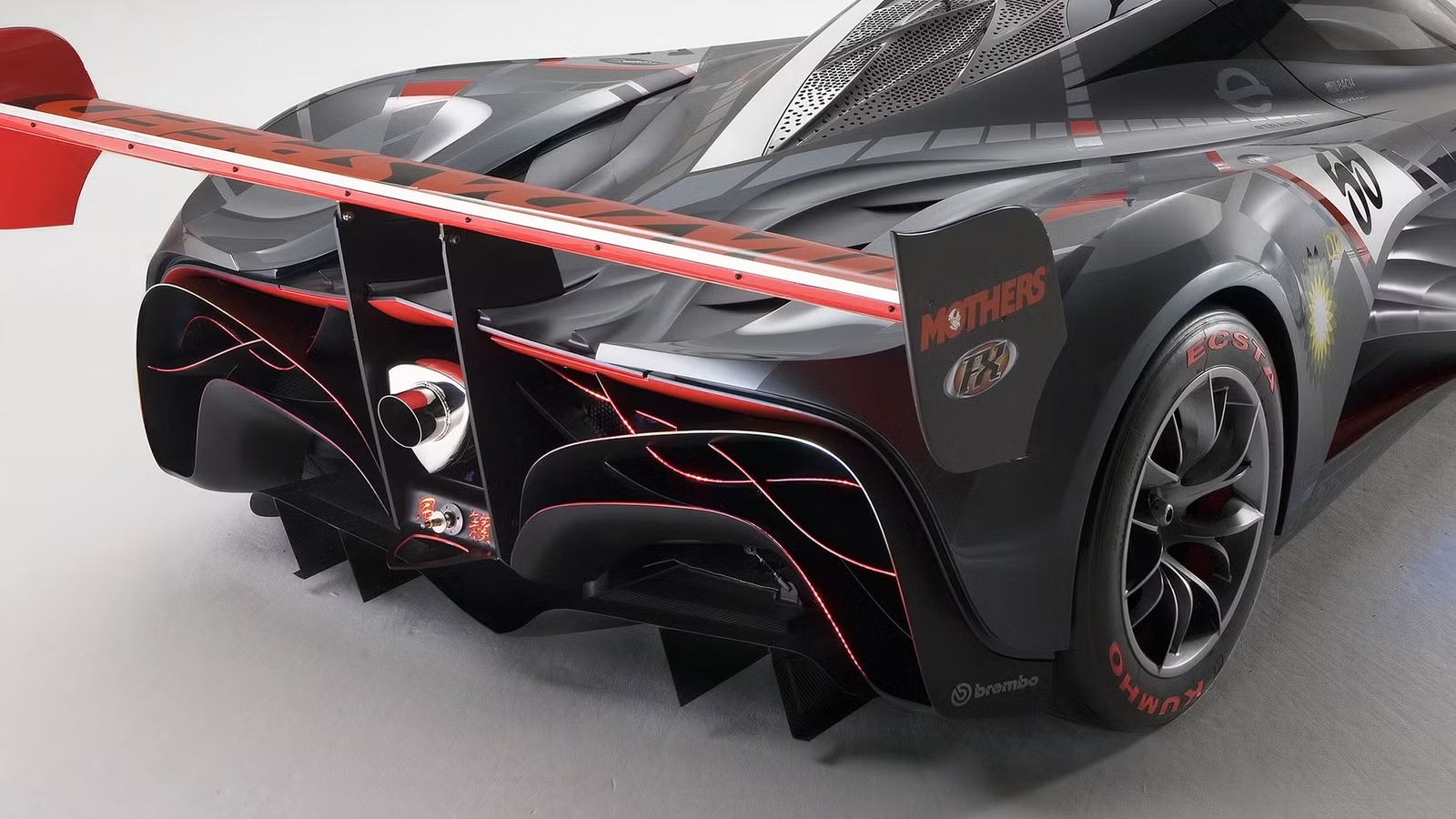
Its subsequent engagement at Royal Air Force Base Bentwaters in the UK, for a cover shoot for Top Gear Magazine in August 2008, would tragically be its last. With Mark Ticehurst, a professional test driver who also served as The Stig for the magazine, behind the wheel, the car caught fire. The fire and rescue crews were well out of sight, and in the approximately eight minutes it took for them to reach the car and extinguish the flames, most of the car had been burned beyond recognition, with only the rearmost section of the bodywork and the massive wing seemingly unscathed.
The sad charred remains of what is still considered one of the most seductive and legendary concept cars of all time were loaded onto a trailer, and the car was reportedly shipped back to Mazda’s Advanced Design Studio in Irvine, California, never to be seen again.
What Could Have Been: Keeping The Spirit Alive

While Mazda insisted that it had no plans to ever race the Furai, or that it was destined to enter production, one can only wonder what could have been had the car lived longer, gone from concept to actual race car, or been developed into an extremely limited run of customer cars. There’s no doubt that the one and only Mazda Furai would have remained a fan favorite, and even more so beyond the narrow scope of its eight short months in the public realm.
Were it still around today, it would probably still regularly be seen as part of Mazda’s heritage fleet alongside the famous (and priceless) orange and green-liveried 787B that became the only rotary-engined car to win Le Mans, a revered machine that has a massive global following and continues to attract huge audiences whenever it makes an appearance around the world.
Indeed, had it spawned a limited number of customer or race cars, there’s no doubt that these would now be among some of the most prized and valuable collectors’ cars on the planet, even sporting a Mazda badge instead of an illustrious name such as Aston Martin or Ferrari.
The furious Furai may be gone, but is certainly not forgotten. It continues to be revived – virtually, at least – as an iconic car in racing simulator games such as Gran Turismo, Forza Motorsport and Forza Horizon (including FH 6, released this year), no doubt inspiring future generations of car enthusiasts that will continue to keep the spirit of real driver’s cars alive for many years to come.
Sources: Mazda, Top Gear UK, Goodwood Festival of Speed

Related posts




Latest Post


No Comments