
The Forgotten Honda Superbike That Changed Everything
Modern sport bikes feel almost inevitable. A compact chassis holds a high-revving engine, race-shaped bodywork, strong brakes, and suspension designed to keep every part working together. The whole motorcycle behaves like one system. In the early 1980s, though, that formula had not yet settled into place. Fast bikes often came from fitting bigger engines into designs rooted in the previous decade, but one motorcycle helped change that thinking.
Superbikes Were Getting Faster Than Their Chassis Could Handle

By the late 1970s, the superbike battle had become an engine-size contest. Honda, Kawasaki, Suzuki, and Yamaha kept adding displacement, cylinders, horsepower, and speed. The Kawasaki Z1 had helped establish the big Japanese four-cylinder formula, while machines such as the Suzuki GS1000, Yamaha XS1100, and six-cylinder Honda CBX pushed performance higher. However, frame development lagged behind.
Manufacturers soon entered a mechanical arms race. Engines grew beyond 1,000cc, top speeds climbed past 125 mph, and quarter-mile times fell. Advertisements promised race-bred power even when the motorcycle beneath the rider still followed the basic pattern of a large roadster. An air-cooled engine sat inside a tubular steel frame, with a telescopic fork in front and two shocks at the rear. That layout worked well at normal speeds. The trouble began when riders used all the power that engineers had worked so hard to provide.
Many of those motorcycles flexed, twisted, and moved around when pushed. Their narrow frames struggled to control heavy engines. Basic suspension allowed the chassis to pitch and wallow. Large fuel tanks, steel parts, and bulky motors raised overall weight. Brakes improved, but they did not always improve as quickly as acceleration. In simple terms, the industry kept adding horses while leaving the barn door on loose hinges.

Honda Built A Racebike For The Street Without Calling It One

The American Motorcyclist Association forced a reset for the 1983 Superbike season. The old rules had allowed four-cylinder machines near the 1,000cc mark. The new rules cut them to 750cc and required manufacturers to base their racers on production motorcycles. A company could no longer rely on a huge engine and a heavily modified race chassis. It needed to sell the bones of its competition bike to ordinary customers. That put pressure on manufacturers to design better street motorcycles from the start.
Honda responded by treating the motorcycle as a complete engineering project. Its designers chose a liquid-cooled V4 rather than another wide, air-cooled inline-four. The narrow layout helped centralize mass and gave engineers more freedom when placing the engine inside the frame. They tilted the engine rearward to improve weight distribution and shorten the wheelbase. They also used the engine to strengthen the chassis instead of letting it sit inside the frame like a heavy passenger.
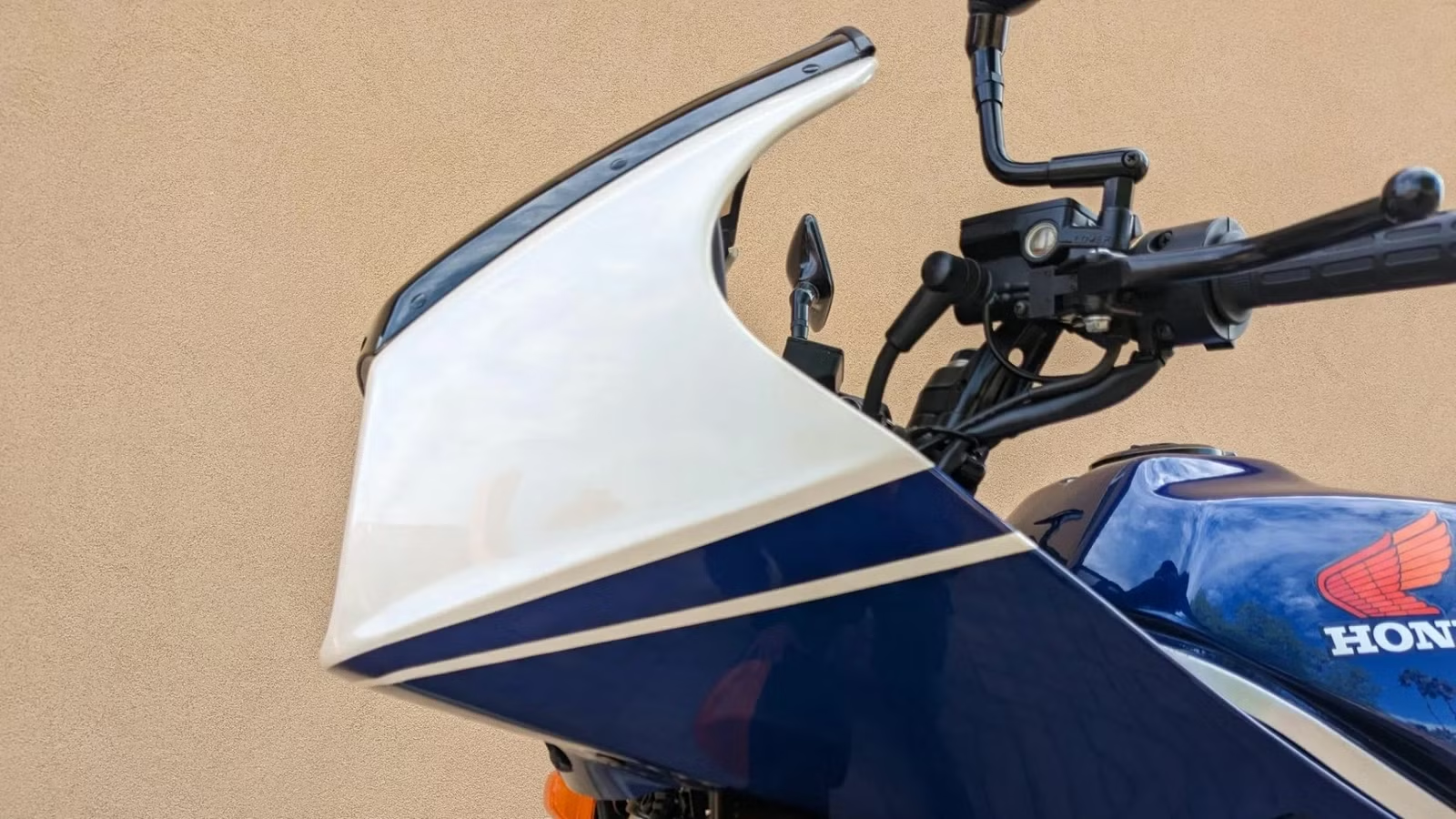
The rest of the machine followed the same goal. A perimeter-style frame wrapped around the motor, and a single rear shock replaced the old twin-shock setup. The fork used race-influenced anti-dive technology, and the front wheel followed the smaller sizes then appearing on competition bikes. The half fairing, low bars, rear-set foot controls, and lower cowl served real jobs: manage air, give the rider room to tuck in, and support control at speed. Honda even had to remove the lower spoiler from its race version because AMA officials considered it too much streamlining.
The 1983 Honda VF750F Interceptor Rewrote The Superbike Rulebook

That motorcycle was the 1983 Honda VF750F Interceptor. It did more than place a powerful engine inside a sporty Honda; it brought the key parts of a modern sportbike together years before the industry made that approach normal. The engine, frame, suspension, brakes, riding position, and bodywork supported one goal: help the rider carry speed with control. It still weighed about 551 pounds with fuel, so nobody would mistake it for a modern featherweight. Its breakthrough came from managing that mass, not pretending it did not exist.
At its center sat a 748cc, liquid-cooled, 16-valve, double-overhead-cam 90-degree V4. Honda claimed about 86 horsepower at 10,000 rpm, while period testing found roughly 77 horsepower at the rear wheel. Those figures gave the Interceptor serious speed, but the layout mattered more than the peak number. The V4 placed two cylinders behind the other two, creating a narrower engine than a comparable inline-four. It delivered strong, usable power with a harder rush near the top of the rev range and a sound that separated it from the usual four-cylinder crowd. The design also gave Honda a strong base for future racing development.
Honda built the square-section steel perimeter frame around that engine. Large frame rails ran close to the sides of the V4 instead of looping beneath it in the traditional way. The company mounted the engine firmly, allowing it to help brace the chassis. A triangulated steering-head area, cast aluminum swingarm, and cross-braced fork added more resistance to twisting. Pro-Link rear suspension used a progressive linkage and one adjustable shock. Up front, Honda’s TRAC system increased fork damping under braking to limit dive. A 16-inch front wheel aimed to quicken steering, while twin front discs and two-piston calipers supplied the stopping force.

The gearbox held only five speeds, another detail that revealed how closely Honda packed the machine. Converting the original V4 design from shaft drive to chain drive reduced the space available inside the transmission. Rather than make the gears thinner and weaker, Honda dropped one ratio. On the road, the decision mattered less than expected because the V4 offered a broad spread of power. Period testers recorded a top speed of about 132 mph, but they spent more time praising the neutral steering, strong brakes, ground clearance, and stability.
That balance also made the motorcycle useful away from a racetrack. The power delivery remained friendly at lower speeds. The seat, bars, and foot controls created a sporty position without turning every ride into a wrist-strength test. The bike could commute during the week and attack a winding road on Sunday. Riders still needed respect for its quick steering and sensitive controls, especially if they had learned on slower machines. Yet the Interceptor made serious performance easier to understand and use.
Racing proved that the design had substance. Interceptor-based machines won eight of the 14 AMA Superbike nationals held in 1983, including a sweep of the top three positions at Daytona. Wayne Rainey still secured the championship for Kawasaki, but Honda’s new machine had delivered its message. The company had created a road-legal motorcycle that needed development for racing, not a total personality transplant. That connection between showroom and track helped establish the race-replica culture that would define the next decade.
The Flaws That Buried Honda’s Breakthrough

The Interceptor should have enjoyed a clean path into motorcycle legend, but its engine made sure that did not happen. Owners of Honda’s early V4 models began reporting premature camshaft wear, unusual top-end noise, and damaged valve-train parts. Cam lobes could develop pits and rough surfaces long before riders expected serious engine work. The exact cause still attracts debate. Oil supply often receives the blame, but experienced specialists also point to rocker-follower surface failure, high valve-train loads, manufacturing compromises, clearances, and maintenance setup.
Cam-chain tensioners added another concern. A weak or damaged tensioner could allow excess chain movement, leading to noise, poor cam timing, and further wear. Reports of tensioners breaking apart made the problem sound even worse. Honda issued service advice and handled many repairs through warranty channels, but it never produced the kind of clean, single fix that could quickly restore confidence. The motorcycle’s advanced V4 became known for “chocolate cams,” a cruel nickname for an engine that otherwise represented some of Honda’s boldest work.
The Successors That Perfected The Formula

The timing made the damage worse. Motorcycle technology moved at a brutal pace during the middle of the 1980s. Suzuki introduced the GSX-R750 with a lighter aluminum frame and a more direct race-replica image. Yamaha brought out the FZ750 with its five-valve engine. Kawasaki continued developing fast, compact sport machines. Honda could not spend years polishing the original Interceptor while competitors attacked from every side. The company needed a replacement that kept the concept but removed the doubts.
Honda delivered that answer with the 1986 VFR750F. The VFR used an aluminum twin-spar frame, gear-driven camshafts, a six-speed transmission, lower weight, and a more refined version of the V4 idea. Gear drive removed the troublesome cam chains and their tensioners from the equation. Honda also improved manufacturing quality and matured the chassis.
Later Hondas pushed the Interceptor even deeper into the shadows. The VFR750R RC30 turned the V4 into a famous homologation special packed with exotic materials and racing hardware. The 1992 CBR900RR FireBlade gave Honda another historic turning point by pairing open-class power with the size and weight of a smaller machine. Long before either of them, the 1969 CB750 had already claimed its place as the motorcycle that helped create the modern superbike market.
The Superbike History Remembered The Successors, Not The Pioneer
A modern sportbike now arrives as a unified performance machine. Engineers place the engine to help balance the chassis, wide frame spars connect the steering head to the swingarm area, and a single rear shock works through a linkage. Strong brakes, compact packaging, race-shaped bodywork, and systems that control the rear wheel all support the rider. The 1983 Interceptor did not perfect those ideas, but it placed a surprising number of them on one production motorcycle.
Its most important achievement had little to do with 86 hp or a 132-mph top speed. Honda built the bike around cornering, braking, stability, and rider control as much as acceleration. The company translated current racing thought into a machine that ordinary customers could buy. It also treated the V4 engine as part of the chassis plan, rather than a power unit that engineers squeezed into an existing frame. That approach led directly toward the VFR family and helped prepare the ground for Honda’s later racing machines.
Reliability problems keep the VF750F from becoming a flawless classic. They also explain why collectors and historians often move past it on the way to the VFR, RC30, or FireBlade. Yet flaws do not erase influence: the Interceptor arrived when superbikes had too much engine and too little unity. It showed the industry what could happen when engineers designed the whole motorcycle to work together. Modern sportbikes made that lesson look obvious. In 1983, Honda had to learn it first.
Source: Honda, Hemmings

Related posts
Latest Post


No Comments