
The Street-Legal Big-Block That Belonged At Daytona
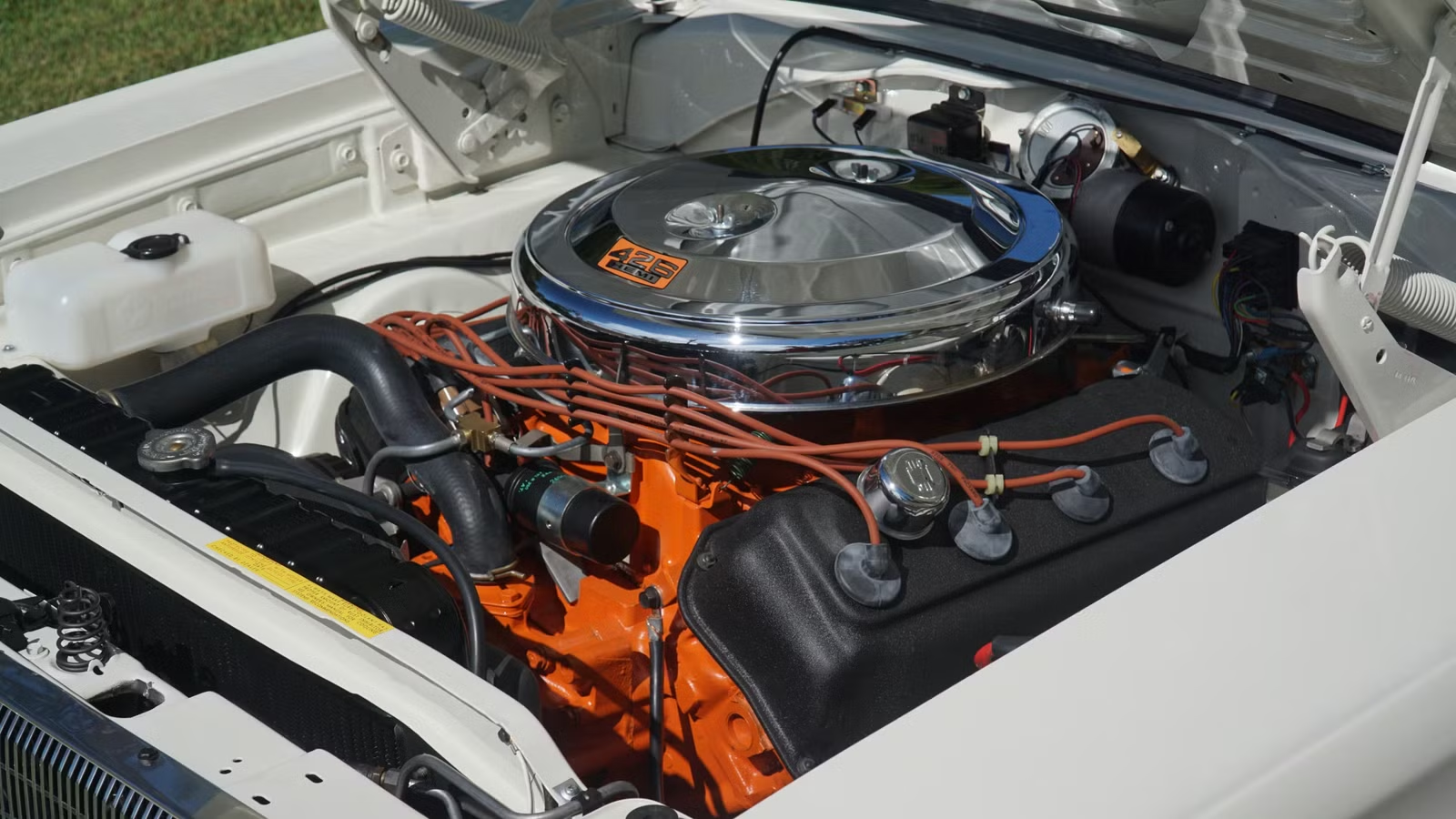
If there’s one defining feature of the golden age of the American auto industry, it’s the existence of massive big-block V8s. These huge engines are such an integral part of the DNA of high-performance muscle cars from this time. One of those high-performance big-block engines is one that, in many ways, was barely suitable for the road. It also powered some of the most legendary muscle cars of all time.
Many American Automakers Developed Crazy Engines For Motorsports

During that golden era of American Muscle Cars, it wasn’t uncommon for automakers to develop absolutely crazy engines just to get the maximum performance possible. These engines were typically not thought of as being for the streets at all. These were racing engines first and foremost. They were often big-block-sized, coming in at 425 cubic inches or greater. They also typically had not only massive amounts of power for their era, but also massive amounts of torque.
These Engines Typically Had To Be Thrown Into Homologation Special Models Of Regular Cars

While these massive, crazy engines were supposed to be for the racetrack, there were homologation rules in place that meant that cars that competed in the upper echelons of American motor sports had to be based on street-legal models. There was a minimum production quota for this (typically 50 examples). Like in many other eras that came later, the American automakers realized they could slightly bend the rules by dropping street-legal versions of their crazy racing engines into regular production cars. This created homologation special versions of those ordinary street cars, and anyone who could afford to buy them from a showroom could. That’s if they got there in time, anyway. These homologation special cars were often limited to just enough examples to fit the rules. Or, alternatively, they were only made available for one or two model years.

One of the racing engines that ended up in street-legal cars due to this process is quite possibly one of the most legendary big-block V8s ever built. Not only did this engine change the game when it came to high-performance V8s, but it was a centerpiece of some of the most legendary muscle cars of all time. That not only included homologation special models, but also high-performance versions of regular cars that weren’t produced in limited numbers.
The Chrysler 426 Hemi V8 Is A NASCAR Engine That Was Only Slightly Toned Down For The Street

If you’ve got even only a passing interest in American muscle cars, you’ll know about Chrysler’s 426 Hemi V8. This 426 cubic-inch big-block V8 really was a game-changer when it appeared in the early 1960s. Its origins lay entirely in Mopar’s motorsports ambitions. As a result, it wasn’t designed anything like a conventional big-block V8. It was also immensely powerful, to the point where its output could genuinely compete with the earliest supercars.
The 426 Hemi was officially rated at 425 horsepower and 490 lb-ft of torque from the factory. That figure is typically thought of as massively underrated, as a way of not scaring insurance companies away from Hemi-equipped street cars. Many believe that the actual power of this engine is more like 500-550 hp for the street versions, with race versions being even more powerful.
It Popularized The Use Of The Hemispherical Combustion Chamber

The main game-changing thing about the 426 Hemi V8 is the hemispherical combustion chamber that gave it part of its name. By using a hemispherical combustion chamber instead of a conventionally-shaped one, Chrysler was able to give this engine intakes and exhaust valves that were bigger than what you’d find on a typical big-block V8 engine. That made the airflow to the engine a lot better, giving it better power at higher RPMs. That was incredibly important for its racing use. It needed to be able to produce as much power as possible at the top of its rev range, as that’s where it would mainly be sitting on those terrifyingly fast superspeedways.
It’s An Incredibly Tough Engine

An aspect of the 426 Hemi that often doesn’t get talked about is how these engines were designed from the outset to be incredibly tough. They were given a reinforced bottom end, which included several components that are heavier-duty than what you’d find in a regular 1960s big-block V8. This included forged internals, and pistons that were absolutely massive. Like the hemispherical combustion chamber, this was incredibly important to its purpose as a racing engine. These engines would need to take a lot of abuse from all that running at high speeds and high RPMs for long stretches of time. So, it made perfect sense to make sure that they were overbuilt.
It Was An Option On Several Dodge And Plymouth Models

The number of cars the 426 Hemi got dropped into during its life cycle might actually surprise you. With it being essentially a racing engine, it did end up powering a couple of NASCAR-bound homologation specials. Those are the Dodge Charger Daytona and the Plymouth Superbird. While these cars were also available with the 440 Magnum engine, the Hemi-engined versions are by far the most desirable. The other Mopar model that enthusiasts associate with the 426 Hemi is the Plymouth Hemi ‘Cuda, a legendary variant of the Plymouth Barracuda. Not only are Hemi ‘Cudas absolute performance monsters thanks to them having the Hemi under the hood, but the convertible version is also one of the rarest and most desirable muscle cars around.
Away from those cars that we all know, several other Dodge and Plymouth models allowed you to spec the 426 Hemi V8 as an option. The Dodge Charger R/T let you have this engine if you asked for it on the order form, as did the Dodge Coronet R/T and Dodge Challenger R/T. On the Plymouth side of things, you could get the 426 Hemi in the Road Runner, GTX and Satellite if you ticked the option on the order form.
It Also Powered A Prototype Supercar From Switzerland

The 426 Hemi didn’t just power American muscle cars, either. For a time, it looked like this engine was going to be the heart of an audacious European production supercar. That’s the Monteverdi Hai 450 SS. The use of the Hemi V8 made it fit in with Peter Monteverdi’s already established philosophy of combining European quality and styling with American power, in a “best of both worlds” situation. As Monteverdi’s original design for the car called for it to be mid-engined, the Hemi was shoehorned into that layout, and parts of its exhaust system were modified to fit it. That actually ended up strangling the engine a bit. Instead of the 450 hp Peter Monteverdi hoped it would have (hence the “450” in the name), it actually had more like 375 hp.
Sadly, this car only ever existed in prototype form. It never ended up getting the limited production run Peter Monteverdi intended for it. As a result, it never ended up being a threat to established European supercars. But the fact that it existed in any form at all is incredible.
It Had A Big Competitor From The Blue Oval

Chrysler developing the 426 Hemi meant that its Detroit competitors needed to step up their game. One of the ones that stepped up the hardest was Ford. The blue oval’s response was the Boss 429 V8, another racing-first design that also powered a homologation special muscle car (the Ford Mustang Boss 429). This engine is a “semi-hemi” V8, using a similar combustion chamber design to the 426 Hemi to achieve the same results in the power band. It’s also fairly similar in size (429 cubic inches). It’s also similarly under-rated in terms of its output. The factory claimed output for the Boss 429 V8 was 375 hp and 450 lb-ft of torque, but many enthusiasts think it had at least 500-550 hp.
The 426 Hemi, then, absolutely beats the Boss 429 in terms of claimed output. But when you factor in what these engines may have actually produced, it’s a lot closer than you’d think. The only advantage the 426 Hemi may have over the Boss 429 in reality is torque (490 lb-ft vs 450 lb-ft).
Sources: Chrysler, Dodge, Ford, Monteverdi, Plymouth

Related posts


Latest Post


No Comments