
The Rarest Chevrolet Corvette Of The 1970s Is A Special Of A Special
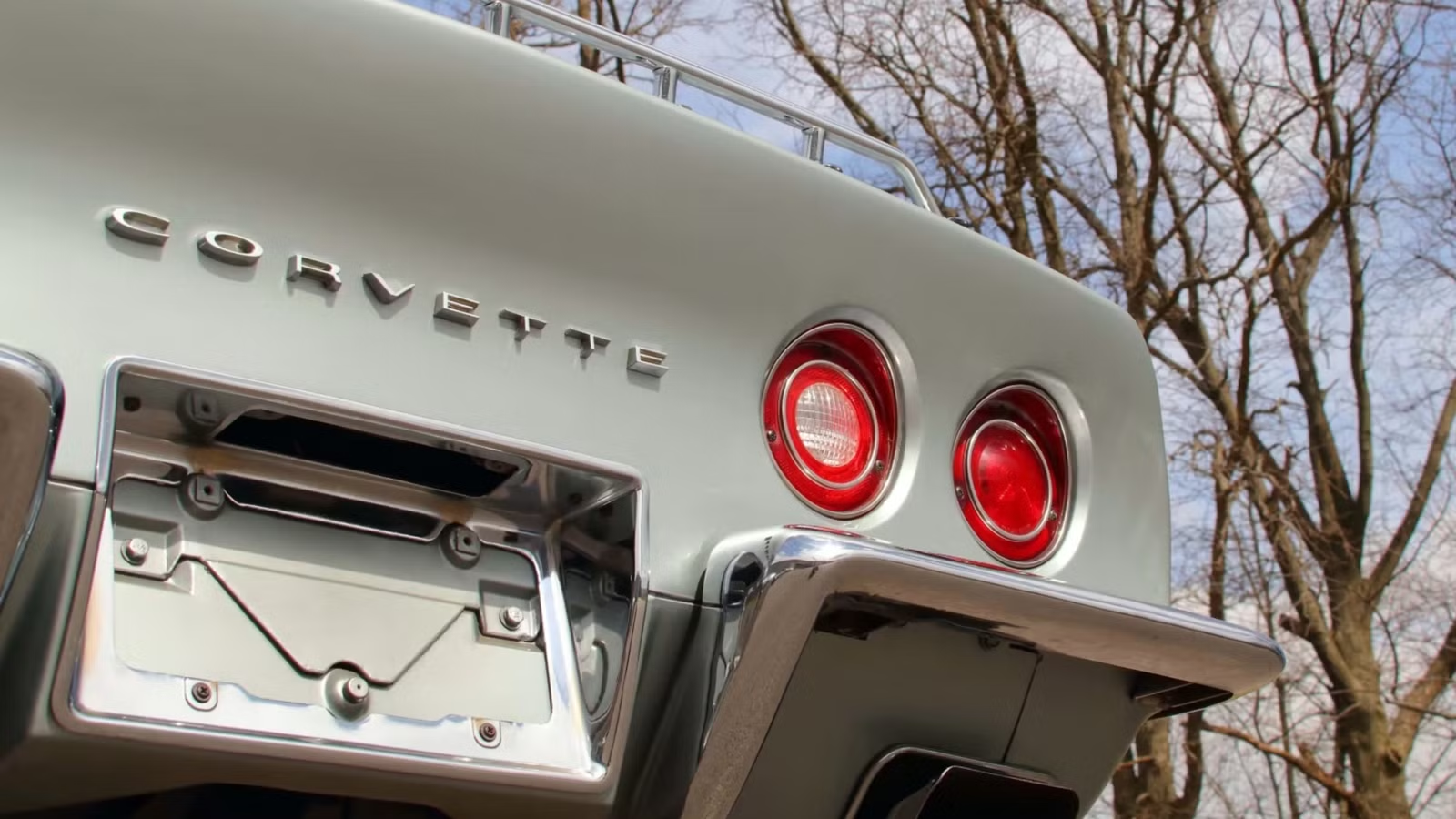
Collector cars don’t get much more elusive than the Corvettes Chevrolet quietly slipped out the door in the early 1970s. While tightening emissions rules, looming fuel crises, and punishing insurance premiums were already reshaping the American performance landscape, a small group of engineers — led by the legendary Zora Arkus-Duntov — refused to let the Corvette go quietly. The result was a handful of ultra-limited special projects that most buyers never even knew existed. We dug through the production records to surface the rarest Chevrolet Corvettes built during that turbulent decade.

In order to give you the most up-to-date and accurate information possible, the data used to compile this article was sourced from General Motors, and other authoritative sources, including GM Heritage, CorvSport, and Mecum Auctions.
The 1971 Corvette ZR1 Is The Rarest Chevy Corvette From The ’70s
By 1971, the auto industry was already buckling under the first wave of federal emissions standards, and the threat of sky-high insurance premiums on high-powered machines had effectively ended what many considered the golden era of muscle cars. Even so, Chevrolet remained determined to build exceptional vehicles for a very select group of customers. The ultimate expression of that commitment was the one-of-one Chevrolet Corvette ZR1 convertible — a sports car so rare that photographic evidence of it is nearly impossible to find.

Chevy still wanted to sell go-fast Corvettes, even if they were built more like secret race cars to help homologate production parts for the real race cars that would tear up circuits worldwide. Win on Sunday, sell on Monday was very much still in effect, and the buyer who came in to see that ultra-cool Corvette might just go home with a more “boring” ‘Vette or an Impala or Malibu for the family.
At the time, big-block Corvettes ruled the road, with Chevrolet offering monsters like the aluminum-block 427 cubic-inch ZL1 engine and the same-displacement but iron-block L88. If those weren’t enough, Chevrolet would offer 454 cubic-inch LS5 engines that made nearly 400 hp.
But even in aluminum, big-block engines are heavy. Weight is the enemy of performance, especially in racing. So the Corvette team, under the legendary direction of Zora Arkus-Duntov, the father of the Corvette, built a high-performance model around a small block instead.
The First Corvette ZR1 Had A Lightweight Small Block
The 1970–72 Chevrolet Corvette ZR1 featured a 350 cubic-inch small-block V8, but it wasn’t like your typical small-block Chevy. This LT1 V8 used aluminum cylinder heads on an iron cylinder block, paired with a high-rise aluminum intake manifold and a 780 CFM carburetor — a significant step up from the pedestrian Quadrajet carbs and low-rise iron manifolds found on regular Corvette models.
A high 11.0:1 compression ratio and a high-performance camshaft helped boost the engine’s output. Solid lifters opened the valves more aggressively, with the added noise and extra maintenance that came with them considered a perfectly acceptable trade-off for the gearheads and racers who were expected to buy the car. The redline was very high for the era — 6,500 rpm — thanks in part to a lighter flywheel, making it even better suited for track use.
The LT1 engine officially made 370 hp in the Corvette, but the NHRA rated it at 425 because it was more powerful on the strip. For 1971, a slightly lower compression ratio — required to comply with a corporate mandate that all GM cars run on 91-octane unleaded fuel — dropped horsepower slightly, but the engine still produced 330 hp and 360 lb-ft of torque. And that’s before the tuners got hold of it and made it truly race-ready.
The Comprehensive ZR1 Package
There was more to the package than just a powerful engine, because the 350 LT1 engine was available without the rest of the ZR1 package. With this special option, Chevy included the heavy-duty Muncie M22 Rock Crusher transmission. The four-speed earned that name for its ability to handle high torque loads and for its lack of synchromesh — grinding gears was common for drivers not experienced with the gearbox.
The package also included heavy-duty power brakes. The J56 code brakes featured dual-piston calipers, a larger-diameter master cylinder, and power assist. The F41 Special Use Suspension added stiffer shocks along with stiffer coil springs up front and an extra leaf spring in the rear. A thick front sway bar rounded out the chassis upgrades, all of them aimed at sharpening handling.
A high-capacity aluminum radiator with an overflow tank, a heavy-duty Positraction rear differential, and a transistor ignition rounded out the ZR1 package. But what was missing from the car was almost as telling as what was included. Features like power windows, rear glass defrost, air conditioning, and the radio were all deleted or unavailable. There wasn’t even a hole in the fender for an antenna if you wanted to add a radio later. This car was built for one purpose: going fast.
All of that performance came at a significant cost. The base 1971 Corvette Coupe carried an MSRP of $5,496. The ZR1 “Special Purpose LT1 Engine Package” option added $1,010 — nearly 20 percent on top of the base price. It also wasn’t advertised, which meant very few of these cars were ever sold.
Chevy Only Built Eight Corvette ZR1s For 1971, And Just One Convertible
Total Corvette ZR1 production from 1970–1972 came to just 53 units — enough on its own to rank it among the rarest Corvettes ever built. 1971 was the lowest-production year, when just eight Corvettes were ordered with the ZR1 option. But only one of those eight was a convertible. That single car makes the 1971 Chevrolet Corvette ZR1 convertible the rarest Chevrolet Corvette of the 1970s, and one of the rarest of all time.
1971 Chevrolet Corvette By the Numbers
|
Option |
Production Figure |
|
Coupe |
14,680 Units |
|
Convertible |
7,121 Units |
|
LS5 454ci/365 hp |
5,097 Units |
|
LT1 350ci/330 hp |
1,949 Units |
|
ZR1 Coupe |
7 Units |
|
ZR1 Convertible |
1 Unit |
|
LS6 454ci/425 hp |
188 Units |
|
ZR2 Coupe |
10 Units |
|
ZR2 Convertible |
2 Units |
|
ZQ4 350ci/270 HP |
14,547 Units |
(Source: Corvette Action Center)
Today, these scarce cars command big bucks, though perhaps not as much as you might expect. Classic.com shows the last reported sale of a ZR1 from a Mecum auction on May 18, 2024. The car was a 1970 model year and sold for $155,000. Another 1970 ZR1 sold in 2020 for $129,250.
The 1971 Corvette ZR2 Is Nearly As Rare As The ZR1
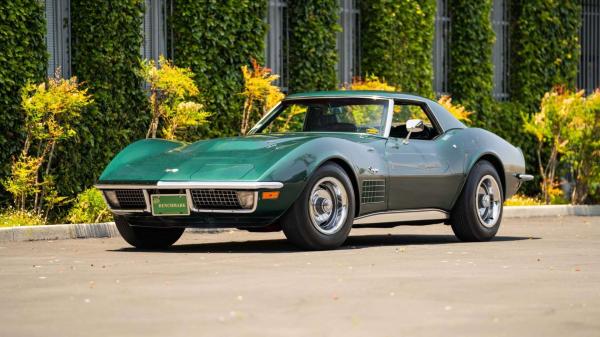
The Corvette ZR2, sold only in 1971, received the same upgrades as the ZR1, but added a rear sway bar and an even more potent engine. The ZR2’s 454 cubic-inch LS6 produced serious power, with GM claiming 425 hp and 575 lb-ft of torque. While factory horsepower ratings of the era were often conservative or inconsistent, the real-world output of the LS6 was widely believed to exceed the official figures.
Though still rare, 12 were built — practically common by the standards set by the ZR1 convertible. Just like the ZR1, the open-top version was rarer than the coupe; not many buyers wanted a drop-top race car. Just two ZR2 convertibles were built, one in green and one painted orange. Both now wear removable hardtops, but only the green one is believed to have left the factory that way.
Chevy 454 V8 LS6 Engine Details
|
RPO |
LS6 |
|
Engine |
7.4 Liter, Mark IV 454-Cubic-Inch V8 |
|
Power |
425 HP @ 5,600 rpm |
|
Torque |
500 LB-FT @ 3,600 rpm |
|
Bore/Stroke |
4.25 x 4.00 Inches |
|
Cylinder Block Material |
Cast Iron |
|
Cylinder Heads |
Aluminum Alloy |
|
Compression Ratio |
9.0:1 |
The Second-Rarest 70s Vette By The Numbers

The ZR2 is more common than the ZR1, but also considerably more desirable — and that desirability is reflected in the prices. At $7,672 when new, roughly a third of the cost of a home that year, the ZR2 Convertible was never cheap. Today, hardtop versions have sold for $650,000 and $221,000 in recent auction cycles — a massive spread, but enough either way to buy an entire house. The two ZR2 convertibles change hands for even more, and with surprising frequency.
The green ZR2 sold at Mecum’s Monterey auction in 2023 for $863,500, having crossed the block at the company’s Indianapolis auction just one year earlier for $962,500. The orange car most recently sold in 2019 for $368,500, and if it were to come to market again today, it would likely command a price in line with the green car.
Sources: Corvette Action Center, Mecum Auctions, Classic, CorvSport

Related posts




Latest Post


No Comments