
This Lotus-Tuned AWD Coupe Is Rarer Than a Bugatti Chiron
Finding something incredibly cool, incredibly rare, yet affordable enough to take your local Cars & Coffee by storm is becoming an increasingly difficult task. Even finding the once-affordable and relatively common coupes from the ’80s and ’90s is becoming difficult, with prices on the rise as nostalgia sets in.

What if we told you, though, that you could pluck up a Lotus-tuned, turbocharged, all-wheel drive Japanese coupe that almost nobody has heard of for Honda Civic money? Step this way.
The ‘90s Was An Incredible Time For Coupes In The US
Before that though, let’s revisit the ‘90s for a moment. It was an incredible decade to be a fan of coupes, with seemingly every manufacturer in the game.

Of course, leading the charge for this Grand Tourer-like sports coupe market was the legendary Toyota Supra, with its 2JZ engine capable of impressive performance.
Closely rivaling that was a family of competitors born from a partnership between Mitsubishi and Chrysler, yielding the Mitsubishi 3000GT and Dodge Stealth. And we absolutely cannot forget the Nissan 300ZX, with its monstrous twin-turbo engine, or the rotary delight of the Mazda RX-7. Ah, how times change. Yet, for all of those legends, there’s one that sits as a real oddity, and we can almost guarantee you wouldn’t have thought about it before today.
Even Isuzu Wanted To Get In On The Act

You know Isuzu best for the Trooper SUV, and anyone working in any sort of heavy industry will likely know them best for producing commercial vehicles. Although it had a reputation for building dependable, tough vehicles designed with utility squarely in mind, it wasn’t exactly a brand you’d look towards for sports cars.
Yet, it does have some history with them. One of its finest arrived in 1968 with the Isuzu 117 Coupe, with bodywork styled by Giorgetto Giugiaro (who would later pen the De Tomaso Pantera, Maserati Boomerang, and BMW M1) and sold exclusively in Japan.
Its most well-known coupe came in 1981, the Isuzu Piazza. Despite being a relatively budget-focused coupe, it notably came with rear-wheel drive at a time when front-driven cars were becoming the norm. The most exciting version was the Turbo which, as you might expect, came with a turbocharged 2.0-liter engine with 140 hp. This model was sold outside of Japan, unlike the 117, and was known in the US as the Impulse. Then 1991 came, and its replacement was due.
The Result Was A Lotus-Tuned Turbo Sports Car

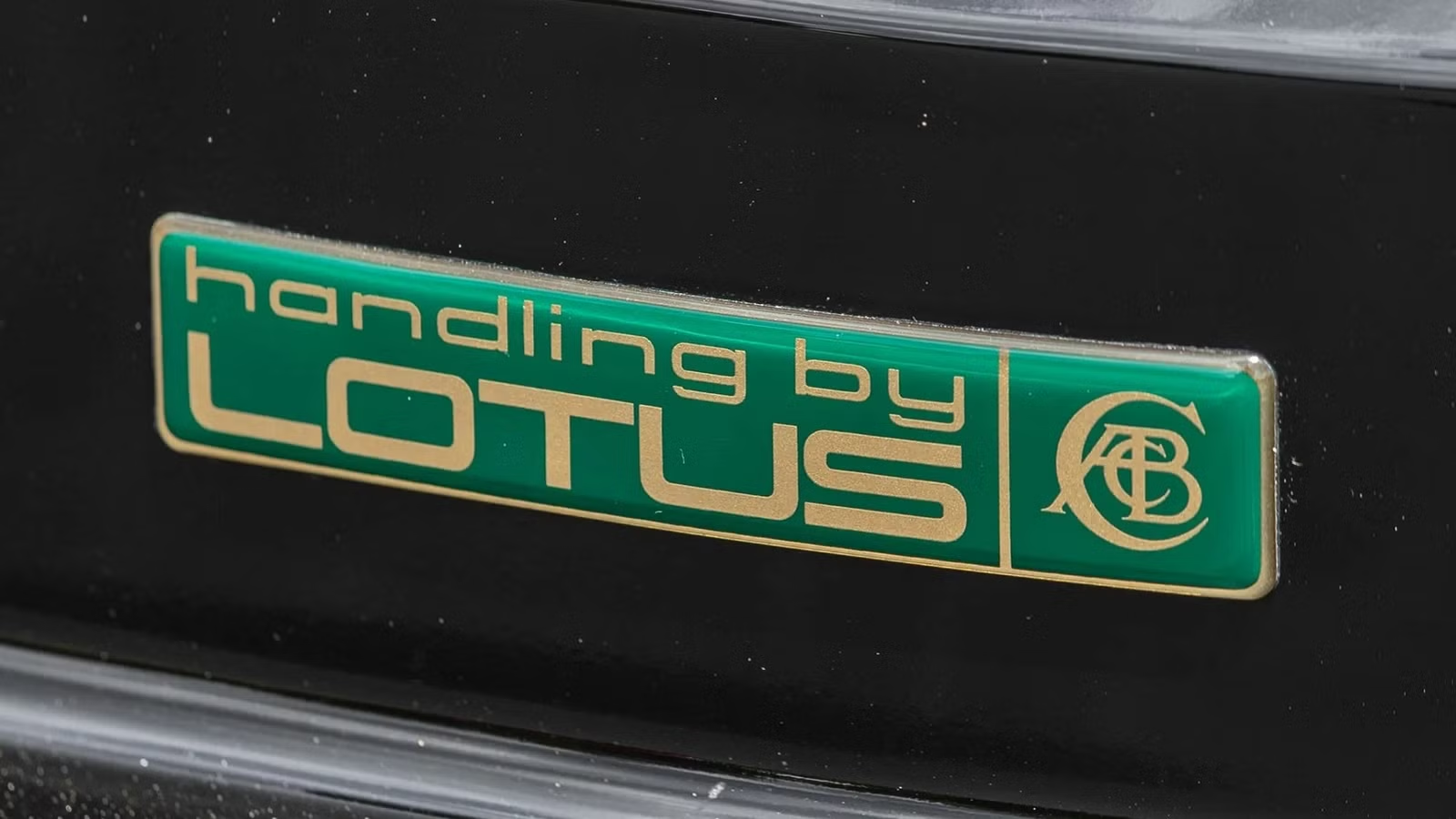
Now, the real enthusiasts out there will know the Isuzu Piazza/Impulse Turbo featured handling tuned by Lotus. That was courtesy of General Motors, which held a stake in Isuzu and, between 1986 and 1993, had control of Lotus. It’s a similar story to what led to the legendary Lotus Carlton, and the considerably less legendary Proton Jumbuck.
For the successor to the first-generation model, Lotus once again got involved with tuning the chassis. The Isuzu Impulse RS Turbo arrived in 1991, with suspension geometry sorted by the British sports car manufacturer, aiming to bring an involved edge to the handling.
It was powered by a turbocharged 1.6-liter four-cylinder engine paired to a five-speed manual gearbox, with that engine later finding its way into the Lotus Elan M100.

While many of its theoretical rivals had power figures well north of 200 horsepower, the Impulse didn’t have close to that. These cars produced 160 hp and 150 lb-ft of torque, allowing for a 0–60 mph time of around seven seconds and a top speed of around 135 mph. Really, it was positioned closer to the Honda Prelude, Mitsubishi Eclipse, and Toyota Celica.
It Majored On Tech, Too

Despite its relatively tame performance, the Isuzu Impulse RS Turbo had some pretty impressive technology packed into it. Although the base Impulse was front-drive, the RS Turbo used a full-time all-wheel drive system with a viscous-coupling center differential, with a rear-biased 43:57 torque split. It also featured rear-axle steering, which Japanese manufacturers seemed very keen on incorporating into their sports cars at the time. See also the Honda Prelude and the R32 Nissan Skyline GT-R.
While its predecessor had been penned by Giugiaro independently of Isuzu, the design of this new model was brought in-house and led by Shiro Nakamura. He would later depart for Nissan, and became involved with the design of the 350Z and R35 GT-R.
In a way, the Isuzu Impulse was like a precursor to the spirit of the Subaru WRX STI, only it came before that car existed and never quite burrowed its way into the consciousness of enthusiasts. So, why has nobody heard of it?
Few Were Sold, And Barely Any Survive

It was an exceptionally rare car. In the US, just 600 examples of the Isuzu Impulse RS Turbo were sold, and it was on sale for just one model year before Isuzu decided to turn its business away entirely from producing sports cars. That means the Impulse RS Turbo holds the very niche distinction of being the manufacturer’s last effort at appealing directly to enthusiasts. Time may have been kind to the driving experience, but reviewers at the time never had anything particularly glowing to say about the Isuzu RS Turbo.
Compared to the Mitsubishi Eclipse GSX, Eagle Talon, Plymouth Laser, and Toyota Celica, it never shone in road tests yet never became known as a disappointment. Rather, it just existed, which perhaps explains why many enthusiasts overlooked it, and it became such a niche model.
Today, it’s an even rarer beast, with estimates suggesting that just 130 examples of the coupe remain on US roads. That’s roughly the same number as the Bugatti Chirons believed to be in the country, for context of just how scarce that makes it.

If you can find one for sale, the asking prices might surprise you. A near-mint, 27,000-mile example sold on Bring a Trailer in 2024 for $18,940, which may sound like a lot for an old Isuzu but places it below the asking prices of many of its contemporary rivals today, and even a relatively new Honda Civic. Just take a look at this later Eagle Talon, for example, to see how much this era of coupe can go for.
For a car that almost nobody knows, and that you’re almost certain to never come across on the road, that might be a price worth paying if you want something unusual. We think there’s a close alternative that might be more worthwhile, though.
Should You Buy Its Predecessor?

Now, on to the first-generation Isuzu Impulse RS Turbo. In a way, this car is a bit like a turbocharged Toyota AE86 thanks to its rear-driven setup, 2.0-liter engine, and even a standard-fit limited-slip differential.
Compared to the regular Turbo, the RS also had larger anti-roll bars, higher spring rates for its Lotus-tuned suspension, and wider tires from the factory. It was also available exclusively with a manual transmission, for a bit of extra kudos. It will likely be slower than the later Impulse RS Turbo, but it’s almost certainly more fun to drive, thanks to its rear-wheel-drive setup and slightly more primitive character overall. It still featured air conditioning and pop-up headlights, so what more could you want?
It’s not known exactly how many examples of the first-generation Impulse RS Turbo made their way Stateside, but there aren’t many left, and they’re certainly cheaper than the later car. Like this 1986 model selling earlier in 2026 for $8,600. You could go further back still and consider importing an Isuzu 117 Coupe from Japan, but expect to pay north of $20,000 all in and deal with an even harder parts-sourcing challenge should things go wrong. All that, plus the small matter of these models being exclusively right-hand drive — although that would earn you considerable attention at any JDM meet.
Sources: Bring a Trailer

Related posts




Latest Post


No Comments