How Much It Costs To Replace A Toyota Corolla Cross Hybrid Battery In 2026
9 minutes reading
Monday, 27 Jul 2026 11:00 0 7 autotech
Now that hybrid car demand is soaring to new heights in 2026, there are a lot of consumers asking what they can expect from these vehicles over long-term ownership. Hybrids are typically more reliable than conventional ICEs, because manufacturers fit them with more resilient engines that don’t handle the full driving load thanks to the integrated electric motor. This means that the powertrain is subject to less stress, which leads to improved longevity. The electrical system in your typical HEV uses compact lithium-ion or nickel-metal hydride battery packs with much lower capacities compared to PHEVs or fully electric vehicles, which is why hybrids can’t operate on electricity alone.
Despite their improved reliability standards, HEVs are still subject to wear, with the battery pack being the most expensive component that requires replacement, typically after 200,000 miles. An advantage of modern hybrids is that the replacement battery technology is substantially more affordable compared to when these hybrids first arrived on the U.S. market. This remains true, even if you factor inflation into the equation. Most brands that have focused on EVs these past few years have incorporated their electrification and battery technology down into their hybrids, resulting in better efficiency, reliability, and combined performance. If you are in possession of a hybrid and have surpassed the 200,000-mile threshold, these are some issues that you may encounter.
A hybrid vehicle’s battery capacity gradually declines due to a combination of chemical degradation and usage patterns. This degradation is completely dependent on the vehicle and how much it has been driven, but the symptoms will remain the same across the segment. With time and use, the lithium-ion or nickel-metal hydride cells within the battery pack experience wear as a result of repeated charging and discharging cycles. This causes the electrodes to deteriorate and the electrolyte to break down. Factors like high temperatures, rapid acceleration, and frequent deep discharges accelerate this process.
An HEV’s battery management system plays a role in regulating voltage and temperature, but as the cells age, this system becomes less effective at balancing the charge between individual cells, leading to uneven wear. After 200,000 miles, a hybrid battery typically loses between 20 and 30 percent of its original capacity, depending on driving habits and environmental conditions.
Toyota’s Industry-Leading Hybrid Strategy
2012 — 2014 Toyota Camry Hybrid Front Three-QuarterToyota
When it comes to gasoline-hybrid technology, it’s very difficult not to think about the Toyota brand first. While Honda technically was the first company to introduce the technology with the first-generation Insight, Toyota led the way for the technology’s development. The Japanese brand has always maintained a high level of commitment to hybrids, led by the Prius, but popularized by models like the Corolla, Camry, and RAV4.
Toyota’s philosophy has always been to incorporate multiple fueling methods, including hydrogen, diesel, and electricity. Hybrid models have increasingly become the driving force of its modern catalog, with the 2026 Camry and RAV4 being available exclusively with its new-generation HEV drivetrains. Toyota backs its technology with a comprehensive warranty that covers all hybrid components for eight years and the battery for 10 years. Consumers recognize the brand’s dedication to the more efficient drivetrain technology and have responded favorably. Over the last few quarters, the brand has reported considerable interest in its hybrid models, and more car owners seek to lower their monthly fuel bill.
How Much A Battery Replacement For A Corolla Cross Hybrid Costs
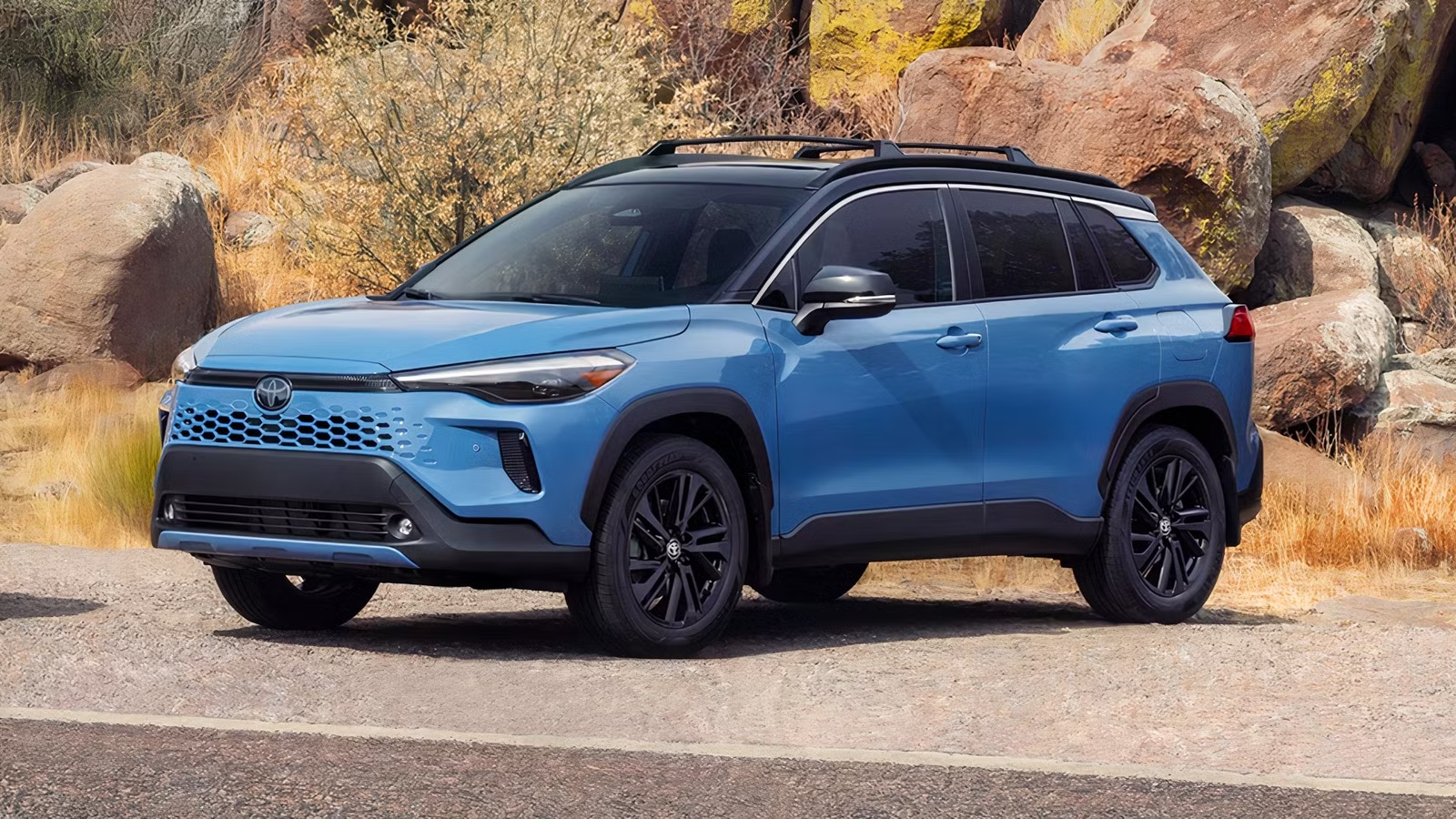
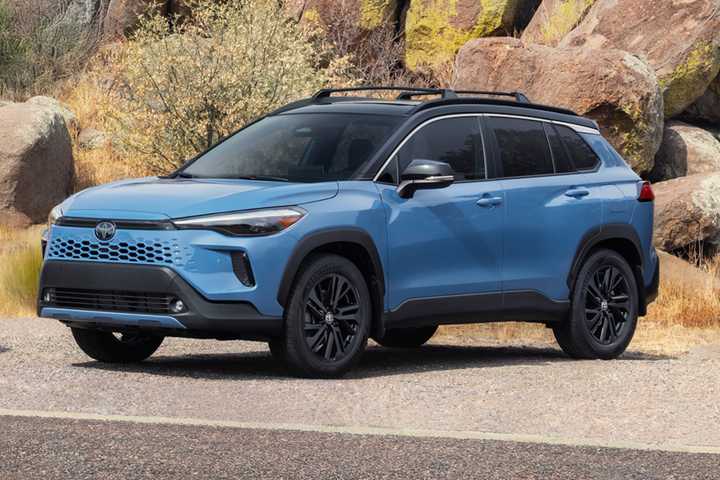
Front 3/4 shot of 2026 Toyota Corolla Cross Hybrid parkedToyota
Toyota offers a very comprehensive online parts catalog for all of its models, but unfortunately, it does not list the 2026 Toyota Corolla Cross Hybrid’s replacement battery pack, so there’s no way for us to tell you how much this part will cost you directly from the manufacturer. Based on online testimonials and information provided by some dealers, you can expect to pay somewhere around $3,000 to have the HEV battery pack replaced when the time comes.
Bear in mind that Toyota’s HEV systems last for years, with some owners declaring their packs to still be going strong after well over 15 years or 150,000 miles of driving. Toyota covers the Corolla Cross Hybrid’s entire HEV battery pack for any manufacturer-related defects over a 120-month or 150,000-mile period, while all related systems will be covered for 96 months or 100,000 miles, reflecting the Japanese brand’s commitment to its tried-and-tested gasoline-electric hybrid drivetrain technology.
Appealing Long-Term Running Costs Beyond The Battery
According to Edmunds, a Toyota Corolla Cross Hybrid ownership experience can cost you $30,414 over five years and 60,000 miles. This includes $3,381 on maintenance, $601 on repairs, and $8,401 on depreciation. CarEdge indicates that the average five-year ownership experience of the entire range comes in at $37,059, which includes spending $9,940 on depreciation, $7,220 on fuel, and $1,873 on maintenance.
Beyond the initial purchase price, the Toyota Corolla Cross Hybrid’s long-term ownership costs reveal that even mainstream automotive experts routinely undersell just how affordable it is to operate over an extended ownership experience. Kelley Blue Book projects a five-year total cost to own of $52,133 for the Toyota Corolla Cross Hybrid, even if you calculate a $13,397 loss strictly to depreciation.
2026 Toyota Corolla Cross Hybrid XSE front 3/4 shotAmee Reehal | TopSpeed
It’s also a strong hybrid crossover if you are looking for long-term value retention. iSeeCars reveals that after five years of ownership, the hybrid crossover will lose $8,810 or 30 percent of its value, which is a bit better than the current average for the segment. This result effectively proves that traditional formulas can fail to capture the compounding financial benefits of good fuel economy paired with proven mechanical reliability.
J.D. Power gives the Toyota Corolla Cross range an 80/100 consumer-verified overall score, which includes 79/100 for quality and reliability, 75/100 for the driving experience, 88/100 for resale, and 78/100 for the dealership experience. iSeeCars gives the same model with an 8.8/10 retained value rating, indicating that the model will lose $9,918 or 34.8 percent of its value in five years, which is somewhat lower than most of its key rivals. The Toyota Corolla Cross Hybrid’s value retention performance results in it developing a reputation for being a long-term commitment that yields good financial returns. This is a factor that works in its favor, as dependability becomes rarer across the broader automotive landscape.
The Corolla Cross Hybrid’s Price Puts Battery Costs Into Perspective
2026 Toyota Corolla Cross Hybrid XSE dashAmee Reehal | TopSpeed
The 2026 Corolla Cross Hybrid range starts at $29,595 for the entry-level S trim. The SE follows this with a $30,915 price tag, followed by the flagship XSE at $33,630. This strategy makes the range a competitively priced model that should appeal to most new car buyers wanting a balanced hybrid vehicle. These prices exclude Toyota’s $1,450 delivery, processing, and handling fee. The Corolla Cross sits on the same TNGA-C platform used by the sedan and hatchback models. It’s also a locally built model, with production taking place at the brand’s Huntsville, Alabama, plant.
2026 Toyota Corolla Cross cargo holdToyota
The Corolla Cross Hybrid is the Japanese brand’s most affordable hybrid crossover option, aimed at first-time buyers who frequent urban and suburban driving environments. It’s an ideal counterpart to the Corolla sedan and hatch range, but benefits from the brand’s more advanced gasoline-electric hybrid technology without the burden of a heftier starting price.
Efficient And Dependable Engine Technology Forms The Foundation
Close-up shot of 2026 Toyota Corolla Cross Hybrid engine bayToyota
All four Corolla Cross trims feature Toyota’s naturally aspirated 2.0-liter four-cylinder Atkinson engine and triple electric motor configuration, which made its first appearance in the current-generation Prius. A direct-drive eCVT transfers a combined 196 horsepower and 152 pound-feet to all four wheels, resulting in a claimed 0-60 MPH time of 7.3 seconds. Independent tests confirm this claim is accurate in real-world conditions.
The engine and two electric motors power the front wheels, while a third motor positioned at the rear completes the all-wheel-drive configuration. The 196-horsepower hybrid system delivers something more valuable than acceleration: 445 miles per tank means NYC to D.C. without stopping for fuel.
In isolation, the ICE generates 169 hp and 152 lb-ft. The front electric motors produce 110 hp, while the rear produces 40 hp and 62 lb-ft. Toyota does not disclose a combined torque figure, so the total torque is not available. Compared to ICE crossovers, it’s not the most capable hauler, but you can tow up to 1,500 pounds if you fit the optional Activity Mount.
Fuel Efficiency Is Its Strongest Suit
2026 Toyota Corolla Cross blue hybrid model and red regular model driving in opposite directions on a roadToyota
The Corolla Cross Hybrid also enjoys the benefit of being one of the most efficient hybrid crossovers currently available in the new car market, with its 46/39/42 MPG city/highway/combined EPA estimates. The 0.9-kWh battery pack means that the drivetrain offers limited EV-only driving capability. It’s a typical hybrid system that acts as a supplementary drivetrain to reduce power losses and lower the internal-combustion engine’s load, resulting in good fuel economy returns. Despite this, it will cover a very impressive 445 miles from a single 10.6-gallon tank.
The Corolla Cross Hybrid’s low fuel cost is another appealing factor. The EPA indicates that you will save $3,750 in fuel cost savings over five years compared to the average new vehicle currently being sold in the U.S. You can also expect to spend $1,400 on fuel every year and $2.38 to drive 25 miles. A full tank of gas will cost around $42.
Toyota’s SUV-Focused Strategy Is Paying Off
2026 Toyota Corolla Cross Hybrid Front QuarterToyota
Toyota’s strategy in the U.S. for 2026 continues to center on a multi-pathway approach. The Japanese brand prioritizes a diverse lineup of crossovers and SUVs that cater to varying consumer needs rather than pivoting exclusively to battery-electric vehicles. This strategy has proven exceptionally successful. As of the first quarter of 2026, the brand’s hybrid vehicles accounted for over 50 percent of total sales volume. This is a milestone that reinforces their market dominance. Sales of their most popular compact and midsize utility models remain at historic highs.
Specific off-road-focused entries saw year-on-year surges as high as 84 percent for ICE variants and even more dramatic triple-digit growth for their hybridized counterparts as new generations reached dealerships. Toyota introduces hybridization as a core powertrain pillar, often making it the standard or exclusive offering for high-volume models to normalize the technology. By integrating planetary gear-based power split devices and high-capacity lithium-ion batteries across its catalog, the brand offers a seamless driving experience that requires no change in consumer behavior. Toyota’s choice to standardize hybridization effectively captures 37 percent of buyers who prioritize long-term resale value and low maintenance costs over the early adoption of fully electric platforms.
Base Trim Engine
2.0L Inline 4
Base Trim Transmission
CVT
Base Trim Drivetrain
Front-Wheel Drive
Base Trim Horsepower
169 HP @6600 RPM
Base Trim Torque
151 lb.-ft. @ 4400 RPM
Make
Toyota
Model
Corolla Cross
Segment
Subcompact SUV
Sources: Toyota, iSeeCars, CarEdge, J.D. Power, Kelley Blue Book, and the EPA.








No Comments