
The 8,000-RPM Mitsubishi Coupe America Was Never Allowed To Buy
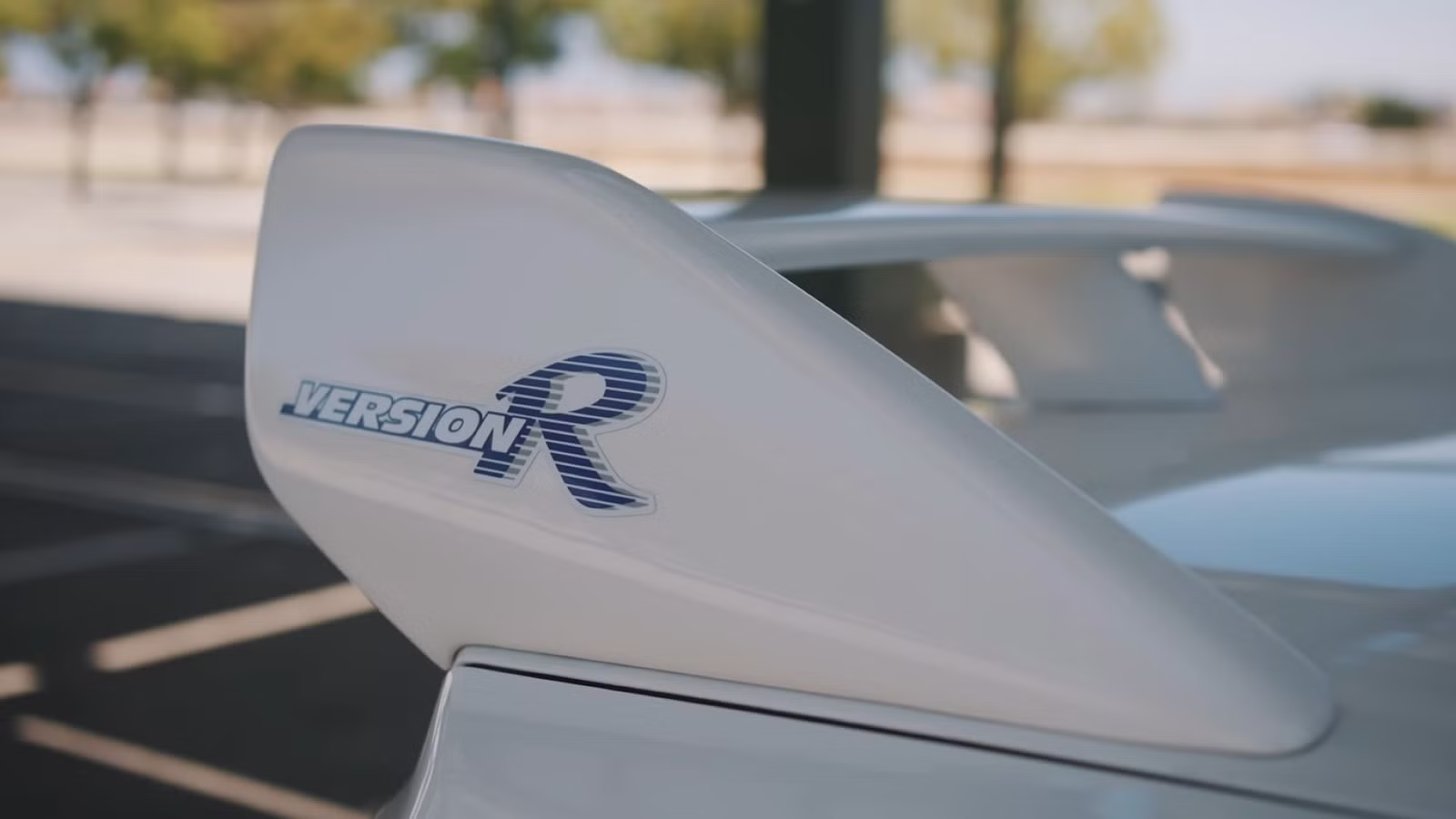
If the ’60s belonged to muscle cars, then the ’90s were all about JDM. Japanese car manufacturers were creating more hype than a Pokémon convention giving out free stickers, and buyers couldn’t get enough. A blend of feisty engines, reliability, and all out fun, meant that cars from the Far East were in many ways the new muscle cars, democratizing performance for the masses. But not every acclaimed JDM car was an instant cult classic, with one in particular slipping through the cracks and failing to get much love on the collector market. A strange thing, as it was one of the best.
In The Late ’90s JDM Coupes Were Taking Over

We are obsessed with asphalt-crushing SUVs these days, but the ’90s were very much a coupe thing. Way before manufacturers were falling over themselves to make every vehicle on the lot look like it was ready for the Paris-Dakar, there was a huge demand for svelte two-doors. While the Europeans had a good shot at this market, with cars like the quirky Fiat Coupe and the pretty Peugeot 406 Coupe, the Japanese carmakers seemed to excel in this kind of vehicle. The Honda Prelude and Integra Type R, the Mitsubishi Eclipse GSX, the Nissan Skyline GT-R – they were all different takes on the coupe theme, but all hit the bullseye.
Mitsubishi Was Looking At A Real-World Follow Up To The 3000GT

Mitsubishi brought the 3000 GT — known as the GTO in Japan — to the market in 1990, with mixed reviews (reflected now in the prices). The 3000 GT tried to do everything, making it a brutish muscle GT (with a twin-turbocharged 6G72 3.0-liter V6 engine that pumped out 300 horsepower and 308 lb-ft of torque), a rally car (using Viscous Realtime 4-wheel drive), and packing it full of luxury and tech like active aero, all at the same time. The 3,810-pound monster was capable enough, but couldn’t quite hide its bulk, and while grippy, it wasn’t exactly a lithe and delicate tool. Mitsubishi decided to have another go, this time with a far more humble car. But that didn’t mean it wasn’t any good.
The GP Version R Was The Stripped-Out Track Weapon Mitsubishi Never Sent To America


The sharp-looking FTO arrived in 1994, borrowing its acronym from one of Mitsubishi’s earliest sports cars: the 1971 to 1975 Galant FTO. The letters stood for Fresco Turismo Omologato, or Fresh Touring Special, or something along those lines. There was a choice of a slightly dull 1.8-liter SOHC four-cylinder or a zingy 6A12 2.0-liter DOHC V6 that produced 168 hp at 7000rpm or 197 hp at 7500rpm when fitted with Mitsubishi’s MIVEC variable valve timing system.
Your mom’s electric Chevy Bolt has more power than that in 2026, but in the early ’90s, that kind of output was a big deal. The FTO was JDM only, and since all JDM cars have a duty to have at least one rare, fast version with a strange name that no one has ever heard of, Mitsubishi duly obliged with the FTO GP Version R. It was faster, lighter, and more focused. What’s not to love?
The GP Version R Was A Lightweight Integra Type-R Challenger

Some coupes of the ’90s were great-looking but were often just two-door versions of hatchbacks or sedans. The FTO may have been related to other Mitsubishi models, but the platform was tuned to make the FTO a legit sports car. Weighing in at around 2,645 pounds and with an available five-speed manual, the FTO was light and nimble.
The GP Version R, which was based on the GPX (fitted with the 197-hp MIVEC V6), turned the FTO up to 11. It was turned into a Type-R fighter by adding thicker anti-roll bars (20mm at both ends), Torsen limited-slip differential in later cars, HID headlights, a new spoiler, and an updated interior. To save around 100 lbs, Mitsubishi binned the radio, sound deadening and air conditioning, as well as the power mirrors and fog lights. The Version R was available in red, black, or white.
The FTO Is A High-Revving Argument For FWD
With such a light package, 197 hp and 147 lb-ft were good for hitting 60 mph in around seven seconds and a top speed of around 140 mph. But it was the way the engine sung that made the GP Version R special. The redline is around 8,200 rpm, with peak power in one of the smallest V6s ever arriving at a strung out 7,500 rpm. We may dismiss FWD in sports cars these days, especially when power outputs in most performance cars exceed 300 hp, but in the ’90s this layout worked a treat.
The FTO looked purposeful and taught, like the body was stretched over a frame, making it the perfect starting point whether you were tuning it on the road or a video game. The handling was acclaimed as being razor-sharp, and the engines free-revving. In a world where we now have to rely on electric gismos everywhere and hybrid or turbo assistance, the FTO Version R seems like a hero from another dimension.
Here’s Why The FTO Version R Disappeared From The History Books

One of the first things to note about the FTO is that it is a grey import market only, having only been sold in Japan (with a few official exports apparently to Australia). But this doesn’t always mean that a car slips under the radar; there are plenty of JDM-only special editions that have gone on to become legendary.
The problem for the FTO was that it arrived in the midst of Lancer Evo fever, so it was overshadowed by its all-wheel-drive, turbocharged sedan siblings. While Mitsubishi’s MIVEC variable valve timing system was clever, it also didn’t gain the acclaim of Honda’s VTEC, which was always associated with the Type-R specials. Finally, Mitsubishi only made 542 of the top-flight GP Version Rs, meaning it was always going to be something of a unicorn.
The Version R Undercuts The Competition In 2026

Despite their rarity, despite their Integra Type-R battling abilities, despite that cool V6, the Version R still undercuts its Honda rival when it comes to price. According to Hagerty, a good condition 1995 Honda Integra Type-R will now cost $31,800. Let’s be honest — getting hold of the rarest JDM-only FTO isn’t going to be easy, but there is one Version R on Goo-net-exchange.com with around 120,000 miles and a price of $9,903. Obviously, you still have to import the car, with the various costs and risks involved, but if you can, you will have a cool, forgotten JDM hero that will stand out at meets. Standard FTOs go for even less, with Carfromjapan.com listing some for as little as $7,000. If you can get a good one, the FTO might just be one of the best forgotten JDM bargains out there.
Sources: Hagerty, Goo-Net-Exchange, Car From Japan, Mitsubishi

Related posts



Latest Post


No Comments