
The Fast Hybrid That Doesn’t Punish You At The Pump
Hybrids, or hybrid electric vehicles (HEVs), were primarily made for efficiency, but depending on how they are developed, adding a hybrid system can also boost performance. That’s especially true in today’s world of hyper-efficiency, while also improving performance every time a vehicle gets completely redesigned.

Today, we’ll be focusing on hybrids only and not plug-in hybrids. Unfortunately, there are no more hybrid sports sedans without a plug, and they are also mostly from European automakers. Without further ado, here’s the fast hybrid that offers fun while delivering commendable fuel economy relative to its performance.
The Physics Behind Why The RX 500h Feels Faster Than A Pure Gas SUV
If you’re looking for the most analog experience from a car, then a hybrid won’t capture your interest. But if the best use of an engine is what you’re after, I’ll explain to you why an electric motor augments the performance of an internal combustion engine (ICE).
Why A Gas Engine Alone Can’t Deliver Instant, Relentless Power


ICEs may be emotional due to the vibrations, the linear (when well-tuned) power delivery, and the sound it makes. The last item, in particular, is only applicable to a small percentage of ICEs, since the vast majority don’t produce the best noises. Anyway, outside these three emotional and subjective aspects, an ICE doesn’t have a broad power band compared to an electric motor, and is less energy efficient. The former is why you see in spec sheets that peak horsepower and peak torque are only produced in a narrow power band. As for the latter, did you know that up to around 20 to 30 percent of fuel in an ICE is turned into mechanical energy? More than half of that energy is what you feel in the engine bay as heat.
To combat these shortcomings, an ICE’s narrower power band versus an EV is addressed by using a multi-speed transmission (whether it’s automatic or manual) so that you’ll only be driving within the engine’s optimal rev range. Regarding an ICE’s energy efficiency, automakers continually work on improving what’s called thermal efficiency. Today, it is Geely that has the most thermally efficient ICE in a production car at 48.41 percent, meaning that when gasoline is combusted, 48.41 percent becomes actual energy. Impressive, but considering that the ICE has been around for more than 100 years, the improvements in thermal efficiency have been very incremental—perhaps a sign that we’ve nearly reached the peak of ICE energy efficiency.
How An Electric Motor Fills The Gaps A Transmission Can’t

By contrast, an electric motor does not suffer from the limited power band and the much lower energy efficiency of an ICE. Because of its much wider power band, an electric motor needs only a single-speed transmission, and this wide power band is why EVs have instant and meaty torque. As for energy efficiency, permanent magnet synchronous motors (PMSMs) used in EVs today can reach 97 percent efficiency, according to FluxSpeed, meaning more of the battery’s electrical energy is converted into mechanical power to propel an EV.
But Isaac, why do EVs need far bigger batteries to travel far, while an ICE’s fuel tank is a lot smaller to achieve a similar feat? Well, that’s no longer due to energy efficiency, but energy density. According to EnerLogic, gasoline contains 34 MJ per liter or 9.5 kWh of chemical energy. But remember, ICE efficiency is only 20 to 30 percent energy efficient on average, so in kWh, that’s only 2.5 to 3 kWh actually reaching the wheels. What batteries need to achieve in the coming decades is higher energy density, and that’s what all-solid-state batteries (ASSBs) are aiming to achieve.

Combine the positive traits of an ICE and an EV, and hybrids can indeed help improve an ICE’s performance. It’s exactly why, when the so-called “holy trinity” of hypercars—the McLaren P1, the Porsche 918 Spyder, and LaFerrari—were born, automakers realized that an electric motor can compensate for the deficiencies of an ICE. Electric motors improve an ICE’s responsiveness as well, and also fill in the gaps of the power band when the transmission upshifts during acceleration. This is exactly what I also felt driving the Porsche 911 Carrera GTS T-Hybrid side-by-side with the standard 911 Carrera, which can help you understand how electric motors make ICEs feel more responsive and relentless.
Lexus Evolves Its Hybrids For Performance

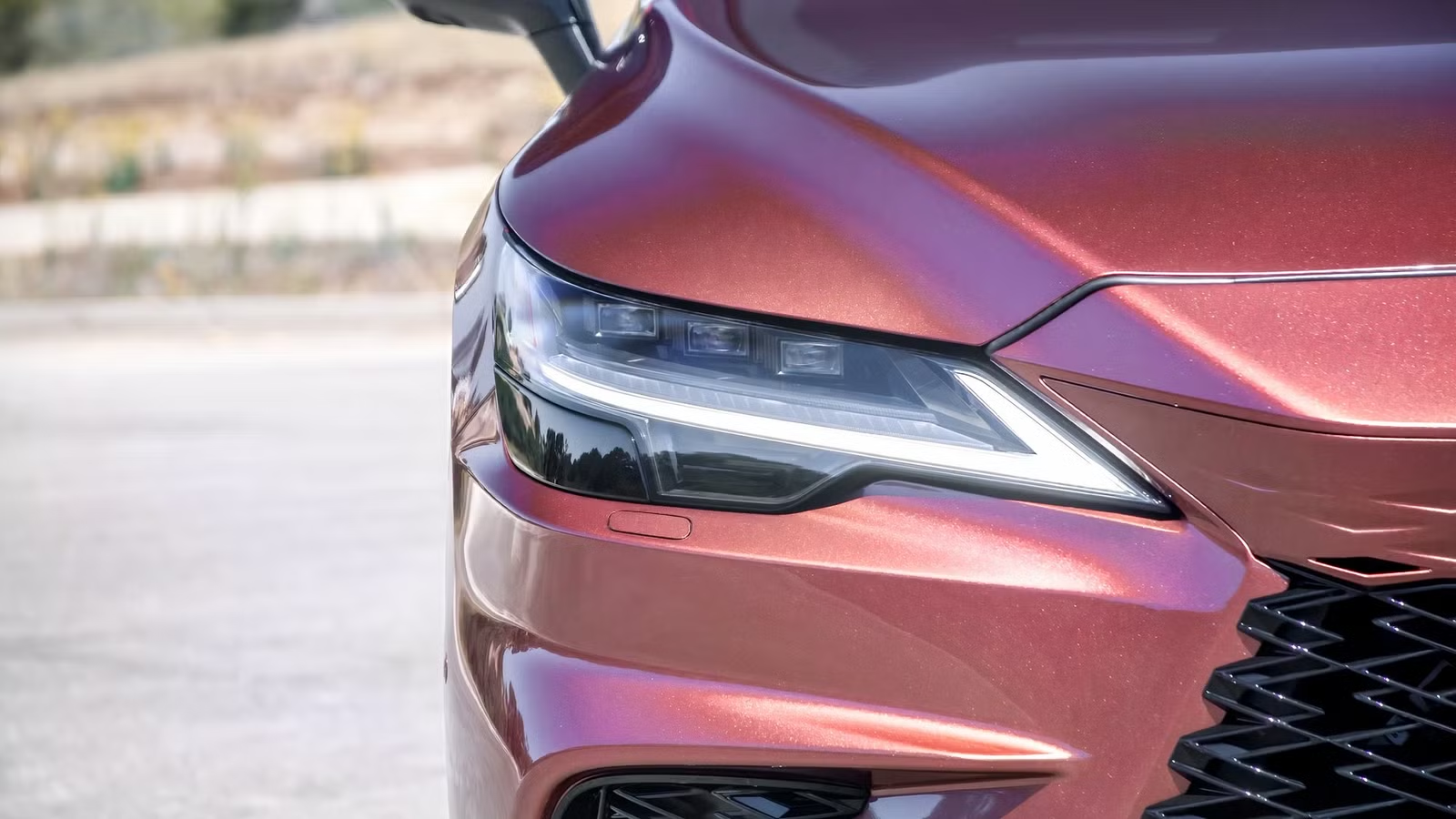
Today, if you want a (non-plug-in) performance hybrid that improves both performance and efficiency, the 2026 Lexus RX 500h F Sport Performance is a perfect fit for you. It’s a luxury SUV that I’ve also personally driven and reviewed, and so here’s why this thrilling yet efficient performance hybrid is worth a look.
How The RX 500h Beats A BMW X5 On Ride Quality While Staying In The Fight On Dynamics

The Lexus RX has never really been known for sportiness, especially when compared to the likes of the BMW X5. But with the RX 500h F Sport Performance, Lexus offers a balance between athleticism and sportiness. Unlike most Lexus models that use a 2.5-liter four-cylinder series-parallel hybrid with a planetary gear eCVT, the RX 500h F Sport Performance uses a 2.4-liter turbo four-cylinder with an electric motor integrated into the six-speed automatic in a parallel arrangement. A pure parallel hybrid is what’s best for providing a sporty driving experience, especially if you still want to retain linear power delivery and the engagement of a multi-speed transmission.
The numbers are healthy: 366 horsepower and a 0–60 mph time of 5.9 seconds, according to Lexus. These won’t blow away the X5 plug-in hybrid’s 4.6-second 0-60 mph time, but that’s plenty quick enough to be thrilling. And being an F Sport Performance model, I thoroughly enjoyed that it retained the signature Lexus supple ride quality while adding just the right dose of sportiness. The Adaptive Variable Suspension (AVS) in its stiffest Sport setting still provides reasonable plushness over bumps.

When pushed into corners, a BMW X5 offers more grip and less body roll, but the RX still feels confident and grippy enough to remain both plush and athletic. Lexus takes pride in its Direct4 electronic all-wheel drive (AWD), wherein it offers true torque vectoring for the rear electronic axle. The way the RX goes through and powers out of corners feels natural and confidence-inspiring—undoubtedly also helped by its subtle rear-wheel steering. The six-speed automatic, even through the paddles, is very smooth, but lacks the snappy feel in Sport mode that an X5 PHEV’s ZF eight-speed auto can provide. The same goes for the engine note, which is half synthetic and half real, but it sounds nice and authentic enough to keep the feature turned on.
Plus, It’s Surprisingly Efficient

Of course, your main motivator for getting the RX 500h F Sport Performance is its blend of performance and fuel economy. Now, with a 2.4-liter turbo four-cylinder and six-speed automatic, don’t expect it to be at the top of the hybrid efficiency rankings. Versus the highly popular RX 350h’s EPA-rated 36 MPG combined efficiency, the RX 500h F Sport Performance is EPA-rated at 27 MPG. Sure, that’s not impressive in outright hybrid terms, but compared to the purely gas-powered RX 350’s 24 MPG, I know which model I’d rather take. Plus, the RX 350 only produces 275 horsepower versus 366 for the RX 500h F Sport Performance.
What The RX 500h F Sport Performance Offers
If you’ve reached this far into the article, then you’re probably considering the 2026 Lexus RX 500h F Sport Performance already. With a base price of $68,450, the RX 500h F Sport Performance is not cheap, but here’s why it’s worth it.
Sporty Yet Elegant Exterior

The current-generation Lexus RX arrived in dealerships in late 2022 for the 2023 model year, meaning this is now a vehicle we’ve been seeing for the past four years. Despite that, the RX, in my opinion, still looks fresh. As the pinnacle of the RX range, the F Sport Performance elegantly integrates sporty elements into its sleek shape. Does it look distinct, though? In isolation, yes, the RX already has a distinct identity, but due to its sheer popularity as the bestselling Lexus, you’ll find an RX in almost every upmarket shopping mall or neighborhood.
The Spindle Grille has evolved into the Spindle Body, in which its body-colored grille blends well with the RX’s rakish silhouette. The sportier bodywork is matched with 21-inch 10-spoke wheels in gloss black. If there’s a minor drawback in this version of the RX, it would be that it needs more distinction from the standard F Sport version of the RX 350h, just so you could somehow showcase that what you’re driving is the performance-oriented version of the RX lineup. But if you want more distinction, Lexus offers an optional Appearance Package, which adds a body kit, more aggressive five-spoke 21-inch wheels, orange brake calipers, and more blacked-out trim.
Sumptuous Interior Feel

Thankfully, the RX’s interior is as exquisite as its exterior design. For the 2026 model year, the RX’s interior gets upgraded with a new 12.3-inch digital gauge cluster as standard. Other standard features for this range-topping RX 500h F Sport Performance include a wireless charger, a panoramic glass roof, electronic door handles, LED ambient lighting, perforated leather upholstery, dark graphite aluminum interior trims, and a 12.3-inch version of the Lexus Interface infotainment system, just to name a few. The Mark Levinson surround sound system is worth the upcharge.
As for the overall interior itself, the materials used are of a luxurious quality. German luxury brands these days tend to have mixed interior quality, especially as they focus too much on screens and interior gimmicks. Nevertheless, the RX’s interior is still one of the nicest in the luxury segment despite its age, especially with its use of matte textures where it matters most. The gloss black bezels surrounding the displays are the only detractors in an otherwise exquisite interior.
Sources: Lexus, The EPA, KBB

Related posts





Latest Post




No Comments