
The Electric Car That Makes Range Anxiety Feel Outdated
Electric vehicle range has always been a subject of much consternation. It’s the single biggest selling point of an electric vehicle, but it’s also a compromise between price and real-world usability. The solution is pretty simple—if you want more range, you need a bigger battery, and the price of the vehicle usually rises directly with the price of the battery—but arriving at that solution is a bit more involved, considering powertrain configuration, technological calibration, thermal management and regenerative braking, all of which also drive price upward.

But there is a shift, with manufacturers investing more in the software side of things. That said, if you want 400+ miles of range, you’re still going to have to pay in excess of $75,000 and sometimes close to $150,000. However, buyers can find models at more accessible prices that will get them closer to that 400-mile threshold. And with today’s technological developments in charging speeds and strategies, as well as the expansion of charging networks, range anxiety is increasingly becoming a distraction, rather than a worry.
The Balance Between EV Price And Range
Battery size remains the most-used range-shaping tool in the EV shed, and it still dictates much of a vehicle’s cost structure. Put plainly and simply, if you want a lot more range, you need a bigger battery, and you’re going to pay for it. But increasingly, manufacturers are looking at other options to eke out more range from fewer battery cells, meaning that a buyer may still need a bigger battery, but not as large a battery as would have been needed even five years ago. And, yes, it may still cost a bit of a premium.

The problem was that bigger batteries gave you more range, but they also required more raw materials, increased cooling complexity and a more rigid platform, which also required more materials. And buyers mostly sat by and watched costs add up. Then, the extra weight of the batteries and platform, and other associated hardware, inherently reduced the efficiency of the vehicle, meaning owners were also going to pay more to operate it. Increasing battery size does not directly increase driving range.
EV Engineering Goes As Far Toward Increasing Range As Battery Size

Once manufacturers moved beyond addressing range anxiety with larger batteries to promote EV adoption, the business began to shift toward efficiency engineering—aerodynamic design, low-rolling-resistance tires, motor optimization, and more sophisticated regenerative braking systems—as a means of improving range, easing range anxiety, and making EV buyers feel more comfortable replacing their ICE vehicles.
That allowed buyers to concentrate on the things they have traditionally thought about—this sleek car is more efficient, but I prefer the more traditional looks of that one; this AWD model is more powerful, but the RWD variant will go farther and need to be charged less often. In the process, EVs became more mainstream because two vehicles with similar battery sizes and motor outputs could have dramatically different real-world usability.
How Charging Times Help Address Range Anxiety

Charging is the other variable in assuaging range anxiety. Granted, buyers will always look at how far an EV can go in deciding if that range is acceptable, but if long trips are a motivating factor in considering an EV, then fast charging becomes an equally important consideration, because a vehicle that can recover 80% of its battery charge faster reduces the downtime during those long trips and can theoretically eliminate the need for longer basic range in the first place.

To sum up, longer range is dependent not on a larger battery alone, but on a balance of battery size, motor efficiency, thermal management, energy recapture, fast charging speeds, and access to charging stations. Potential EV owners whose range anxiety is mostly triggered by battery size and the cost associated with it can today find relief through more attainable, more efficient electric cars like this one.
The 2026 Mercedes-Benz CLA 250+ Is An Attainable EV With Impressive Range
Rated At 374 Miles; Could Reach 400 Miles In Ideal Weather, Driving Conditions

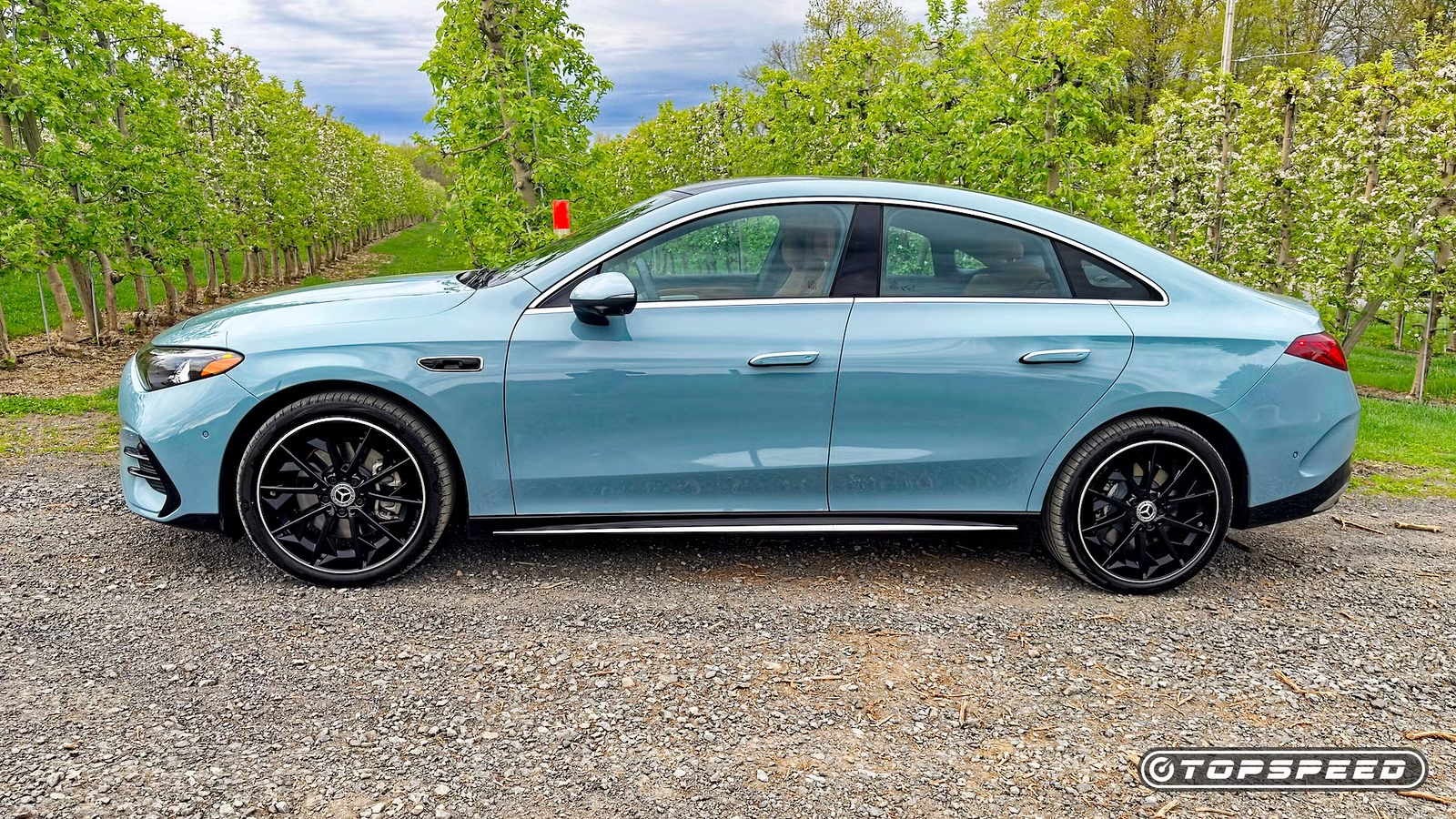
The 2026 Mercedes-Benz CLA 250+ with EQ Technology is an entry-level luxury car that proves you don’t have to pay big bucks to get a decent range. Rated by the EPA at 374 miles on a full charge, the compact luxury car could conceivably reach the 400-mile threshold under ideal driving and climatic conditions. The reason is that the EPA factors in a 30% reduction in the range as tested, to account for driving styles and changes in weather conditions.
Granted, that still won’t put it into the range echelon of the Lucid Air Grand Touring or Tesla Model S, but it’s an impressive range from a car that has a significantly smaller battery and costs nearly half the MSRP of those two. The electric Mercedes CLA achieves its impressive range by extracting maximum efficiency from more optimized energy-management systems.
The Priorities Of The 2026 Mercedes-Benz CLA 250+ With EQ Technology

The 2026 Mercedes-Benz CLA 250+ with EQ Technology could be a game-changer with its efficiency-first philosophy, where every element of its design and engineering is oriented toward reducing energy loss. From aerodynamic shaping to drivetrain tuning to energy management systems, everything about the car is designed to prioritize steady-state battery efficiency at speed.

It’s the purist EV form, not the type that has taken advantage of electric torque delivery to produce maximum acceleration and reduce 0–60 times. Despite the three-pointed star on its hood, the 2026 Mercedes-Benz CLA 250+ with EQ Technology is not a performance EV. It’s a distance EV, with the primary goal of stretching every kilowatt-hour in its reasonably sized battery farther than competitors in its segment and in the EV world as a whole.
How The 2026 Mercedes-Benz CLA 250+ With EQ Technology Works

The 2026 Mercedes-Benz CLA 250+ with EQ Technology pursues longer range through a modern EV philosophy: long range comes from making every part of the vehicle work smarter, not simply by adding more kilowatt-hours of battery capacity. Not only does that keep its price point affordable, but it also preserves the historical Mercedes-Benz look (a trait that was attacked with the first wave of Mercedes-EQS vehicles).

Aerodynamics plays a major role in that equation, as does a highly flexible modular platform that emphasizes meticulous power management, an electric powertrain calibrated to minimize energy loss, energy recapture, and charging capabilities meant to make long-trip planning easier to manage. The CLA 250+’s energy management formula shows how modern EV development increasingly favors system optimization rather than brute battery capacity.
How The 2026 Mercedes-Benz CLA 250+ With EQ Technology Delivers Range

The 2026 Mercedes-Benz CLA 250+ With EQ Technology does what it does with a tightly controlled efficiency package. Aerodynamic optimization plays a central role, reducing drag at highway speeds, where most long-distance energy usage is realized. Drag increases exponentially (not linearly) with speed, so the faster the car goes, the harder external forces work against it. Range anxiety also plays a key role at highway speeds—no EV owner stresses over going from home to school to the office and back, but consider a 375-mile road trip and the stress becomes real.

The electric CLA 250+ addresses driving distance primarily through a powertrain tuned for consistent efficiency rather than peak output. Early EV drivers had to think and plan during their journeys, anticipating times when more power was needed and offsetting that with sustained energy-recovery distances. The CLA’s emphasis is on reducing energy waste during sustained cruising, accomplished through the use of rare two-speed control over its rear-mounted motor (the Audi e-tron GT and Porsche Taycan also use them).
How Charging Performance Aids Long-Distance Usability


|
2026 Mercedes-Benz CLA 250+ With EQ Technology |
2011 Nissan Leaf |
|
|
Motor |
200 kW permanently excited |
80 kW AC synchronous |
|
Power |
268 hp |
107 hp |
|
Torque |
247 lb-ft |
207 lb-ft |
|
Driveline |
Rear-wheel drive |
Front-wheel drive |
|
Usable Battery Capacity |
85 kWh |
24 kWh |
|
Range |
374 miles |
73 miles |
|
Charging Times |
22 minutes to 8.75 hours |
30 minutes to 8 hours |
|
Efficiency City |
127 MPGe |
106 MPGe |
|
Efficiency Highway |
124 MPGe |
92 MPGe |
|
Efficiency Combined |
126 MPGe |
99 MPGe |
|
Energy Consumption |
27 kWh/100 Miles |
34 kWh/100 Miles |
Charging speeds have become increasingly important in reducing range anxiety. Early EVs had to contend with shorter ranges and long charging times, and drivers on road trips had to consider time as well as distance—the 2011 Nissan Leaf, for example, could travel for about 75 minutes on the highway before having to plug in for about 30 minutes. Today’s CLA can theoretically do a non-stop highway run in 6.25 hours (a 9.25-hour trip, with charging stops, for the 2011 Leaf). Before batteries were fully integrated into the EV platform, some EV-makers considered mid-trip battery swaps instead of recharging, which would reportedly take less time.
Range, Cost Positioning, And Real-World Relevance


In practical terms, the 2026 Mercedes-Benz CLA 250+ With EQ Technology sits in a competitive space defined by efficiency-focused electric sedans. Once you get into luxury EVs, the onus seems to switch to power, performance, charging ecosystem strength, and brand prestige, and all of those carry a price premium. The line between affordability and prestige seems to be drawn between driving efficiency and battery strength, with the electric CLA walking that line.
An Affordable Long-Range Electric Sedan

Perhaps the biggest takeaway about the 2026 Mercedes-Benz CLA 250+ with EQ Technology is that it reframes the idea that EV driving range is not entirely dependent on battery size, but rather on a synergy of design, engineering, battery management, and charging technology. There are electric sedans that attain longer ranges, usually by employing larger batteries, and others that get better efficiency from smaller batteries, but the CLA leads the market with its combination of affordability, range, efficiency, and even prestige.
In the long run (pun intended), the CLA 250+ offers a driving experience where long trips can be completed with relatively little downtime at charging stops—as little as 10 minutes, if your destination is fewer than 200 miles away. In practice, it eases the stress that comes with range anxiety, allowing owners to simply enjoy the driving experience. It also presents a more usable overall package than its two nearest competitors in the luxury EV marketplace.
The 2026 Tesla Model 3 Premium RWD Eases Range Anxiety With An Extensive Charging Network

Like the Mercedes, the 2026 Tesla Model 3 Premium RWD offers similar usability, leaning heavily into efficiency and employing a highly developed charging network, rather than relying on maximum battery size. Its strength lies in ecosystem maturity through a predictable, widely available charging network that reduces the uncertainty that comes with range anxiety. Though it doesn’t match the range of the electric CLA (363 versus 374 miles, respectively), it does have the infrastructure advantage.
The 2026 BMW i4 eDrive40 Has Decent Range But Prioritizes Performance And Driving Dynamics

The 2026 BMW i4 eDrive40 offers a different take on EV ownership, prioritizing driving dynamics over outright efficiency (as we’ve come to expect from BMW). Its range is a commendable 333 miles, but its charging speeds will add more downtime on an extended highway run, even if you’re just looking to add an additional 200 miles of range to reach your destination (taking more than twice as long as the CLA 250+).
Sources: Mercedes-Benz, the EPA, E&ENews, Green Car Reports, EV Database

Related posts


Latest Post


No Comments