
The Corvette Skunkworks Program GM Ordered Destroyed Is Now Worth $25 Million
When gearheads talk about the most valuable Corvettes ever made, a few icons always dominate the conversation. The ultra-rare 1969 ZL1 has topped $3 million at auction, while legendary L88s and split-window fuel-injected models regularly command seven-figure prices thanks to their rarity and racing pedigree. But what if we told you the most valuable Corvette isn’t one that Chevrolet proudly sold, but one that wasn’t even supposed to exist in the first place?

Born from a secret skunkworks project and marked for destruction by General Motors, the handful that escaped are now worth tens of millions collectively, with one example poised to become one of the most expensive American cars ever sold when it crosses the auction block.
The Shelby Sports Car Chevrolet Rejected Came Back To Haunt Corvette On The Track
In 1961, Carroll Shelby approached Chevrolet seeking small-block V8s for a lightweight British roadster he was developing around the AC Ace. Chevrolet declined, reportedly unwilling to arm a potential rival to the flagship Corvette. Shelby quickly found a willing partner in Ford, whose new 260 cubic-inch V8 transformed the featherweight roadster into the Shelby Cobra in 1962.

The formula was devastatingly effective. A small aluminum-bodied roadster, a tubular chassis, and a lightweight Ford-sourced V8 gave the Cobra an exceptional power-to-weight ratio that left the heavier Corvette struggling to keep pace on America’s road courses. Chevy had avoided creating an in-house rival, only to watch that same rival return wearing a Ford badge and rewriting the rules of American sports car racing.
Chevrolet Wanted To Fight Back, But GM Had Already Banned Factory Racing

By the time the Cobra began embarrassing Corvettes on America’s road courses, Chevrolet was desperate for an answer. The problem was General Motors itself. Since signing the Automobile Manufacturers Association’s voluntary anti-racing agreement in 1957, GM had officially banned factory racing after the 1955 Le Mans tragedy, leaving Chevrolet unable to fight back publicly.
Shelby faced no such obstacle. Backed by Ford’s newly launched Total Performance program after the company walked away from the agreement in 1962, the Cobra enjoyed the factory support Corvette could only dream of.
Zora Arkus-Duntov Ignored Corporate Orders To Save Corvette’s Reputation

To Corvette enthusiasts, Zora Arkus-Duntov is more than an engineer or race car driver; he is the man who turned America’s sports car into a performance icon. After arriving at Chevrolet in 1953, the former Le Mans class winner wasted little time convincing management to install the small-block V8 in the Corvette, a move that completely transformed the car for 1955. His racing ambitions didn’t stop there. Over the following years, Arkus-Duntov developed increasingly ambitious competition machines, including the SR1, SR2, and Corvette SS, each bringing Chevrolet closer to international motorsport relevance.
Arkus-Duntov’s ambition often clashed with GM’s anti-racing stance and influential executives, forcing many of his competition programs into the shadows, despite quiet backing from Chevrolet General Manager S.E. “Bunkie” Knudsen. When the revolutionary 1963 Sting Ray arrived, Arkus-Duntov finally had the platform he’d been waiting for, but even the race-focused Z06 couldn’t match the Shelby Cobra’s superior power-to-weight ratio. To beat Shelby, Chevrolet would have to build something far more radical than any Corvette that had come before. That’s exactly what Arkus-Duntov create
The 1963 Corvette Grand Sport Survived A Destroy Order To Become An Eight-Figure Legend

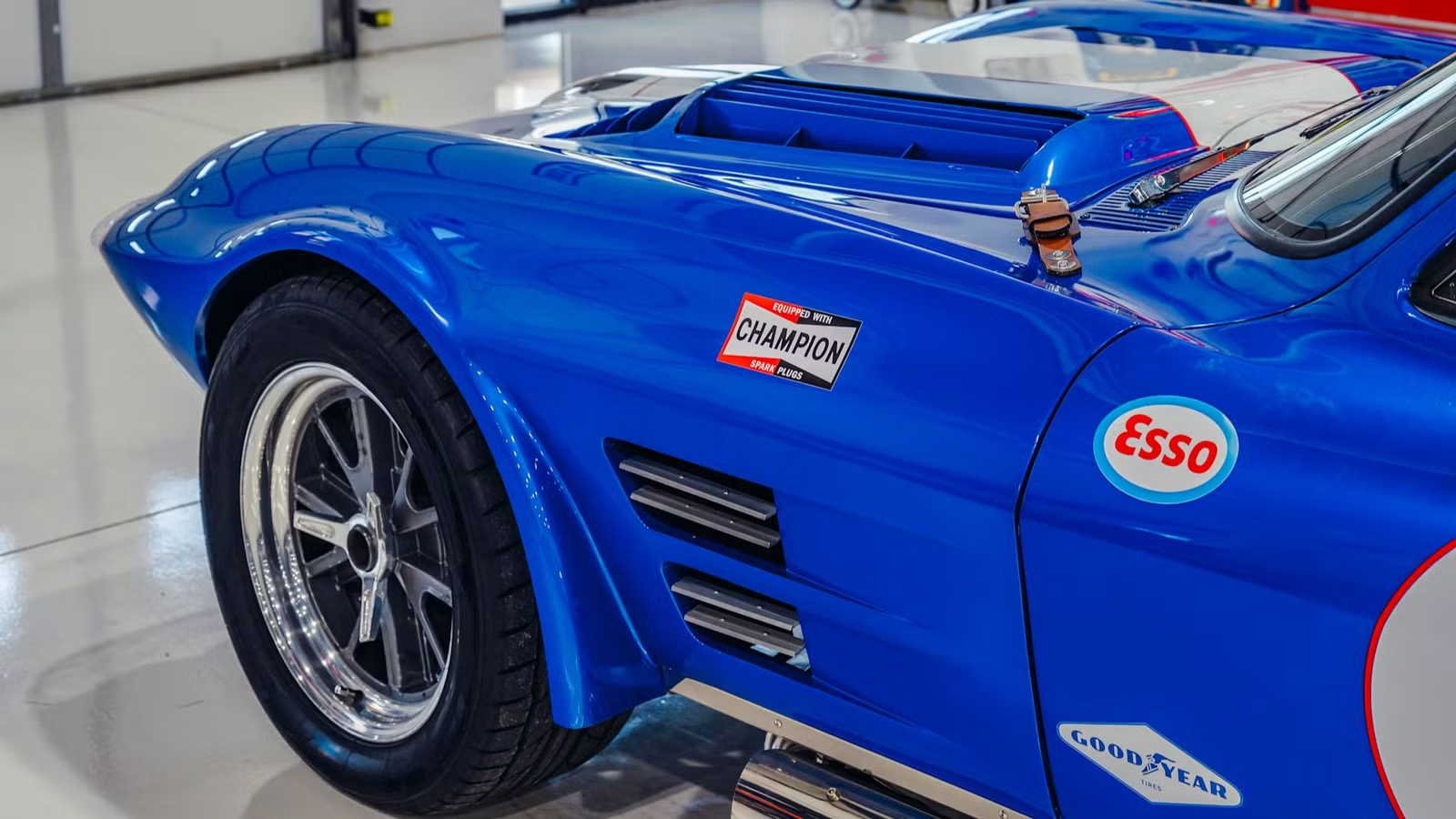
The car at the heart of this story is the 1963 Chevrolet Corvette Grand Sport, a machine so radical it was never meant to leave Chevrolet’s engineering department. Developed behind closed doors by Zora Arkus-Duntov, it was Chevrolet’s uncompromising answer to the Shelby Cobra and was engineered solely for international competition. It began life as the new split-window Sting Ray, but that’s where the similarities ended. Virtually every component was redesigned for racing, transforming it into a lightweight prototype disguised as a production Corvette.
Duntov planned to build 125 for FIA homologation, but only five were completed before GM discovered the skunkworks program, shut it down, and ordered the cars destroyed. However, thanks to Arkus-Duntov’s quiet intervention, all five escaped the crusher, and today they’re collectively worth roughly $25 million, with one now carrying an eight-figure auction estimate on its own.
Built With One Mission: Kill The Shelby Cobra

When the 1963 split-window Corvette debuted, it entered a world where Carroll Shelby’s Cobra had become the benchmark for American sports car racing. Even Chevrolet’s race-oriented Z06 package couldn’t overcome the Cobra’s biggest advantage: an unbeatable power-to-weight ratio. If the Corvette was going to reclaim its place at the front, it had to be reinvented from the ground up.
Weight reduction became the obsession. A tubular steel frame replaced the production chassis, an aluminum birdcage added rigidity without weight, and countless steel components were recast in aluminum or magnesium. The fiberglass body was thinner and wider, incorporating fixed headlights, Plexiglas windows, and subtle aerodynamic refinements. Together, those changes slashed curb weight to around 1,900 pounds, nearly 1,000 pounds lighter than a standard Corvette Sting Ray.

Power eventually matched the diet. While the earliest prototypes used the fuel-injected 360-horsepower 327 small-block, Arkus-Duntov’s ultimate vision was an all-aluminum 377 cubic-inch V8 producing as much as 550 horsepower. Girling disc brakes, competition-tuned suspension, Halibrand magnesium knock-off wheels, and FIA-required features completed what was far more than a modified Corvette.
The Destroy Order That Created A Legend

The Grand Sport’s secrecy unraveled during private testing at Sebring in late 1962, where its astonishing pace attracted unwanted attention from competitors and journalists. Word soon reached GM Chairman Frederic Donner, who was furious that Chevrolet had quietly built a factory race car in defiance of the company’s anti-racing policy. He immediately shut down the Lightweight program, ending its official future before it could fulfill its international ambitions.
For most projects, that would have been the end. Instead, Arkus-Duntov quietly transferred the completed cars to carefully chosen privateers, ensuring the Grand Sport would earn its reputation on the racetrack rather than disappear into the crusher.
The Race Program GM Never Wanted Still Made Corvette History

Although General Motors had officially ended the Grand Sport program, Zora Arkus-Duntov had no intention of sidelining the cars. He quietly entrusted chassis #003 (more on this particular chassis later) to Corvette dealer Dick Doane, who campaigned it throughout the 1963 SCCA season. Competing in C-Modified with a dependable 327 V8, the lightweight Corvette quickly proved its potential, earning class victories while gathering valuable development data. The approach paid dividends as Doane claimed class wins at Wilmot and Greenwood, while famously leading the Road America 500 outright for 93 laps before a mechanical failure ended an otherwise remarkable run.
By late 1963, the Grand Sports were ready for their biggest test. With quiet backing from Chevrolet General Manager Bunkie Knudsen, three coupes headed to the 1963 Bahamas Speed Week at Nassau under John Mecom Jr.’s racing team. Now equipped with lightweight 377-cubic-inch aluminum V8s, wider Halibrand magnesium wheels, and extensive aerodynamic revisions, the cars arrived in Nassau looking unlike any Corvette the public had ever seen and quickly became the talk of the paddock, even drawing the attention of Carroll Shelby himself.
Their performance justified the secrecy. Chassis #003 finished fourth overall in the Governor’s Trophy before taking second in class and eighth overall in the Nassau Trophy, while sister car #005 claimed class honors. They repeatedly demonstrated they could outrun the Cobras on Nassau’s long straights and outperformed them in several headline events, earning the nickname “Snake Eaters” and validating Arkus-Duntov’s belief that Chevrolet had finally built a true Cobra rival.
GM’s renewed crackdown ended any hope of an official Daytona campaign, but Sebring remained within reach. Three Grand Sports returned in 1964 wearing Mecom Racing colors to tackle one of the world’s toughest endurance races. Chassis #003 recovered from mechanical delays and stormed from the back of the grid to 23rd overall after A.J. Foyt passed 50 cars on the opening lap, setting a Sebring record. Meanwhile, sister car #005, piloted by Roger Penske and Jim Hall, proved the Grand Sport’s mettle by claiming victory in its prototype class. Unfortunately, these performances weren’t enough for GM to reconsider its position, and the program quietly faded away. By 1965, Arkus-Duntov had quietly transferred all five chassis to private owners, ensuring his outlaw Corvettes would survive long after Chevrolet’s factory racing ambitions had ended.
Where All Five Original Grand Sports Ended Up

Although General Motors killed the Grand Sport program almost as quickly as it began, Zora Arkus-Duntov’s five prototypes refused to disappear. Today, all five survive, making them some of the most coveted Corvettes ever built. The first to reach competition were coupes #003 and #004, with #003 becoming the undisputed star of the group. It won multiple SCCA races, famously led the Road America 500 outright, helped establish the Grand Sport’s reputation at the 1963 Bahamas Speed Week, and later finished second in class at Sebring. After decades in prominent collections, it is now being offered publicly for the first time in more than 20 years.
Chassis #004 also had a distinguished racing career before finding a permanent home at the Revs Institute, while coupe #005 became the most successful racer of the three, claiming its class at the 1964 Sebring 12 Hours before eventually entering Bill Tower’s long-term collection. Roadsters #001 and #002 were completed after the Nassau campaign, with #001 now owned by Harry Yeaggy after selling for $4.2 million in 2002, while unrestored #002 resides at Philadelphia’s Simeone Foundation Museum following its 2009 acquisition. A disputed sixth chassis remains part of Grand Sport folklore, but historians generally regard the original five completed Grand Sports as the definitive cars of the program.
One Of America’s Greatest Race Cars Is Finally Up For Sale

The Grand Sports have evolved from outlaw racing specials into some of the most valuable Corvettes ever created. Together, the five surviving cars are worth an estimated $25 million, dwarfing even the rarest production Corvettes. Starting life as 1963 split-window Corvettes, they were transformed into purpose-built competition prototypes, raced by some of America’s greatest drivers, and survived a corporate destroy order that should have erased them from history.
Now, one of those legends is returning to the spotlight. Chassis 30837X100003, arguably the most significant Grand Sport of the five, is heading to RM Sotheby’s Monterey sale with an $11–13 million estimate. Should it sell within that range, it would establish itself as the most valuable Corvette ever offered publicly and further cement the Grand Sport’s status among America’s greatest competition cars.
What Makes Chassis #003 Worth Up To $13 Million?

RM Sotheby’s $11–13 million estimate places chassis #003 in an entirely different league from the other surviving Grand Sports, which are generally valued at around $5–6 million each. The last original Grand Sport to change hands publicly (chassis #002) was acquired by the Simeone Foundation Automotive Museum in 2009 for a reported $4–5 million, making #003’s estimate a dramatic leap that reflects far more than simple rarity.
While being one of only five Grand Sports already guarantees blue-chip status, chassis #003 stands apart as arguably the most historically significant example. It was the first completed Grand Sport coupe, the development car that established the model’s reputation through multiple SCCA victories, a 93-lap stint leading the Road America 500, standout performances at Nassau, and a second-place class finish at the 1964 Sebring 12 Hours. Remarkably, despite such an active competition career, it escaped the crashes, rebuilds, and component swaps that claimed so many race cars of its era, preserving much of its original structure. Over the years, it remained in running condition through just a handful of long-term owners, earned multiple Bloomington Gold certifications and NCRS recognition, and then underwent a meticulous four-year, nearly $1 million restoration that returned it to its authentic 1964 Sebring specification.
Whether it reaches its estimate or not, chassis #003 represents far more than another valuable Corvette. It stands as proof that Arkus-Duntov’s refusal to abandon a dream transformed a forbidden skunkworks project into one of the most coveted American competition cars ever built.
Sources: Hagerty, Auto Heritage Foundation, Classic Driver, Simeone Museum, MotorTrend, RM Sotheby’s

Related posts
Latest Post


No Comments