
The Japanese Motorcycle Riders Keep Well Past 100,000 Miles
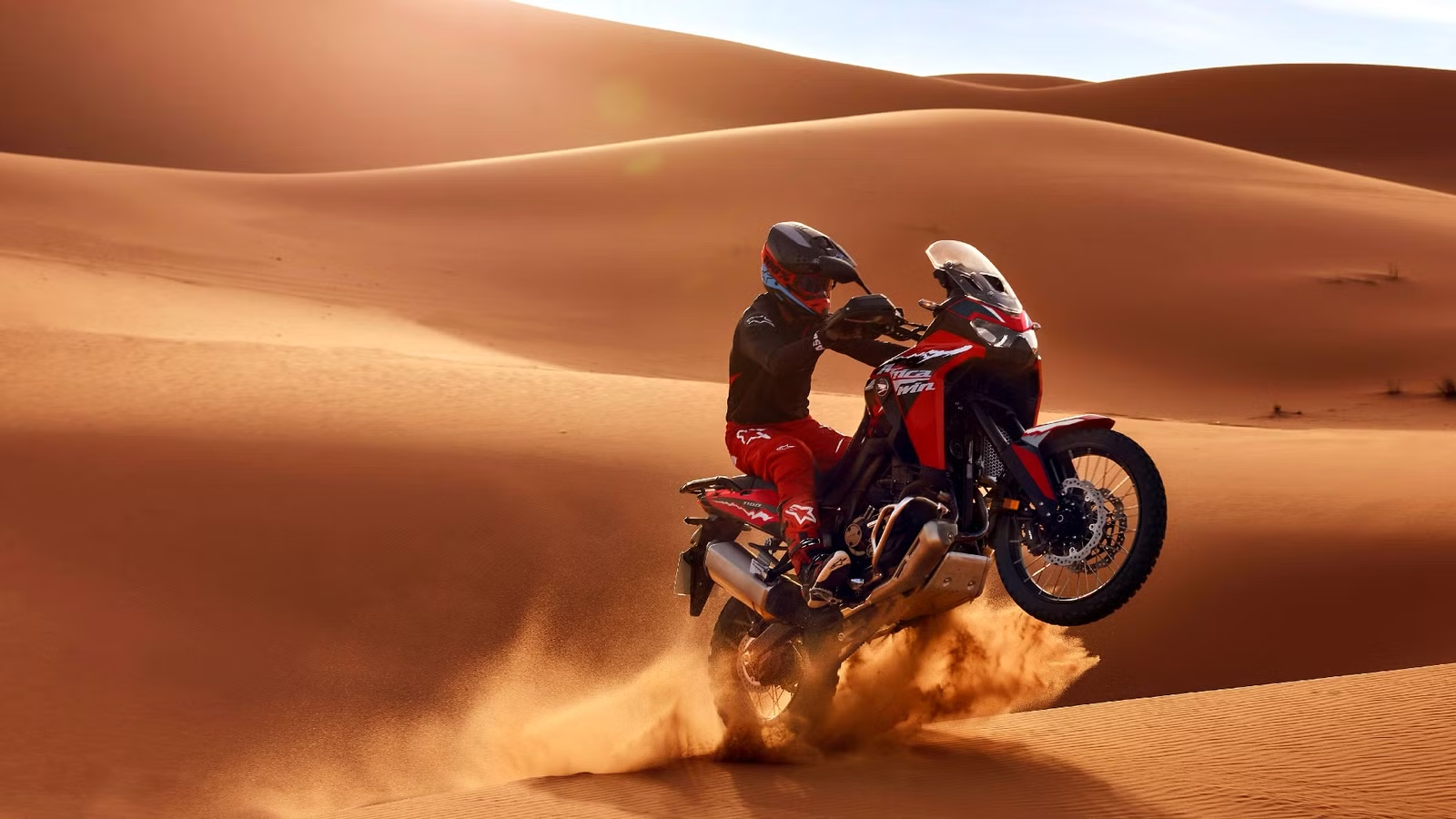
Often times, motorcycles are judged by what they promise rather than what they ultimately deliver. It’s easy to fall for a machine when it is brand new. The real test, however, doesn’t begin until the odometer starts piling on miles. That’s when reliability, durability, and everyday usability become far more important than anything else.

What ultimately separates a truly great motorcycle from the rest is how it performs after tens of thousands of miles. That is where only a handful begin to stand apart. Among all motorcycle categories, ADVs in particular have earned a strong reputation for such longevity. In fact, one such Japanese bike has helped countless owners push well beyond the 100,000-mile mark.
Why Japanese Motorcycles With Six-Digit Odometers Are Quite Common
Japanese motorcycles have long carried a reputation for mechanical durability. Unlike some manufacturers that chase maximum performance by pushing mechanical tolerances to their limits, Japan’s ‘Big Four’ (Honda, Yamaha, Kawasaki, and Suzuki) have built their legacy on engineering motorcycles that balance strong performance with exceptional reliability, longevity, and everyday usability. This philosophy is best reflected by the growing number of Japanese bikes that have comfortably surpassed the 100,000-mile mark. Reaching such a feat is less about luck and more about the result of robust engineering paired with responsible ownership.
Adventure Bikes Make The Ideal Candidate Due To Their Versatility


Adventure motorcycles arguably have the easiest path to rack up serious mileage because they rarely have a reason to stay parked. Unlike supersports that excel mainly on twisty roads or cruisers that favor relaxed highway riding, adventure bikes are designed to perform well almost everywhere. They can commute to work on weekdays, tour on weekends, and handle unpaved terrains when the route gets interesting.
That means the odometer keeps turning while the rider stays engaged. ADVs are also engineered with durability in mind. When a motorcycle comfortably handles 500-mile days and still feels ready for more, reaching 100,000 miles becomes a realistic long-term goal, and this Honda ADV does exactly that.
The Honda Africa Twin Is Built To Be Ridden Hard And Long
MSRP: $15,199

Among Japanese adventure bikes, few models have earned a stronger reputation for dependable long-distance touring than the Honda Africa Twin. Ever since Honda revived the iconic nameplate in 2016, the Africa Twin has established itself as one of the world’s most respected adventure bikes, admired for its versatility, reliability, and go-anywhere capability. Instead of chasing class-leading horsepower figures, Honda engineered the Africa Twin around a well-balanced package that excels both on and off the pavement.

Starting at $15,199, the Honda Africa Twin offers more than enough power for effortless highway cruising, genuine off-road capability for tackling challenging terrain, and all-day comfort that encourages riders to spend countless hours in the saddle. Moreover, it benefits from Honda’s longstanding reputation for building robust engines that prioritize durability over the long haul. These qualities inspire owners to rack up miles with confidence, making it no surprise that many Africa Twins continue running strong well beyond the 100,000-mile mark.
A Proven Parallel-Twin Engine Designed For Durability

At the heart of the Africa Twin is Honda’s popular 1,084cc liquid-cooled, parallel-twin engine. It churns out 101 horsepower at 7,500 RPM and 83 pound-feet of torque at 5,500 RPM. While those figures may not dominate the segment, they perfectly suit this ADV’s purpose. Available with both a six-speed manual and a six-speed automatic dual-clutch transmission (DCT), this motor is considered to be a masterclass in offering practical performance.

Honda has tuned this engine to deliver broad, usable torque throughout the rev range. This characteristic is valuable for a versatile adventure bike like the Africa Twin, which is expected to remain manageable at low speeds, comfortable on long interstates, and composed when tackling off-road trails. Moreover, the parallel-twin configuration keeps mechanical complexity relatively manageable while maintaining excellent balance and efficiency. Routine maintenance remains straightforward by adventure-bike standards, and owners report trouble-free ownership over tens of thousands of miles over the years.
Chassis And Suspension That Can Handle Years Of Abuse

Long-term durability extends far beyond the engine, and the Africa Twin’s chassis is equally impressive in this regard. Its lightweight semi-double-cradle steel frame is engineered to withstand repeated punishment from rough roads, rocky trails, and fully loaded touring without sacrificing stability. Suspension duties are handled by 45mm inverted Showa forks at the front with 9.1 inches of travel and a Pro-Link Showa single shock-absorber at the rear with 8.7 inches of travel.
It’s worth mentioning that the ES variant of the Africa Twin gets electronically adjustable Showa suspension with slightly lesser travel than the standard model for a low seat height and center of gravity. The standard version rides on 21-inch front and 18-inch rear tires while the ES gets 19-inch front and 18-inch rear units. Braking duties on this ADV are performed by dual 310mm discs at the front and a 256mm single disc at the rear with dual-channel ABS.
Electronics That Enhance Riding Without Compromising Reliability

Modern motorcycles increasingly rely on sophisticated electronics, but with the Africa Twin, Honda has avoided that trap by using rider aids that improve control and comfort while keeping the bike’s fundamental character intact. It features six riding modes (Tour, Urban, Gravel, Off-road, and two customizable User modes), along with a 6-axis inertial measurement unit (IMU) that manages cornering ABS, multi-level Honda Selectable Torque Control (HSTC), and wheelie control. Other highlights include a 6.5-inch TFT color touchscreen with Apple CarPlay and Android Auto along with a secondary LCD screen for essential riding information, and it gets cruise control as well.
The Honda Africa Twin Proves That Long-Term Ownership Can Still Be Exciting
The real magic of the Honda Africa Twin is that it proves reliability does not have to be boring. This ADV remains exciting for owners even after crossing the 100,000-mile mark because its appeal goes far beyond a single USP. Honda designed it as a true do-it-all adventure bike, and rather than feeling outdated over the years, it continues to excel as a daily commuter, long-distance tourer, and capable trail machine.

Against premium rivals like the BMW R 1300 GS, KTM 1290 Super Adventure S, Ducati Multistrada V4, and Triumph Tiger 1200, the Africa Twin may not boast the best-in-class specifications or the most advanced features. However, it delivers a simpler ownership experience with Honda’s renowned long-term reliability and comparatively lower running costs. That’s why, even after six-digit figures on the odometer, it remains less of an aging motorcycle and more of a trusted adventure companion ready for the next journey.
Source: Honda

Related posts




Latest Post


No Comments