
The Kawasaki Homologation Superbike That Beat Ducati And Lost The Poster War
World Superbike racing in the nineties was an absolute blast, providing the perfect arena for manufacturers to go toe-to-toe trying to outdo one another. And unlike the dedicated race bikes competing in the GP championship, every machine on the grid had to be homologated before it was allowed to take part. That meant a limited production run to comply with FIM regulations, but the required numbers varied depending on how large each company was. These rules spawned the WSBK homologation special, which essentially translated to road-legal race bikes with lights and license plates, built in limited quantities. Major manufacturers had to produce at least 1,000 copies, whereas smaller companies could get away with just 500 or even 200 units in the case of boutique brands.
The Golden Age Of WorldSBK Homologation Bikes
Honda was the first to jump on the homologation special bandwagon in 1988 with the VFR750R, commonly referred to as the RC30. Others followed soon after, and the arms race for who could gain the upper hand on the World Superbike battlefield was well and truly underway. Yamaha came up with the FZR750R (also known as the OW-01), Suzuki had the GSX-R750 SPR, and Ducati famously produced several homologation versions of the 916. Of course, that’s only a handful of all the amazing superbikes released during the championship’s early days, so it should go without saying that competition was fierce and allowed very little room for error. But what was Kawasaki up to back then?
A Not-So-Sneaky Ninja Hanging With The Big Boys

Kawasaki’s most successful WSBK campaigns took place during the latter half of the 2010s, with Jonathan Rea winning six consecutive titles between 2015 and 2020. The first two were on the ZX-10R, while the rest of them from 2017 onward saw him riding the updated Ninja ZX-10RR to secure four more championship wins. But let us rewind back to the old days for the purpose of our discussion, and that’s where we find the GPX750R as the model which kicked off Kawasaki’s World Superbike aspirations. It only managed a single race win at the Hungaroring during the inaugural season, though, so the company knew it had to up the ante in order to have a better shot at defeating Honda and Ducati. Thus, Kawasaki went back to the drawing board to create a more competitive machine.

The ZXR-750R Was A Real Tour De Force

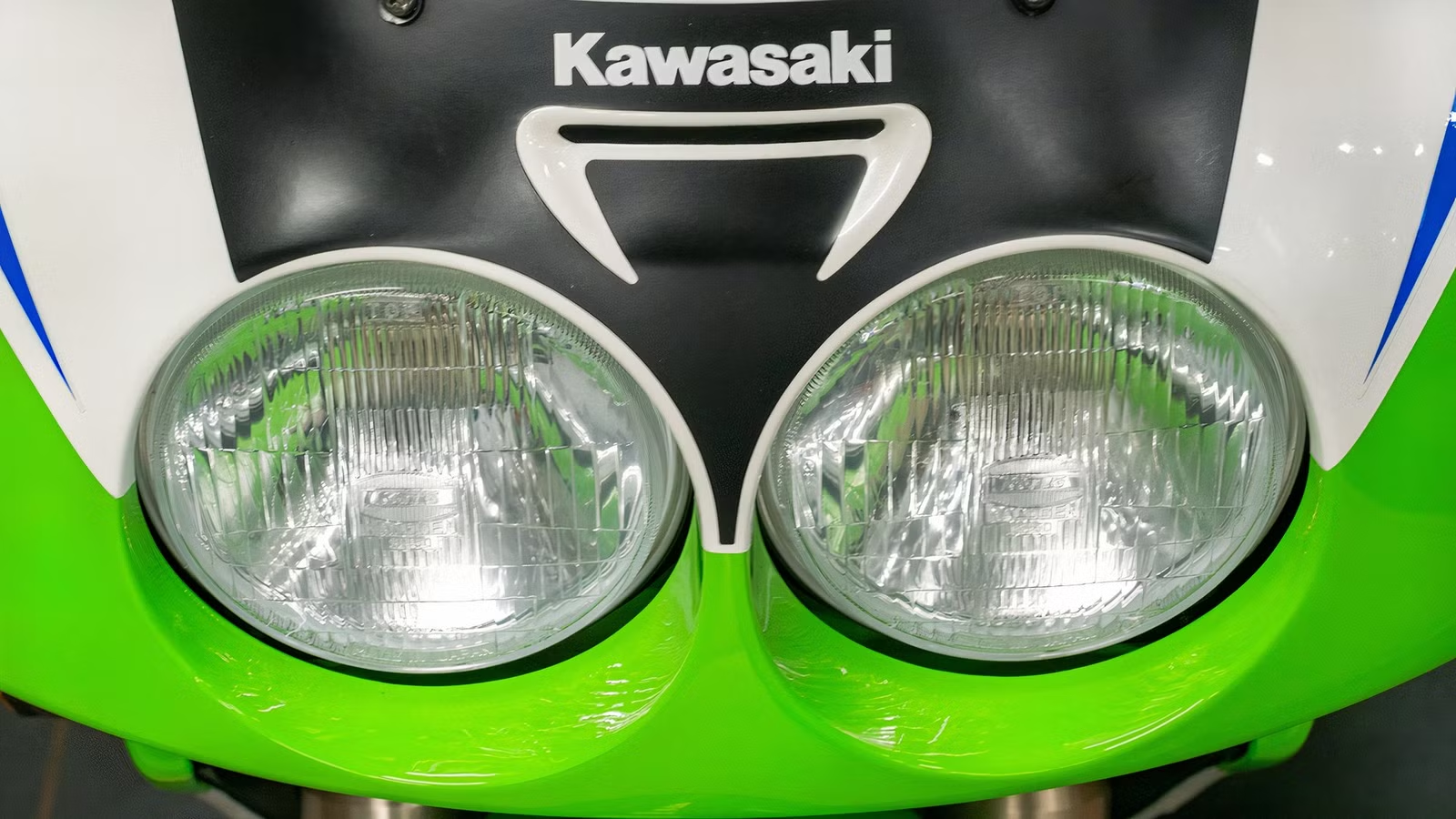
Enter the ZXR-750R, released in 1991 and marketed as ZX-7R in the United States. That nomenclature can be a little confusing, as Kawasaki’s standard ZXR-750 model was renamed ZX-7R globally in 1996 and the true descendant of the 750R became the ZX-7RR. As such, the ZX-7R can refer to both the regular Ninja and its homologation counterpart, so you’ll need to look at the model-year to differentiate between them. Now that we’ve clarified the company’s strange naming practices, let’s take a closer look at what the ZXR-750R brought to the table. Because although it doesn’t have nearly as much clout as the RC30, Suzuki’s GSX-R or the Tamburini-designed Ducati 916, it honestly deserves far more attention than it actually gets.

Starting with the engine, it featured a number of key differences on the homologation model compared to the standard ZXR. Most notably, it did away with the latter’s constant-velocity carburetors in favor of 39-millimeter (1.5-inch) Keihin flat-slide alternatives. These changes altered its character fundamentally, making it less suitable for regular riding but far better on the racetrack. Enhanced airflow, instant throttle response, and improved performance at high revs were some of their key advantages, whereas the one notable downside had to do with their unsuitable nature for riding in city traffic. And as for the engine itself, it was a liquid-cooled 748cc inline-four with a 71-millimeter (2.8-inch) bore and 47.3-millimeter (1.86-inch) stroke.
It came with four valves per cylinder, dual overhead cams, and 121 horsepower delivered at 10,500 rpm. That force made its way to the rear wheel by means of a six-speed close-ratio gearbox, resulting in a top speed of approximately 160 mph. The 750R is said to have been rather tame, even sluggish, at lower revs, but it really came alive above 8,000 rpm and rewarded aggressive riding. Its chassis was pretty sweet, too, featuring an adjustable steering head and swingarm pivot which could be tailored to your exact needs. The bike weighed in at around 420 pounds dry, lighter than the standard ZXR but far more capable on the racetrack.
Scott Russell Rides The ZXR-750R To WSBK And AMA Superbike Glory

With its new homologation beast under Scott Russell’s command, Kawasaki became a serious contender for the WorldSBK title. To the dismay of Ducati and Honda, Team Green won the championship in 1993 with Russell, who’d also taken the AMA Superbike title on a 750R prepped by Rob Muzzy the previous year. Celebrations were fairly short-lived, though, because it didn’t take long for Ducati to respond with the 916 and take the World Superbike crown back from Kawasaki. Two decades would pass before the Japanese manufacturer snatched another title, which came in 2013 with Tom Sykes riding the ZX-10R. Meanwhile, the ZXR-750R was discontinued in 1994 and later replaced by the ZX-7RR in ‘96.
The ZX-7RR Was A Huge Step Forward, But Not Quite Enough

The new Kawi had beefier suspension and brakes, a stiffer chassis, and dual ram-air inlets compared to the ZXR’s single duct. It had just about as many ponies on tap but could be tuned for a much higher output in full race trim, while the flat-slide carbs grew in diameter ever so slightly to 41 millimeters. The ZX-7RR was a capable machine, for sure, but it sadly never managed to give Kawasaki the championship victories it had hoped for, at least not in WorldSBK. Ducati was killing the World Superbike game with the 916 and Honda’s RC45 came in swinging to take its only title in 1997, so the competition was simply too stiff for the Ninja to really get ahead. Its saving grace was found in AMA Superbike, with two consecutive championships claimed by Doug Chandler in 1996 and the following year. But ultimately, the ZX-7RR was only available to the public for two years before getting the axe, though it continued racing well into the 2000s.
Why Kawasaki Lost The Bedroom Poster War

With motorcycles like the Gixxer, Honda RC30 and Ducati 916 grabbing people’s attention, the homologation Ninjas flew under the radar more than they should have. The ZXR-750R and Kawasaki’s later ZX-7RR weren’t bad by any means, though, only casualties of just how heated the superbike arms race was during the nineties. And the RC30 is remembered as the first of the bunch, whereas the 916 dominated WSBK racing and is widely considered to be the most beautiful motorcycle ever made. The Ninja name didn’t carry nearly as much weight, no matter how good these machines were from an engineering standpoint. One thing we can all appreciate is that Kawasaki sought to make top-tier superbike performance more accessible to the masses, with considerably lower price tags than what you’d pay for other homologation specials.
Pricing Then And Now

For comparison’s sake, the RC30 had a sticker price of about $15,000, Yamaha’s OW-01 commanded $16k, and the later 916 SPS would set you back a cool $24,000. The ZXR-750R was priced far more modestly at just 10 grand, while the later ZX-7RR was only slightly pricier at $12,000. Both were produced in fairly limited quantities, though, yet reliable figures for us to go on are very scarce since Kawasaki never officially released them. Estimates from contradictory sources vary wildly, but they mostly fall between 1,500 and 2,000 units for the homologation ZXR. On the other hand, the 7RR is generally believed to have sold between 1,000 and 1,500 copies. However, it’s all just speculation beyond the minimum of 1,000 examples required for FIM homologation purposes.
Either way, both of them are highly sought-after by collectors and not at all easy to come by today. As far as the ZXR is concerned, a notable recent example is a 1992 model with 3,300 miles on the odometer, sold via Iconic Auctioneers for £18,000 ($24,368) back in April. Then there was a 1997 ZX-7RR in great condition and with 15,169 kilometers (9,425 miles) under its belt, which went under the hammer on Iconic Motorbike Auctions for around $29,500 just last month. Clearly, buyers will be paying a premium to get their hands on one of these homologation icons, even if they were once overshadowed by the competition.
Sources: Cycle World, Visordown, BeMoto, BikesWiki, Superbike Archives, Iconic Auctioneers, Iconic Motorbike Auctions

Related posts

Latest Post


No Comments