
Half Of America’s BMW M2 CS Coupes Left The Factory In Velvet Blue
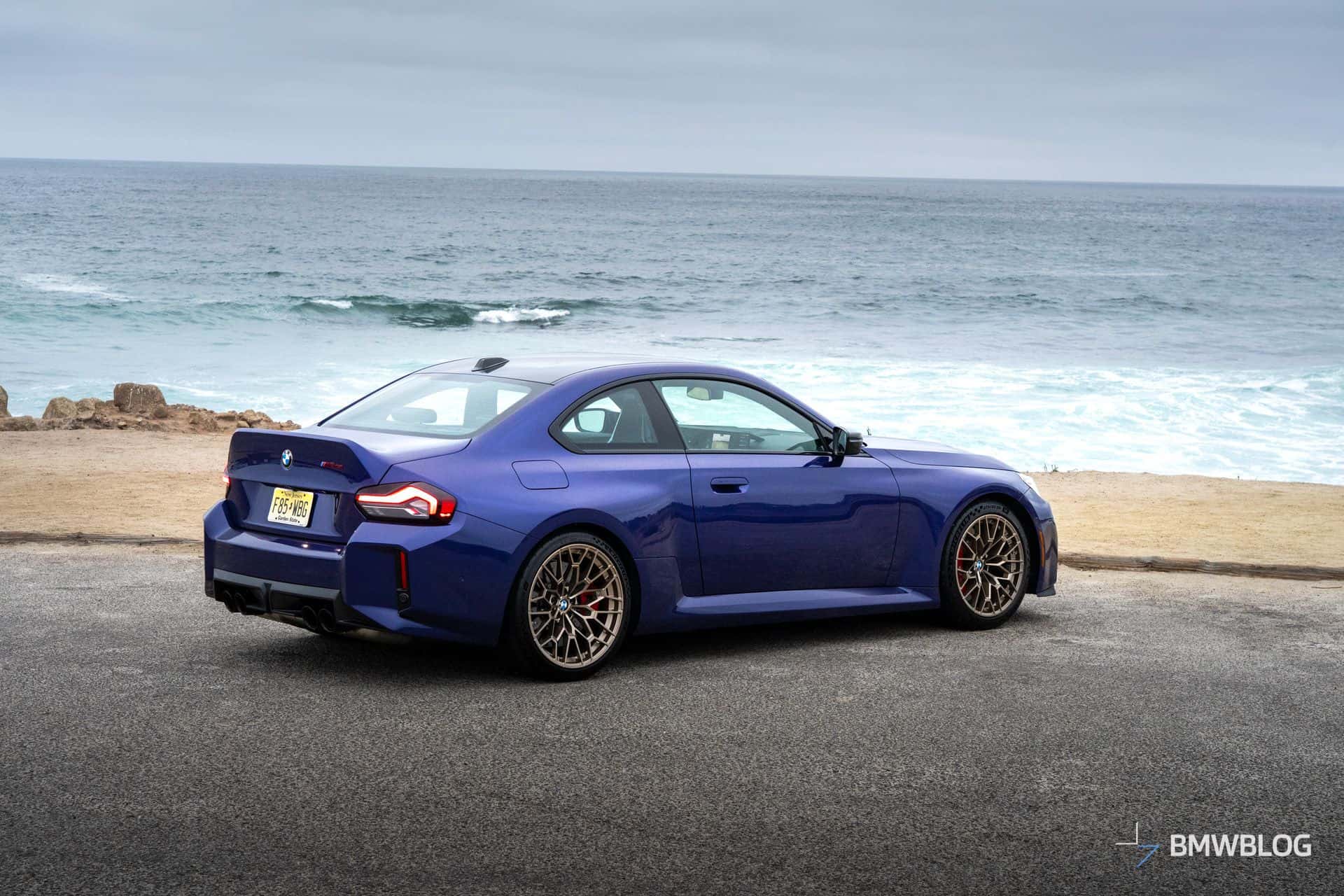
BMW M2
Velvet Blue took half of US orders, Germany chose Black Sapphire, and one F87 M2 CS was built in Birch Green.
Article Summary
- BMW closed G87 M2 CS production on July 29, 2026 at 2,882 cars, 21% more than the 2,381 F87 M2 CS built in the previous generation.
- The US took 770 cars and put 53% of them in Velvet Blue, while Germany’s 386 buyers made Black Sapphire the top color at 44%.
- Carbon ceramic brakes went on 43% of US cars against 31% in Germany, and all 770 US cars have Active Cruise Control.
The last G87 BMW M2 CS was built on July 29, 2026, closing the run at 2,882 cars. That is 21% more than the 2,381 F87 M2 CS BMW built in the previous generation, according to production data published by MDataWorks. The United States took 770 of them, the largest share of any single country. Germany came next at 386, then the UK at 105 and Canada at 103. The remaining 1,518 cars went to every other market combined. Right-hand drive cars accounted for 583 of the total.
Velvet Blue Took Half The US Order Bank

Americans picked one color and stayed with it. Velvet Blue went on 407 of the 770 US cars, nearly as many as the other three colors put together.
- Velvet Blue: 407 (52.9%)
- Black Sapphire: 192 (24.9%)
- Brooklyn Grey: 105 (13.6%)
- Portimao Blue: 66 (8.6%)
Velvet Blue is also the only M2 CS paint BMW charges for. It is a $3,000 BMW Individual option, while Black Sapphire, Brooklyn Grey and Portimao Blue are free. American buyers ticked the paid box 407 times, roughly $1.2 million in paint across a 770-car market.
Germany read the same order guide and reached the opposite conclusion. Black Sapphire led there with 170 of 386 cars, and Velvet Blue fell to third.
- Black Sapphire: 170 (44.0%)
- Brooklyn Grey: 90 (23.3%)
- Velvet Blue: 80 (20.7%)
- Portimao Blue: 46 (11.9%)

Portimao Blue finished last in both markets, which is the one thing US and German buyers agreed on.
Carbon Brakes And Active Cruise Control
US cars were the more heavily optioned. Carbon ceramic brakes are an $8,500 line item, and 330 of the 770 US cars have them, a 43% take rate worth close to $2.8 million on its own. Germany took them on 121 of 386 cars, or 31%. The Active Cruise Control split is wider still. Every US car has it, all 770, which points to standard fitment on American cars rather than 770 individual decisions. In Germany, 281 buyers took it and 105 did without.
How The F87 M2 CS Compares

The F87 M2 CS ran to 2,381 cars, and its color spread was flatter than anything the G87 produced in a single market. Misano Blue led globally with 903 cars, 38% of the run, well short of the 53% Velvet Blue pulled in the US.
- Misano Blue: 903 (37.9%)
- Hockenheim Silver: 650 (27.3%)
- Black Sapphire: 554 (23.3%)
- Alpine White 3: 273 (11.5%)
- Birch Green: 1 (0.04%)
That last line is not a typo. One F87 M2 CS left the factory in Birch Green, a color that does not appear on the regular F87 palette at all, which makes it the rarest specification of either generation by a margin of 272 cars.
The F87 also had a silver option that sold in fairly high numbers. Hockenheim Silver took 27% of that run, and the G87 has no direct equivalent. Brooklyn Grey is the closest thing to a neutral on the newer car and it managed 13.6% in the US.
What The 2,882 Buyers Got

The S58 twin-turbo inline-six makes 523 hp and 479 lb-ft in CS tune, 50 hp up on the standard M2 and enough to make this the most powerful rear-drive M car BMW has built. Engineers pulled 97 pounds out of the automatic M2 to land at 3,770 pounds, mostly through the carbon roof, the CFRP ducktail trunk lid and the carbon bucket seats, all of which are standard. It sits 0.2 inches lower on retuned springs and dampers, runs 0-60 mph in 3.7 seconds and stops at an electronically limited 188 mph.
All of that lists at $98,600 plus $1,175 destination, and BMW was clearly working to keep the sticker under six figures at $99,775. Line it up against the M3 CS at $118,700 and the M4 CS at $123,500 and the smallest CS comes out looking like the value play in the family, which is a peculiar sentence to write about a $100,000 coupe.
The reservation is the one enthusiasts raised the day the car was revealed. The F87 M2 CS could be ordered with a six-speed manual. The G87 cannot. The eight-speed Steptronic is quicker by every stopwatch measure and nobody seriously argues otherwise, but a CS badge has historically meant the most involving version of a car, and losing the third pedal on the small, rear-drive, short-wheelbase M car is the one that stings. Some of the people who bought the first CS did not buy this one for exactly that reason.
The 2,882 who did decided a 523 hp rear-drive coupe under six figures was worth it anyway, and more than half the Americans among them spent three grand extra to make sure you would notice. Production figures in this article come from MDataWorks, which publishes BMW production breakdowns by market, color and equipment.

Related posts

Latest Post



No Comments