
The Forgotten Mazda Coupe With Skyline-Tier Steering Tech For Civic Money
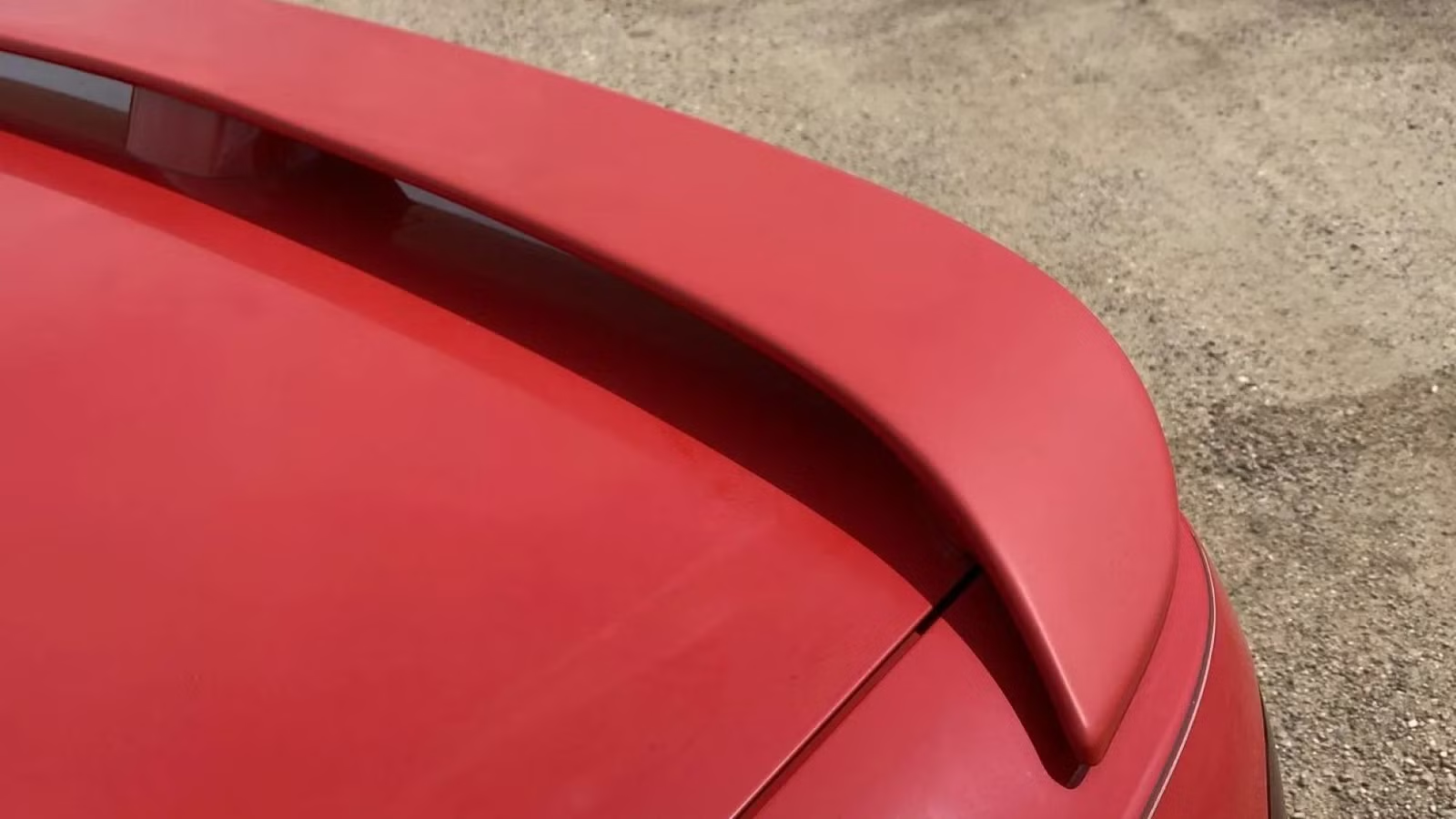
Everyone wants a turbocharged ’80s or ’90s Japanese coupe, right? This was the golden age of JDM classics, when Japanese firms wanted to push the boundaries of what was possible with a performance car. The only trouble is that everyone knows that. So, when we look through the classifieds for one of these high-tech boosted models, the prices are generally astronomical, and we go back to checking the football results. But there is good news. One techy trailblazer, which was made in the same vein as the Nissan Skyline, has slipped through the net and could be one of the JDM performance bargains of 2026—read on to find out what it is.
Japanese Manufacturers Were Entering A Tech Arms Race In The ’80s

You only have to look at a story about the Porsche 959 to know how serious Japanese carmakers were about beating each other when it came to technology. A famous tale in the automotive press reports that Nissan bought a 959 and took it apart to find out its secrets, using that knowledge as inspiration for the Godzilla R32 Skyline GT-R. We all know what happened next: the GT-R went on to demolish much more expensive cars, and became a legendary turbocharged two-door from Japan.
But along with things like the ATTESA E-TS all-wheel-drive system and a revolutionary twin-turbo RB26DETT engine, the GT-R also had something called Super HICAS Four-Wheel Steering. This system (short for High Capacity Actively Controlled Steering) toes the rear tires a few degrees in line with the fronts for sharper steering response at high speed, but rotates them slightly in the opposite direction for more maneuverability at low speeds. Honda launched 4WS technology on the Prelude, and for many, it was seen as the most revolutionary step in car handling to date. But there was one carmaker who might have got there first.
Mazda Wanted To Be a Pioneer, Not a Settler

Mazda may have really been put on the sports car map in the late ’80s with the MX-5 Miata, but the company was a quiet revolutionary in the years before. Mazda had introduced the world’s first rotary turbo engine in the Cosmo (929) and Luce (929), and the second-generation, or FC, RX-7 took the company’s two-seater sports car a huge leap forward. In 1985, Mazda even introduced full-time four-wheel drive to the 3-door hatchback of the 6th generation Familia, linked to a 1.6-liter DOHC 16-valve intercooled turbo engine. But while a lot of other companies grabbed the headlines, it was also Mazda that claimed a world-first with four-wheel-steering. And in a model most people have long forgotten.

The Mazda MX-6 GT Turbo Was Chasing Halo-Car Chassis Tech

Everyone knows the Mazda Capella, right? OK, for most people in Europe and North America, this jaunty-sounding model was better known as the 626. Originating in 1970, the 626’s fifth-generation model was launched in May 1987. This car was available with the first mass production diesel engine to feature a pressure wave supercharger, as well as full-time 4WD and a host of other new technologies. But what had escaped a lot of people’s attention was that the new Capella/626 also came fitted with what Mazda describes as “the world’s first speed-dependent four-wheel steering (4WS).” And it was available on a sporty turbocharged model too.
The 4WS System Took On The Skyline And Prelude

Mazda was so proud of its 4WS innovation that it stringently inspected every unit. Mazda had introduced the new system in the 626 sedan, but it wasn’t very popular, with just 850 units sold. For 1988, Mazda had a rethink, realizing that it was sportier cars that were being developed with 4WS, with the emphasis on more spirited driving. The result was the Mazda MX-6 GT 4WS.
The 4WS system was stuffed into a two-door coupe body style, taking on the Prelude Si 4WS, and serving as a more day-to-day alternative to the incoming Skyline GT-R. The steering on the GT 4WS responds to vehicle speed and utilizes both hydraulic and mechanical elements to control the rear wheels. Below 22 mph, the rear wheels point in the opposite direction, but above that they turn in the same line as the fronts.
The MX-6 GT Turbo Was A Turbocharged Sleeper

Under the hood of the MX-6 GT is a turbocharged and intercooled 2.2-liter four, with 145 horsepower at 4300 rpm and 190 lb-ft of torque at 3500 rpm. The car was available with a five-speed manual, or a four-speed auto. The only fly in the ointment was the 183 pounds that the 4WS gear added to the curb weight, but nevertheless, it would still hit 60 mph in 7.43 seconds and cover the quarter mile in 15.70 sec at 91.2 mph. In traditional Japanese ’80s fashion, the MX-6 remained something of a sleeper. True, some turbo cars would have the word written along the bodywork in large letters, but the MX-6 stuck to that recipe of looking sedate (read: classy), with only discreet badges and that impressive power to do the talking. But it probably wasn’t enough.
Here’s Why Everyone Slept On The Mazda MX-6 GT Turbo

The spec sheet of a two-door, turbocharged, 4WS coupe from Japan should have then and now got JDM fans’ hearts racing. But the reality was different. Motor Trend said Mazda figured that just 15% of the roughly 40,000 MX-6s it expected to sell in 1989 would be 4WS models. The fact that the 4WS was reportedly a $1,200 option on the $15,499 base price probably put a few buyers off, too.
The 4WS option only lasted two years, and by the time the second-gen MX-6 arrived in 1992, the 4WS tech wasn’t available in the USA anymore. In truth, Mazda had hit on a new magic formula—it was called the Miata. This simple drop-top with rear-wheel drive couldn’t have been more different from the tech-laden offerings from Japan in the ’80s, and was an instant hit. Maybe going back to basics was a better idea after all?
The Mazda MX-6 Is A Forgotten Turbo JDM Model From The Golden Age

It’s hard to say exactly how many MX-6 4WS units Mazda sold in those two years at the end of the ’80s (a forum search suggests 1,500), but there certainly aren’t many up for sale these days. We found a project car in Australia for $3,500 USD, and this forum user in California was selling a manual 1989 MX-6 GT Turbo 4WS that had been in storage for $3,800 or best cash offer.
There seem to be several other people out there who have one stashed away, but running examples are incredibly rare. That’s why the car in the picture is not described as a 4WS, instead a standard MX-6 GT turbo. If you are ambitious, know something about rare ’80s tech, and want a car that is so obscure even JDM fans might not know much about it, the MX-6 4WS certainly makes a great case for itself.
Sources: MX6.com

Related posts


Latest Post


No Comments