
The Perfect Alternative To The Toyota RAV4 That You Can Buy
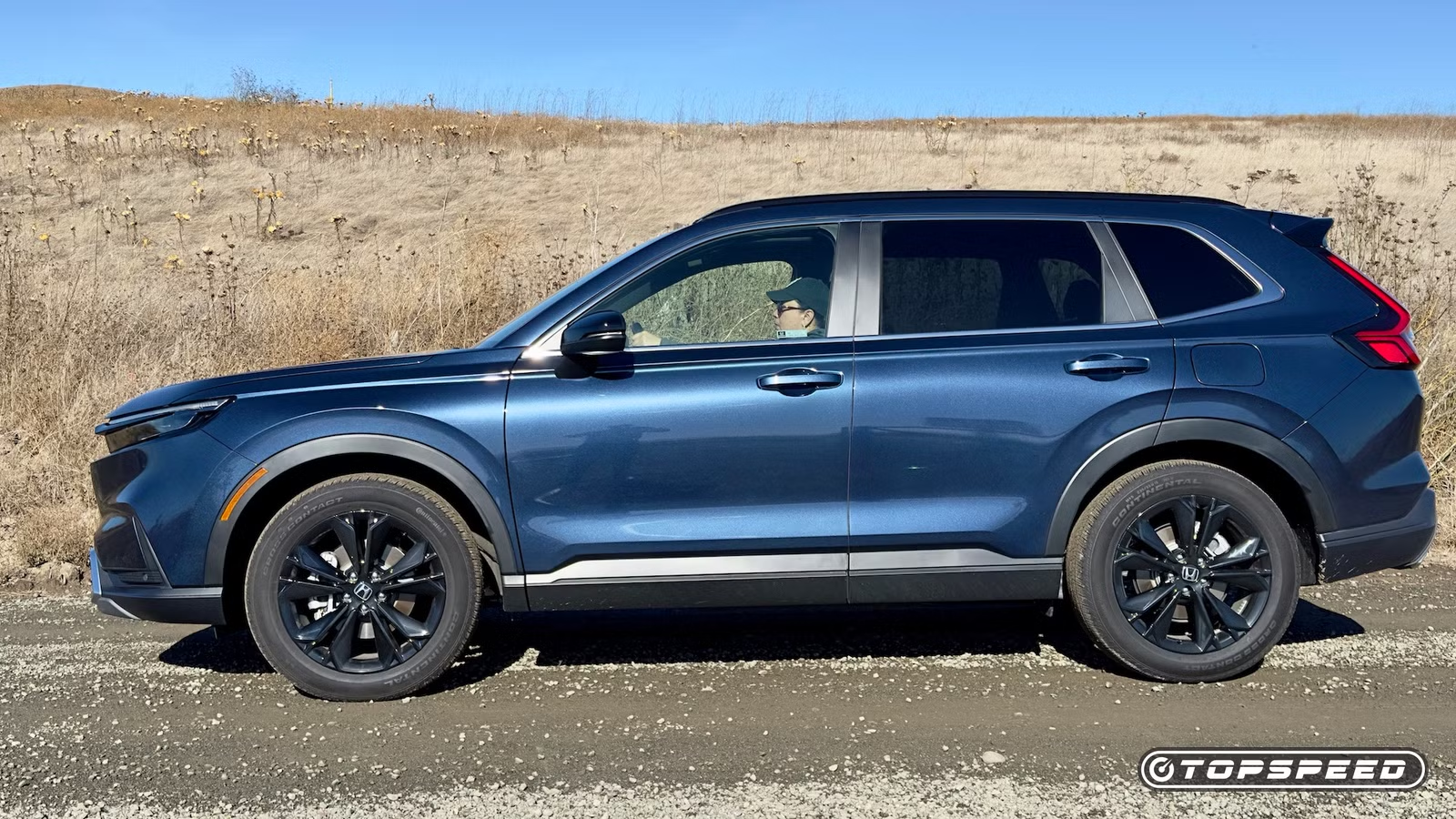
When it comes to hybrid vehicles, Toyota tends to dominate the conversation — and for good reason. But there’s a compelling rival that has quietly been closing the gap, and in some segments, outright surpassing it. Honda was actually the first automaker to bring a mass-market hybrid to North America, beating the Prius to dealerships by mere months with the original Insight. That early lead, however, didn’t translate into the sustained hybrid commitment Toyota maintained for decades. mass-market hybrid called the Prius back in 1997.

Unlike Toyota, Honda’s commitment to hybrids has been mixed despite having a similar start. That’s exactly why Toyota built a more diverse hybrid portfolio and has been reaping the rewards as hybrid sales continue to surge. To be fair, Honda’s renewed hybrid push in recent years arrived just in time for the ongoing hybrid boom, and as a result, it now has a few models that are even outselling certain Toyota equivalents. newer Honda Civic Hybrid. One of those models is the Honda Accord Hybrid, which currently outsells the Prius. However, if you want an alternative to Toyota’s best-selling non-sedan model, the RAV4, then here’s your answer.
Why You May Want A CR-V Hybrid Over A RAV4 Hybrid
That crossover SUV is the Honda CR-V Hybrid, which now makes up 54 percent of overall CR-V sales. There’s a perfectly good reason why these two compact crossovers have been fiercely competing since both entered the market in the 1990s. The CR-V and RAV4 have always been no-brainer options, and buyers of both cars have been known to jump between the two models with each new generation just to try something different. To help you decide whether the CR-V Hybrid is the right choice, here are two key reasons it has an edge over the RAV4 Hybrid.
Incrementally Sportier

Let’s be honest — both crossovers are popular precisely because of how inoffensive they are. They’re well-designed for everyday tasks and serve as default choices for buyers who want something comfortable, reliable, and versatile. Emotional factors rarely tip the scales when choosing between them, but the CR-V Hybrid does offer a subtle but real sportiness advantage that sets it apart. No, the CR-V Hybrid isn’t going to run rings around the RAV4, but its steering, suspension, and body control have an incrementally sportier orientation than its Toyota rival. Having driven both cars extensively in hybrid form, I consistently lean toward the CR-V Hybrid for its slightly better body control, slightly sharper steering, and a hybrid system that feels more engaging overall.
Honda Being Honda With Its Hybrids

On paper, the CR-V Hybrid’s drivetrain looks similar to the RAV4’s — but the way Honda implements it couldn’t be more different. Both vehicles pair a four-cylinder engine with two electric motors: one acting as a motor-generator and the other driving the wheels. Both use e-CVTs, though neither is a conventional belt- or chain-driven unit. Toyota employs a planetary gear-type transmission that delivers an infinite number of ratios, while Honda uses a two-clutch (not dual-clutch) system. Honda’s two-clutch setup uses one lock-up clutch for low-speed operation and another for high-speed use. This means the engine can charge the CR-V Hybrid’s battery independently without driving the wheels, resulting in noticeably smoother low-speed behavior when the engine is running.
At higher speeds, the high-speed lock-up clutch connects the engine directly to the wheels. The system then decides — based on throttle input — whether to use pure electric drive or combined hybrid drive. Paired with Honda’s pre-programmed Linear Shift Control, the result is a hybrid system that’s not only smoother at low speeds but also delivers more linear, engaging acceleration, without the engine-droning effect that comes from mimicking a traditional automatic’s shift points.

With Toyota’s setup, the engine is always mechanically linked to the front wheels via the planetary gear transmission when running. Under hard acceleration, there’s no pretense of simulating a conventional automatic — the revs simply climb and hold for as long as you’re on the throttle. On the plus side, a planetary gear system responds more instantaneously than the clutch-based setup Honda uses. Neither system is outright superior; both have their own trade-offs. The Honda system, however, is the better fit if you prioritize a smoother and more spirited driving experience.
What Else A CR-V Hybrid Offers

Now that you know what distinguishes the two vehicles, here’s everything else the Honda CR-V Hybrid brings to the table for buyers planning to live with it long-term.
Sporty Looks As Standard

Choosing the hybrid powertrain immediately gives your CR-V a sportier appearance compared to the standard models. Honda has used this as a way to position its hybrids as the more premium drivetrain choice — a distinction backed up by the incrementally sportier driving experience. On the outside, you get a more aggressive front bumper and a black mesh grille, and all variants come with black alloy wheels: 18-inch units as standard, with nicer 19-inch alloys on the Sport Touring. The Sport-L adds a powered tailgate, while a foot-activated sensor is reserved for the range-topping Sport Touring. Overall, while the CR-V Hybrid looks sharper than the standard models, it isn’t a groundbreakingly striking design. It doesn’t turn heads, but there’s nothing wrong with it, either. Honda’s restrained aesthetic approach means the CR-V is unlikely to look dated anytime soon.
Simple But Modern Interior

Like the exterior, the CR-V Hybrid’s cabin keeps things clean and unfussy. That said, as with many current Hondas, the interior feels reasonably upscale and well-assembled. Soft-touch materials appear on the dash and door panels, and the honeycomb air vent strip running across the dashboard looks genuinely premium. Honda has also wisely limited gloss black trim to areas that are rarely touched, meaning the matte surfaces throughout will age far more gracefully. The cabin is also reasonably modern, with a partially digital gauge cluster and a touchscreen with Apple CarPlay and Android Auto as standard. Leather seats, power-adjustable front seats, wireless Apple CarPlay and Android Auto, and a larger infotainment display step up with the Sport-L trim and above. The range-topping Sport Touring adds a premium Bose sound system.
What Opportunities Lie Ahead For The CR-V Hybrid

While the Honda CR-V Hybrid is currently at the top of its game — with a well-engineered hybrid system, a practical and spacious interior, and a strong features package — there are areas where it could become even more compelling in the North American market.
There’s A Plug-In Hybrid Version In Europe

The most notable gap in the CR-V Hybrid’s North American lineup is the absence of a plug-in hybrid option. Honda already sells a plug-in hybrid CR-V in Europe, and it would be a natural competitor to the RAV4 Prime. The European CR-V plug-in hybrid uses a version of the same hybrid system with a larger battery and a slightly more powerful electric motor, producing 212 horsepower and 242 pound-feet of system torque, with a WLTP-rated electric range of around 50 miles.
Combined with the CR-V’s already sportier handling character, a plug-in variant could make for a genuinely fun compact crossover. For now, the only CR-V with a plug in North America is the CR-V FCEV — a fuel cell electric vehicle that uses a hydrogen fuel cell stack alongside a plug-in battery. Given the current state of hydrogen infrastructure, that’s a limited proposition for most buyers.
It Could Be Priced Slightly Lower

At the moment, the CR-V Hybrid is priced slightly above the RAV4 Hybrid. The gap largely comes down to base CR-V Hybrid having more features than a base RAV4 Hybrid. If Honda were to introduce a more affordable CR-V Hybrid trim — perhaps one that foregoes the sportier exterior styling in favor of a look closer to the standard model — it could open up the lower end of the market and drive additional volume. That said, Honda has historically priced its vehicles a step above their Toyota counterparts, and the brand doesn’t pursue fleet sales the way some rivals do; any fleet activity tends to be dealer-driven rather than a factory initiative.
Sources: Honda, Toyota

Related posts




Latest Post


No Comments