
The Ford V8 NASCAR Banned Before It Ever Turned A Lap
The grandstands at the 1964 Daytona 500 were supposed to witness a total Ford celebration. Instead, the Blue Oval fleet was completely run off the high banks, suffering a public humiliation that sent shockwaves straight back to Dearborn.

This single, devastating race weekend triggered a fierce, secret 90-day engineering sprint inside Ford. Henry Ford II wanted immediate revenge, demanding a radical new V8 unlike anything Detroit had ever built before. Yet what his engineers created was so far ahead of the rulebook that it never got to prove itself on a NASCAR track. It became a legendary outlaw weapon, banned before it could ever turn a competitive lap.
The 1964 Daytona 500 Defeat That Made Detroit’s Horsepower War Personal
The shift in power happened in a single afternoon. At the February 23, 1964 Daytona 500, Chrysler unleashed its all-new 426 Hemi V8 engine and utterly destroyed the competition. Richard Petty famously piloted his Hemi-powered Plymouth to victory, leading an astonishing 184 of the 200 laps as Chrysler swept the podium.

For Ford, this was a massive public embarrassment. The Blue Oval team had completely dominated NASCAR throughout the 1963 season, making this sudden, high-profile defeat a bitter pill to swallow.
The loss reportedly deeply angered Henry Ford II. He was already highly sensitive to public setbacks, having recently been rejected in his famous, high-dollar bid to purchase Ferrari. He immediately took the racetrack defeat personally and pressured his engineering team to deliver a swift, devastating answer to Chrysler.
The challenge was that Ford could not simply build a bigger engine to claw back the performance deficit. NASCAR enforced strict displacement limits capped at 7.0 liters, meaning any viable answer to the Hemi would have to come from a totally new design philosophy rather than basic size.
Ford’s Coolest Forgotten Sedan With NASCAR Power Under The Hood
We take a look back at the Blue Oval’s full-size sedan that could be equipped with a powerful 427 V8 under the hood.
Ford’s 90-Day Weapon: The Radical 427 SOHC V8 Detroit Never Expected

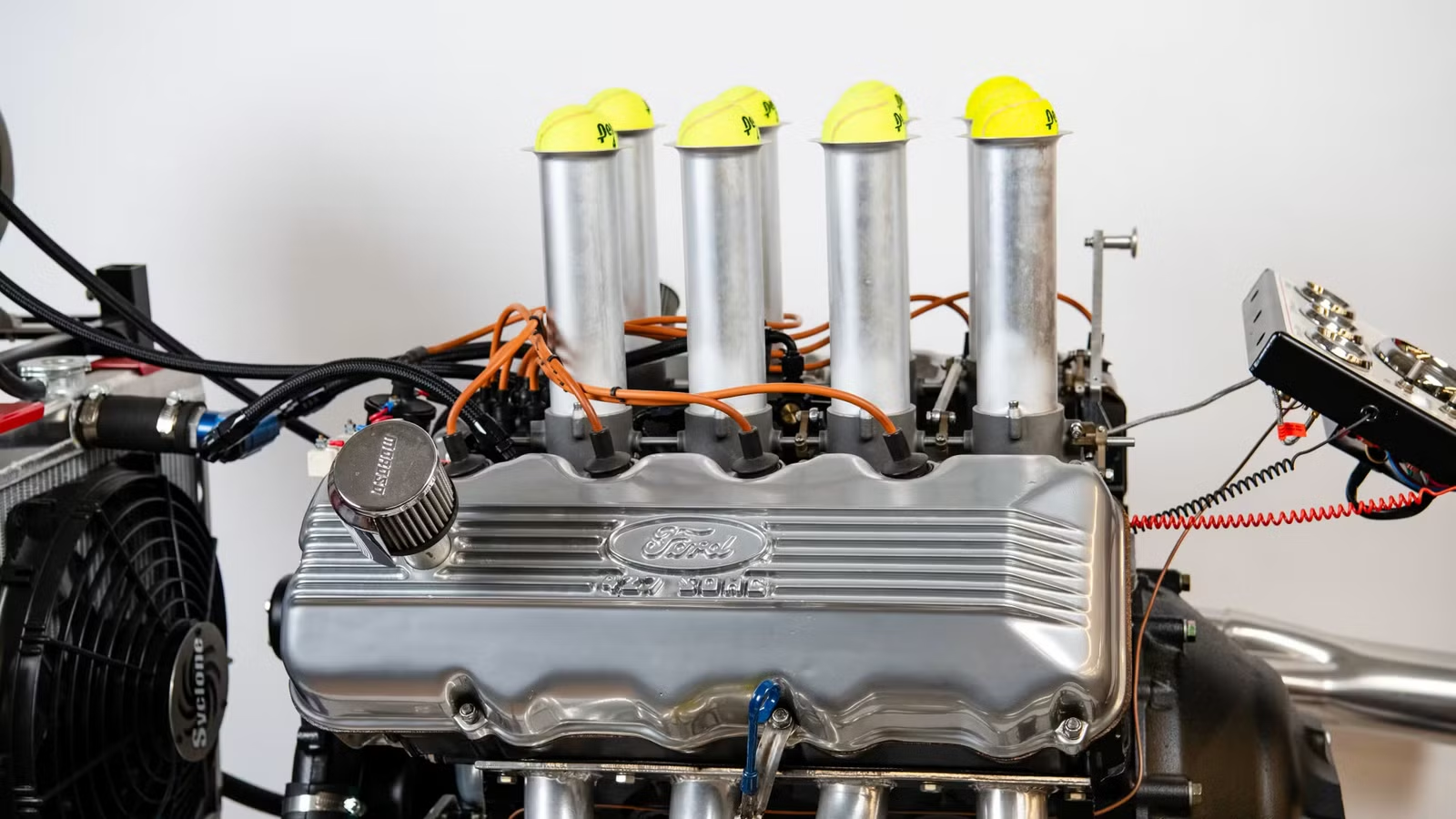
Ford responded with an engineering miracle that came to be known as the 427 SOHC. Developed on an incredibly tight schedule, the engine earned the internal nickname “90 Day Wonder” among the engineers who rushed it to life. To save vital development time and production costs, the team wisely avoided designing a brand-new bottom end from scratch. Instead, they built the new power plant using Ford’s already proven 427 FE “side-oiler” engine block as a sturdy foundation.
The real magic happened up top, where engineers created a clean-sheet cylinder head redesign featuring hemispherical combustion chambers. They added a single overhead camshaft per head to operate shaft-mounted roller rockers and massive stainless-steel valves, completely abandoning the traditional pushrod setup.
This complex layout required a notable engineering compromise: a massive, chain-driven cam drive. Because the timing chain was so long—ranging anywhere from six to nearly seven feet depending on the historical source—engineers actually had to vary the cam timing to counteract natural chain stretch under heavy racing loads. Interestingly, this engine was not conceived as an incredibly expensive moonshot project. It was actually developed in parallel as a budget-conscious cousin to Ford’s much pricier DOHC Indy racing engine program.
Banned By NASCAR: The 1964 Political Rules That Outlawed Ford’s Ultimate Engine

Ford first pitched the sophisticated overhead-cam engine concept to NASCAR brass around the time of the 1964 Daytona 500. NASCAR boss Bill France was notoriously unimpressed by the advanced design, allegedly writing it off as “European exotica” that completely clashed with his blue-collar vision for stock car racing.
On October 19, 1964, NASCAR formally closed the door by outlawing all “special racing engines” from Grand National competition for the 1965 season. This blanket rule was a massive political maneuver, successfully knocking out both Ford’s high-tech SOHC and Chrysler’s dominant Hemi in a single blow.

While Chrysler temporarily pulled out of the racing series in a loud protest, Ford decided to stay in the game using its conventional, older pushrod 427 engine. Consequently, the team redirected the entire SOHC program toward other racing venues.
NASCAR briefly offered a minor compromise in 1966, saying the engine could run exclusively in massive Ford Galaxies if they carried a punishing 4,400-pound minimum weight limit. Historians point out this was effectively a secondary ban, ensuring the engine never actually stood a realistic chance of winning or competing.
The ultimate irony of the “90 Day Wonder” remains incredibly clear. The advanced powerhouse designed explicitly to be Ford’s ultimate weapon on the high banks never turned a single competitive lap in a NASCAR race.
The Rare Mopar Monster That Outran The Hemi ‘Cuda
Arguably one of the most iconic pieces of American muscle, this Dodge could outrun just about everything on the road.
Exiled To The Drag Strip: How The 657 HP Cammer Dominated The NHRA

Completely locked out of stock-car oval tracks, Ford immediately moved its ultimate V8 over to the drag racing circuit. The SOHC found a welcoming new home in NHRA Factory Experimental, funny car, and Top Fuel competition, famously debuting inside factory-backed 1965 Mustangs and Mercury Comets.
According to data compiled by the Automotive History Preservation Society, the engine’s power output was absolutely staggering for the era. Equipped with a single four-barrel carburetor, the V8 produced a healthy 616 hp at 7,000 rpm.
For teams looking for maximum speed, stepping up to a dual-carburetor setup pushed the performance numbers to an incredible 657 hp at 7,500 rpm. Torque figures were equally impressive, generating anywhere from 515 to 575 lb-ft depending entirely on how the fuel system was tuned.
Ford 427 SOHC “Cammer” Specs
|
Displacement |
Horsepower |
Torque |
|
427 Cubic Inches |
616-657 HP |
515-575 LB-FT |
Weighing in at roughly 680 pounds, the engine was certainly heavy to drop into a lightweight drag car chassis. However, its incredibly high rpm ceiling allowed it to scream past traditional pushrod V8 engines that simply could not spin that fast without bending components.
The engine quickly became a terrifyingly effective weapon on the quarter-mile strip. Drag racers loved the raw power, even though that incredibly long, original timing chain remained a constant maintenance headache and a well-known mechanical weak spot.
The Stolen Future: How A 1960s Race Ban Delayed Ford’s Modern Coyote V8 For Decades

Today, automotive enthusiasts and historians view the 427 SOHC as much more than a rare vintage racing relic. It is widely considered the true early genetic forefather of Ford’s modern overhead-cam engine family, a lineage that directly includes the current Coyote V8.
Look closely at Ford’s highest-performing modern powerplants, such as the supercharged Shelby GT500 Predator V8. The advanced dual overhead cam technology under those modern hoods traces its core engineering logic directly back to the lessons learned on the 1960s “Cammer.”

NASCAR’s conservative politics essentially forced Detroit to freeze its engine development in time, locking American muscle cars into a pushrod sandbox for another thirty years. While the rest of the automotive world quickly embraced overhead cams for superior efficiency and high-rpm power, American manufacturers stayed stuck in the past.
Had NASCAR allowed the 427 SOHC to race, overhead-cam technology likely would have trickled down into everyday showroom Mustangs and Torinos by the early 1970s. Instead, track regulations successfully postponed the natural evolution of the American V8 engine for decades.
12 Big-Block Monsters That Defined The ’60s And ‘70s
Discover 10 legendary big-block muscle cars from the ’60s and ’70s that defined the horsepower wars and America’s golden age of performance.
From $2,300 Crate Part To $140,000 Icon: The Priceless Legacy Of An Outlaw V8

Back in the mid-1960s, a factory-original Ford 427 SOHC crate engine would set a buyer back roughly $2,300. This relatively high price tag reflected its true status as a limited, specialized racing part rather than something you could order in a standard family sedan.
Fast-forward to the modern classic car market, and surviving original engines regularly command up to $140,000 at high-end auctions. This astronomical valuation speaks directly to the engine’s extreme rarity, beautiful engineering, and outlaw mystique.
The scarcity is partly tied to folklore surrounding Ford’s secretive “X-Garage,” a restricted-access testing facility reminiscent of Area 51. Ford engineers allegedly dropped experimental Cammers into prototype Galaxies for evaluations, ordering most of the cars destroyed immediately after testing concluded.
Ultimately, NASCAR’s historic 1964 ban did far more than simply protect the competitive balance of a single stock car racing season. It effectively altered automotive history by delaying a massive piece of Ford’s engineering future.
Sources: Ford, Automotive History Preservation Society

Related posts





Latest Post


No Comments