Kia EV9: Why This Three-Row EV Redefines Family Utility
10 minutes reading
Wednesday, 22 Jul 2026 14:00 0 62 autotech
Over the last decade, companies across the world have been investing great deals of capital into electric vehicle platforms. This technology forms the foundation of modern EVs, dictating how these vehicles charge, handle weight, and manage thermal energy. Kia builds the EV9 on the Hyundai Motor Group Electric-Global Modular Platform, commonly referred to as E-GMP. This dedicated EV platform positions the battery pack flat along the floor between the front and rear axles, which lowers the center of gravity, enhances overall handling stability, and frees up significant interior floor space.
The platform’s headline feature is its 800-volt electrical architecture. Most mainstream electric vehicles operate on a traditional 400-volt system, but the E-GMP’s higher voltage allows current to flow with far less resistance. This reduction in resistance limits heat buildup during heavy power draw and high-speed energy replenishment. This allows the system to maintain sustained peak charging speeds of up to 230 kW without rapid thermal throttling. Beyond charging performance, the architecture integrates a lightweight drive axle to enhance structural stiffness and supports vehicle-to-load capability that exports up to 3.6 kW of external power.
Kia offers two battery sizes on this platform to balance range returns and pricing. The entry-level 2026 Kia EV9 Light trim uses a 76.1 kWh battery pack paired with a rear-wheel-drive motor that produces 215 horsepower and 258 pound-feet of torque. Upgrading to the Light Long Range variant brings a larger 99.8 kWh battery pack and a single rear motor tuned to 201 horsepower and 258 lb-ft of torque. This is the configuration you need to consider if you prioritize total distance over acceleration. The Wind e-AWD and Land e-AWD feature a 99.8 kWh battery alongside a dual-motor all-wheel-drive layout that generates a combined 379 horsepower and 443 lb-ft of torque. The performance-focused Kia EV9 GT-Line e-AWD retains the same 99.8 kWh battery and 379 horsepower rating but increases torque output to 516 lb-ft through software calibration and larger power inverters.
Single-motor rear-wheel-drive configurations prioritize electrical efficiency above all else, allowing the Light Long Range model to achieve an EPA-estimated range of 304 miles. Dual-motor configurations add a front electric motor to provide all-wheel-drive traction. The extra drive hardware brings a weight penalty that affects overall efficiency. In real-world highway driving at constant cruising speeds, the GT-Line delivers around 240 miles of range from a single charge. When connected to a 350 kW DC fast charger, the 800V E-GMP architecture allows you to charge the 99.8 kWh battery from 10 percent to 80 percent in approximately 24 minutes. You also gain direct access to widespread public charging networks through standard North American Charging Standard ports or CCS adapters, depending on your market.
Three-Row Interior And Family Practicality
Kia EV9 GT front seatsKia America
The Kia EV9’s interior is designed around functional floor space and everyday versatility. Because the platform lacks a central driveshaft tunnel, the cabin floor remains completely flat across all three rows. Kia configures the EV9 with seven-passenger bench seating or six-passenger second-row captain chairs, ensuring plenty of flexibility for growing families.
The third row provides genuine adult-usable legroom rather than serving as an afterthought for young children. Front-row occupants benefit from 41.4 inches of legroom, while second-row passengers receive a generous 42.8 inches. Third-row passengers benefit from 32.0 inches of legroom, which exceeds the rearmost space found in many traditional midsize three-row luxury SUVs. Accessing the back seats is straightforward because the second-row seats slide forward electronically at the push of a button.
A shot of the 2024 Kia EV9’s E-GMP platform.Kia
Storage flexibility remains a strong point throughout the cabin, starting with 20.2 cubic feet of cargo volume behind the third row when all seats are upright. Folding down the third row expands the rear storage capacity to 43.5 cubic feet, while lowering both the second and third rows increases maximum load volume to 81.7 cubic feet. You also get a small front trunk under the hood that adds 3.2 cubic feet of extra storage for charging cables or small items. The cargo floor sits low to ease loading heavy items, and convenient power-folding buttons located inside the tailgate lower the rear seats without requiring manual lever adjustments.
Sustainable materials cover major cabin surfaces to create a modern aesthetic. Kia replaces traditional leather options with durable polyurethane synthetic seat coverings, while the interior trim incorporates recycled plastic bottles and bio-based carpet fibers. Twin 12.3-inch digital displays form a single continuous dashboard panel housing vehicle telemetry and infotainment controls, yet physical switches remain for essential climate settings and volume adjustments to minimize driver distraction.
The Towing Edge: EV9’s Overlooked Differentiator
Side action shot of a Kia EV9 GTKia America
The Kia EV9 towing capacity represents a significant differentiator among battery-electric three-row vehicles. While many electric crossovers limit towing output to preserve battery reserves, dual-motor EV9 models feature a factory-rated towing capacity of up to 5,000 pounds when equipped with an integrated brake controller and weight-distributing hitch. This places the dual-motor EV9 on equal footing with competitors like the Tesla Model X and ahead of the Volvo EX90 at 4,850 pounds. It does fall short of the Rivian R1S and its 7,700-pound limit. Single-motor rear-wheel-drive EV9 trims pull up to 2,000 pounds.
Towing a heavy load increases aerodynamic drag and mechanical rolling resistance, which noticeably impacts efficiency. You should expect real-world highway range to decrease by 40 to 50 percent when pulling a fully loaded trailer near the 5,000-pound limit, dropping a 280-mile EPA estimate to roughly 140 miles under continuous trailering conditions.
The 800-volt Kia EV9 charging architecture offsets this range loss by minimizing stop times at public DC fast chargers along your route. Using this system, you can add roughly 100 miles of range in just 13 minutes on a high-output charger. Integrated Tow Mode software automatically adjusts remaining range calculations based on sensor input from the rear suspension and real-time powertrain load, removing the guesswork from trip planning.
EV9 GT-Line vs. Base Models: Performance And Value
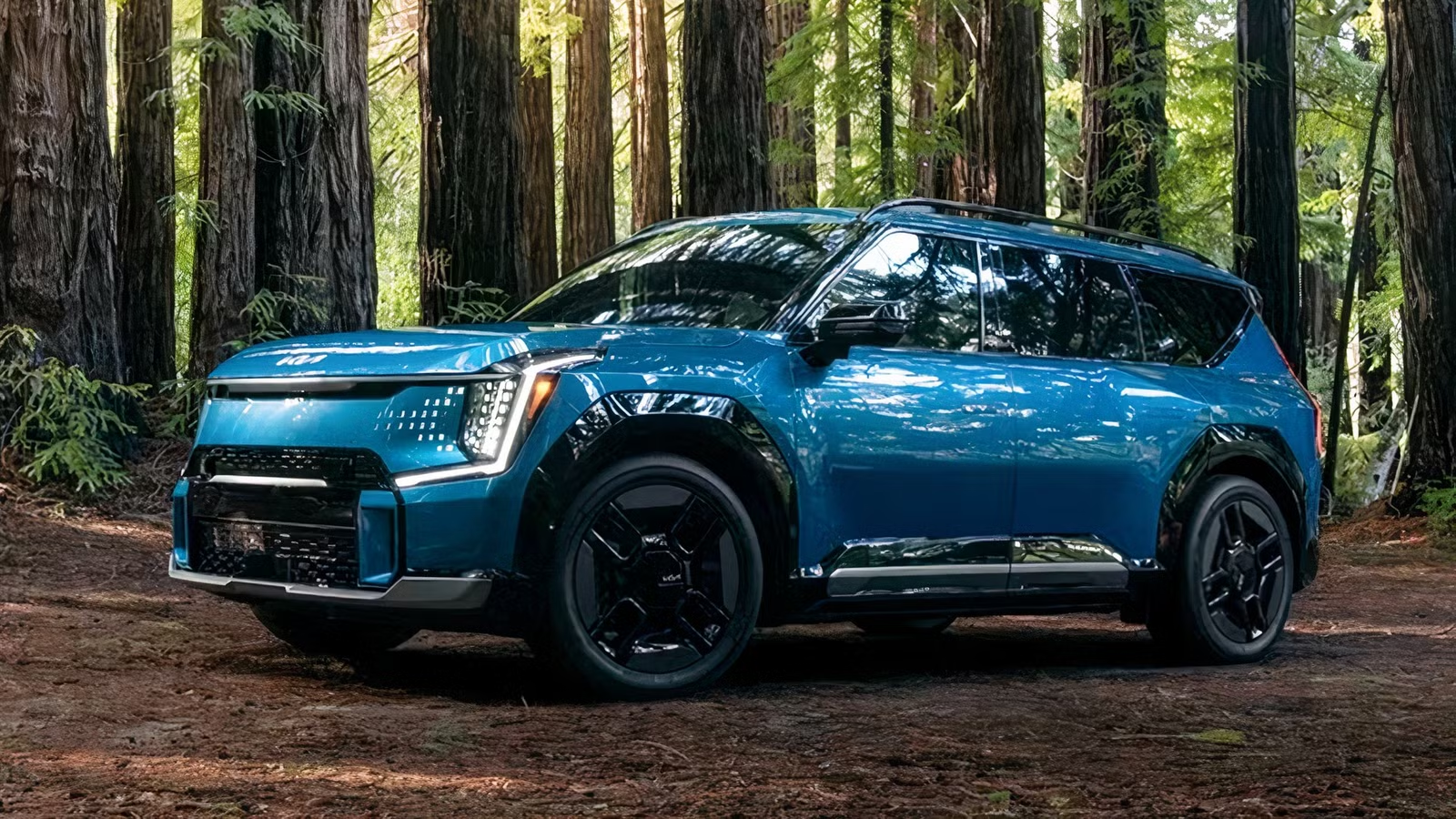
2024 Kia EV9 GT-Line in Ocean Blue driving Guillaume Fournier | TopSpeed | Valnet
The EV9 model range spans multiple price tiers and performance capabilities. Choosing between the base Light trim and the range-topping GT-Line changes powertrain output, wheel size, and chassis equipment, making it important to weigh speed against long-distance efficiency.
The $54,900 base Light RWD is only available with a single motor, producing 215 hp. With this configuration, the South Korean EV SUV accelerates from 0 to 60 mph in 7.7 seconds. The $57,900 Light Long Range variant reduces peak output to 201 hp to favor battery longevity, which extends the 0–60 mph time to 8.8 seconds. These single-motor models suit drivers who prioritize maximum distance over passing speed. The Light RWD offers 230 miles of range, while the Light Long Range trades quickness for a 304-mile highway radius.
Kia EV9 steering wheel and dashboardKia
Upgrading to the Wind e-AWD trim costs around $63,900 and brings dual motors delivering 379 horsepower, 443 lb-ft of torque, a 5.0-second 0 to 60 mph time, a 5,000-pound tow rating, and an estimated 280 miles of range on 19-inch wheels. The top-tier GT-Line e-AWD starts at $71,900 and retains the dual-motor setup, but software enhancements bump torque to 516 lb-ft. Boost mode enables a 4.5-second 0 to 60 mph time in independent testing, though the larger 21-inch alloy wheels result in 270 miles of range. The GT-Line also benefits from self-leveling rear air dampers, unique front bumper fascia, and dynamic interior lighting.
The Wind e-AWD trim offers the strongest overall balance of capability and Kia EV9 price within the lineup. You receive all-wheel drive, the full 5,000-pound tow rating, and 280 miles of EPA range while avoiding the steep price jump and minor range penalty associated with the 21-inch wheels on the GT-Line.
Kia EV9 vs. Rivian R1S: The Price-to-Performance Question
The Kia EV9 vs. Rivian R1S comparison reveals two distinct approaches to the three-row electric SUV market. The EV9 focuses on road-focused family transportation, high-speed charging, and accessible pricing, whereas the Rivian R1S emphasizes off-road capability, higher power output, and a luxury positioning that comes with a premium cost.
The price gap between the two models is substantial. The EV9 lineup spans from roughly $54,900 to $71,900, whereas the Rivian R1S ranges from around $76,900 for an entry dual-motor configuration up to $121,990 for flagship variants. You pay a premium for Rivian’s standard dual-motor power outputs that exceed 530 hp, an adjustable air suspension, specialized off-road hardware, and a higher maximum towing capacity of 7,700 pounds. The R1S also offers larger battery options that achieve up to 410 miles of EPA range.
Dynamic shot of the 2026 Rivian R1S QuadRivian
Despite the Rivian’s performance advantages, the EV9 holds a clear edge in charging architecture and interior packaging. The EV9 uses an 800V system capable of peak charging speeds up to 230 kW, allowing a 10 to 80 percent recharge in 24 minutes. The R1S uses a 400V system peaking around 220 kW, which requires 30 minutes for the same charge window.
In terms of daily comfort, the EV9 features a wider third-row floorplan that accommodates adults more easily, while the R1S delivers a firmer ride on pavement due to its off-road air suspension tuning. You save over $20,000 when choosing an upper-tier EV9 over a base Rivian R1S, making the Kia a far lower-cost option for suburban driving and family road trips.
Ownership Costs, Reliability, And Long-Term Value
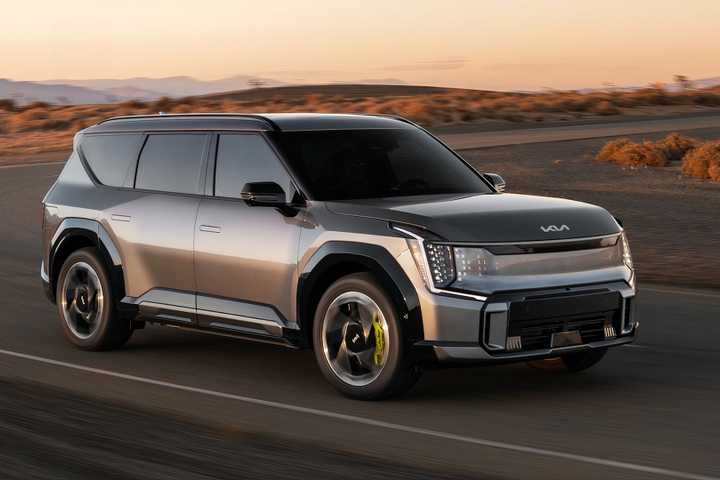
2025 Kia EV9 Side ProfileKia
Operating costs for the EV9 remain low compared to internal combustion three-row SUVs like the Kia Telluride or Infiniti QX80. Moving away from gasoline eliminates engine oil changes, spark plug replacements, air filter services, and transmission fluid flushes. Long-term cost factors remain favorable thanks to reduced brake wear from regenerative braking systems, lower home Level 2 charging rates compared to highway fuel prices, and comprehensive high-voltage component coverage.
Kia covers the EV9 powertrain and high-voltage battery pack with a 10-year or 100,000-mile limited warranty, alongside a bumper-to-bumper vehicle policy lasting five years or 60,000 miles. Edmunds‘ long-term owner reports highlight high overall satisfaction with daily ride quality, quiet cabin noise insulation, and real-world fast-charging reliability. Reported owner concerns primarily center on minor software interface glitches and climate control display placement behind the steering wheel rim.
Depreciation curves for electric vehicles vary based on regional incentives and evolving battery technology. Nevertheless, the EV9 retains solid residual value due to its rare position as an accessible three-row electric SUV with genuine 800V charging capabilities.
Should You Buy? The Verdict
2025 Kia EV9 Side Profile In Front Of WaterKia
You should buy the Kia EV9 if you require true three-row passenger space, fast road-trip charging capability, and reliable 5,000-pound towing without paying luxury prices. It delivers the functional utility of a traditional family crossover alongside advanced electric propulsion.
The EV9 serves as a great fit for growing families who need comfortable seating for up to seven passengers with usable third-row legroom. It also appeals to road-trippers who value 800V fast charging to minimize downtime at public charging stations, as well as towing enthusiasts who regularly haul small boats, camper trailers, or leisure gear up to 5,000 pounds.
However, off-road enthusiasts who plan to tackle rough terrain, rock crawling, or deep trails requiring extreme ground clearance and air suspension should look elsewhere, such as the Rivian R1S. Drivers seeking extreme distance between stops who require over 400 miles of continuous highway range on a single charge will also find the EV9’s battery options falling short of their needs.
The Kia EV9 establishes an accessible standard for three-row family electric vehicles. It blends real-world range, ultra-fast 800V charging, functional cabin space, and dual-motor performance into a practical package.












No Comments