
The Forgotten Concept That Wore Italian Couture Over Corvette Big-Block Muscle
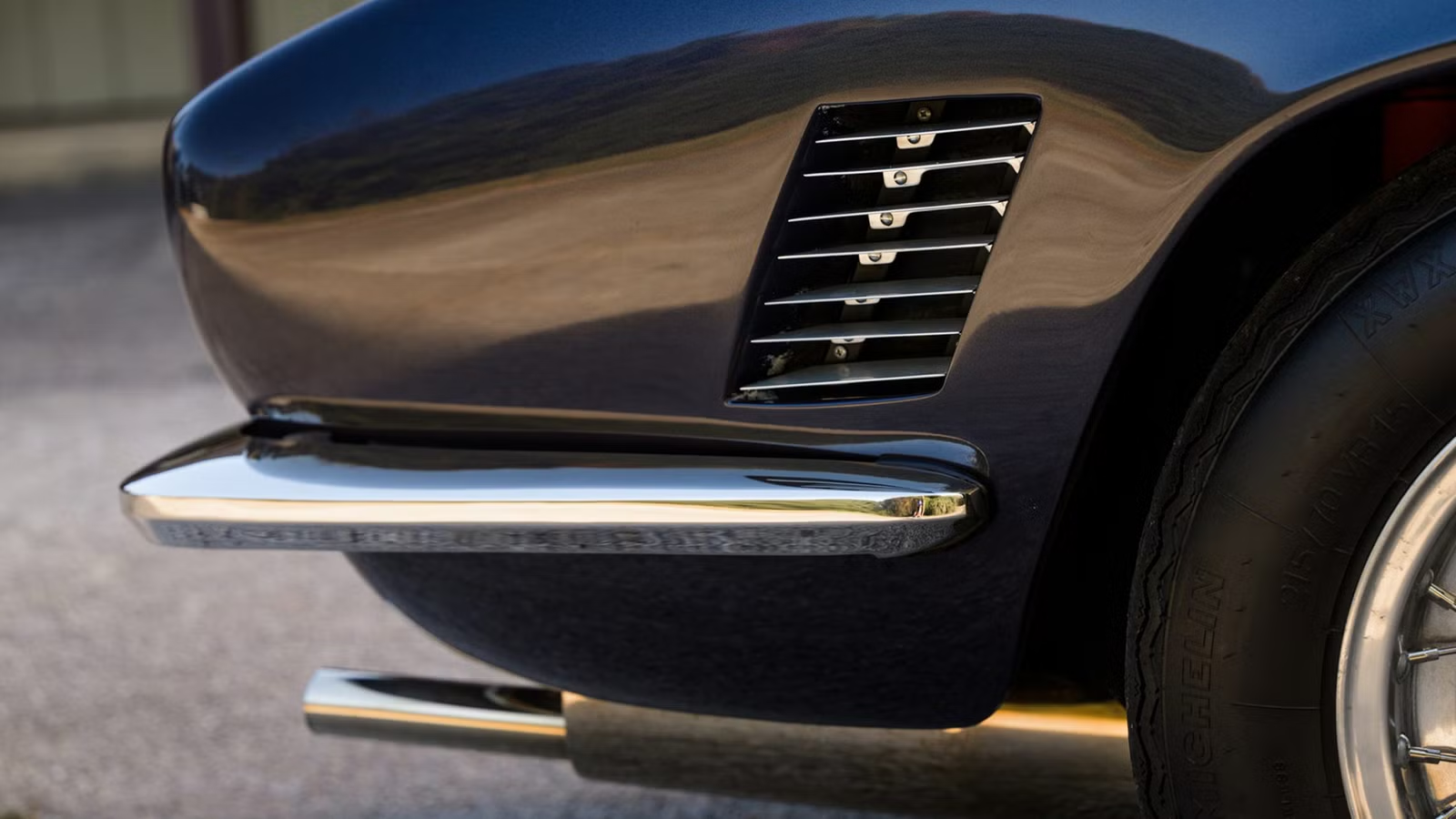
During the 1960s, Italy became the epicenter of grand touring cars. Ferrari dominated the segment with race-bred GTs, while Lamborghini quickly established itself as a serious challenger with the 350 GT in 1964. Amid these legendary names, Iso Rivolta took a different approach. Instead of developing an expensive Italian engine, founder Renzo Rivolta paired stunning Bertone styling with Chevrolet power.

Despite its credentials, it never achieved the fame of a Ferrari or Lamborghini, largely because of Iso’s small production numbers and limited global presence. Today, however, enthusiasts increasingly recognize it as one of the most underrated Italian GTs ever built.
When Bertone Styling Met Bizzarrini Engineering Genius
Few grand tourers have combined such an impressive design and engineering pedigree as this forgotten concept. Its sleek body was penned by a young Giorgetto Giugiaro during his time at Bertone, giving the car a long hood, short rear deck, and clean proportions that easily stood alongside contemporary Ferraris and Lamborghinis.

Beneath the elegant sheet metal was the work of Giotto Bizzarrini, the engineer who helped develop Ferrari’s legendary 250 GTO before leaving Maranello following the 1961 “Palace Revolt.”
Bizzarrini engineered the car’s chassis around a low-mounted front engine positioned well behind the front axle, improving weight distribution and handling. Combined with a stiff chassis and carefully tuned suspension, the result was a grand tourer that delivered confident high-speed stability and balanced road manners, proving it offered far more than simply Italian styling wrapped around an American V8.
The Series I Iso Grifo: Ferrari Looks With Chevy 327 And 427 Muscle

When the Series I Iso Grifo debuted in 1965, it was powered by Chevrolet’s proven 327 cubic-inch (5.4-liter) small-block V8, producing up to 350 horsepower depending on specification. The engine gave the Grifo effortless performance while remaining inexpensive and straightforward to maintain.
In 1968, Iso introduced the Grifo 7 Litri, replacing the small block with Chevrolet’s legendary 427 cubic-inch (7.0-liter) big-block V8. With as much as 435 hp on tap, the 427 transformed the Grifo into one of the fastest road cars of its era. Weighing roughly 3,100 pounds, the Italian GT combined exceptional power with a well-balanced chassis, allowing it to sprint to 60 mph in around six seconds and touch 170 mph. It was performance that rivaled, and in some cases surpassed, contemporary Ferrari and Lamborghini grand tourers.
Why Iso Chose Chevrolet Power Instead Of An Exotic Italian Engine

Iso Rivolta’s decision to install Chevrolet V8s was driven by practicality rather than compromise. Founder Renzo Rivolta wanted the Grifo to offer exotic Italian styling without the complexity and expense of a bespoke powertrain.
Chevrolet’s small-block and later big-block V8s had already proven themselves in road cars and motorsport, delivering impressive reliability, abundant torque, and a vast supply of affordable replacement parts. Unlike many contemporary Ferraris, which require specialist servicing and costly engine work, the Grifo’s Chevrolet engines could be repaired by competent mechanics almost anywhere.
That combination of dependability and accessibility significantly reduced ownership costs while preserving outstanding performance. Rather than diminishing the car’s appeal, its American V8 became one of the Grifo’s defining strengths, giving owners the best of both worlds: Italian craftsmanship paired with robust, proven engineering that was built to be driven.
The Series II Grifo And The Move From 427 To 454 Cubic Inches

The Iso Grifo entered its Series II production in 1970, bringing subtle styling revisions and a new generation of Chevrolet big-block power. While the Series I 7 Litri had earned its reputation with the formidable 427 cubic-inch V8, tightening emissions regulations and Chevrolet’s evolving engine lineup saw the 454 cubic-inch (7.4-liter) LS5 become the flagship engine.
The updated Grifo featured a notable raised hood scoop to accommodate the larger engine, along with detail changes to the front end and interior. The changes reflected evolving regulations and engine availability rather than any loss of the Grifo’s performance focus.
Even so, the 454-powered Grifo retained the effortless high-speed character that had defined its predecessor, proving that the Series II remained one of the fastest and most exclusive Italian grand tourers of its day.
The Unusual Ford Boss 351 Experiment That Few Remember
By 1972, Iso faced an unexpected challenge as Chevrolet’s tightening emissions requirements and supply constraints made its V8 engines increasingly difficult to source for export models.
In response, the company introduced the Grifo IR-8, powered by Ford’s high-performance Boss 351 V8. Although smaller than the Chevrolet 454, the 351 cubic inch (5.8-liter) engine still produced around 330 hp and offered strong performance while meeting changing market conditions. Only 34 IR-8s were built before Iso ceased automobile production in 1974, making them among the rarest Grifos ever produced.
While many enthusiasts associate the Grifo with Chevrolet power, the Ford-powered IR-8 highlights Iso’s willingness to adapt in order to survive. Today, these unusual models represent a fascinating chapter in the company’s history and are prized by collectors for their rarity and unique specification.
Only 413 Built: Rare Enough To Matter But Still A Real Driver’s Car

Iso built just 413 Grifos between 1965 and 1974, comprising approximately 330 Series I models and 83 Series II cars. Those numbers make it considerably rarer than many contemporary Ferrari and Lamborghini grand tourers, yet not so scarce that surviving examples never appear on the market.
Many Grifos have been carefully restored, while others continue to surface after decades in private collections or long-term storage, occasionally creating genuine barn-find opportunities. Unlike ultra-exclusive Italian exotics that rarely change hands, the Grifo remains attainable for knowledgeable collectors willing to search. Its combination of low production and Chevrolet-based mechanicals has steadily increased demand without pushing the car into an unattainable collector category.
Owning An Iso Grifo Today: Ferrari Drama Without Ferrari Maintenance Costs

The Iso Grifo has steadily gained recognition among collectors, with Hagerty values and recent auction results showing continued demand for well-preserved, matching-numbers examples. Hagerty put its average value at between $320,000 and $430,000. In 2016 atGooding & Company, a well-preserved 1969 7 Litri example sold for $682,000. On the other side of the spectrum, a 1966 barn find was auctioned at RM Sotheby’s for $162,400.
While prices have climbed into Ferrari territory for the very best cars, the Grifo still offers a compelling value proposition thanks to its unique blend of Italian design and American engineering. Chevrolet-powered models benefit from excellent parts availability, and experienced mechanics can service their V8s far more easily than period Ferrari or Lamborghini engines. That practicality encourages owners to drive rather than simply display them.
The Forgotten GT Gearheads Should Be Hunting Before Everyone Notices

The Iso Grifo remains one of the automotive world’s best-kept secrets, combining Giorgetto Giugiaro’s timeless Bertone styling, Giotto Bizzarrini’s race-inspired engineering, and Chevrolet V8 performance in a package unlike any other Italian grand tourer.
As Ferrari and Lamborghini values continue to climb, the Grifo stands out as a more attainable alternative without sacrificing exclusivity or driving excitement. Collectors should prioritize original Series I 7 Litri models powered by the 427 cubic inch V8, particularly matching-numbers examples with documented ownership history and factory specifications.
Professionally restored cars are also highly desirable, provided their originality has been preserved. With only 413 built and growing recognition among enthusiasts, the Grifo is steadily shedding its forgotten status. Those who buy one today are acquiring one of Italy’s most rewarding and underrated grand tourers before values climb even higher.
Sources: Bring a Trailer, Hagerty, Gooding & Company, RM Sotheby’s

Related posts



Latest Post


No Comments