
Harley-Davidson Once Made A Superbike
Harley-Davidson has always stood for something bigger than the destination — it stands for the ride itself. No other manufacturer has made a stronger case for the wide-open road, the unplanned route, and the unhurried mile. The massive V-twin engines, the deep bassy rumble, and a riding posture that looks cool from every angle combine to create an experience that feels less like transportation and more like a statement. Whether you’re threading through old country backroads or pointing the front wheel at the horizon with nowhere specific to be, a Harley is the right tool for the job.

Yet for all its cruiser DNA, Harley-Davidson has occasionally surprised the world by stepping away from the open road and pointing itself squarely at the racetrack. There was even one remarkable instance when the company built something entirely uncharacteristic — a genuine superbike.
Harley-Davidson Goes Racing With The Wrecking Crew
Believe it or not, Harley-Davidson bikes are a familiar sight on American circuits. There is even a championship designed for the Road Glide and the Indian Challenger called the King of the Baggers Championship. The Harley-Davidsons competing there run on modified Milwaukee-Eight 131 engines producing nearly 150 horsepower and 150 foot-pounds of torque. Beyond the engine, these machines go further still — race-ready suspension kits, aggressive ergonomics, increased ground clearance, and custom air intakes transform them into genuine thoroughbred racing machines.

This, however, was not Harley’s first stint at racing. You have to go back — way back — to the early 1900s. To the days of the Wrecking Crew.

The Wrecking Crew were a post-World War I Harley-Davidson racing outfit formed to secure national championships and shatter speed records. Even the name HOG — which now stands for the Harley-Davidson Owners Group — is rumored to have originated with rider Ray Weishaar, who famously completed a victory lap while holding a piglet. The Wrecking Crew included legends like Leslie “Red” Parkhurst, who set over 20 speed records in 1920 at Daytona Beach; Albert “Shrimp” Burns, the youngest champion of his generation; and Otto Walker, the first rider to win a 300-mile race with an average speed exceeding 80 mph.

So, Harley-Davidson went racing. But what’s this about a Harley-Davidson superbike?
Harley-Davidson VR1000: Everything You Need To Know

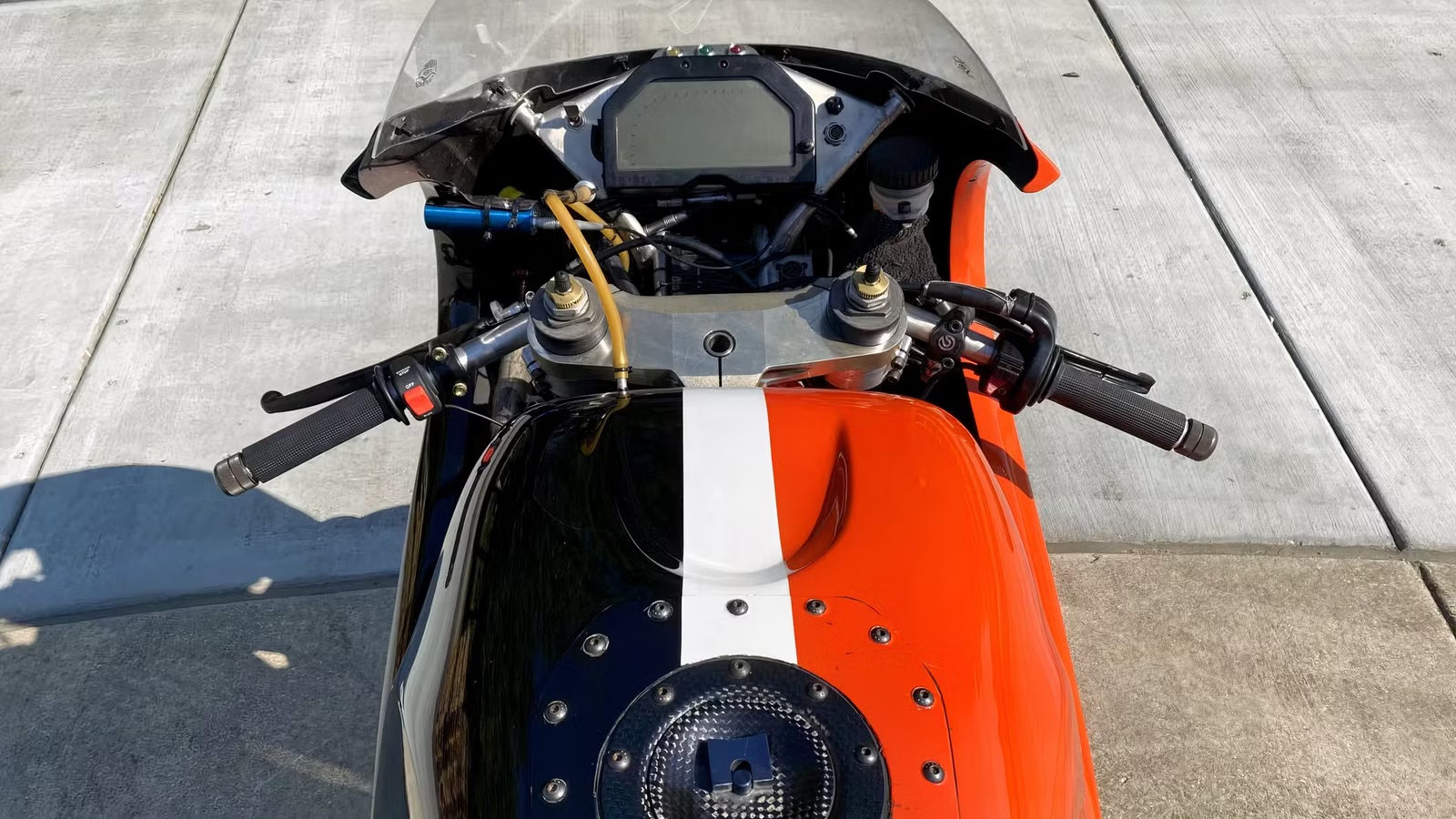
The VR1000 was Harley-Davidson’s answer to the American Motorcyclist Association (AMA) Superbike Championship in the early 1990s. Development began in the late 1980s with the involvement of Porsche under the banner Project Nova. That collaboration produced a water-cooled V-twin engine in V4 and V6 variants, work that would eventually feed into the modern-day Revolution engine family.
The bike made its on-track debut in 1993 for testing, then entered its first race in 1994. What set this Harley apart from everything else wearing the bar-and-shield badge? Unlike its cruiser siblings, the VR1000 was built around a liquid-cooled DOHC 60-degree V-twin engineered for one purpose alone: racing. It was America’s answer to the Japanese inline-four superbikes that had come to dominate the era.

The Harley-Davidson VR1000 was powered by a liquid-cooled 996cc V-twin DOHC engine developing 150 hp — or 135 hp in road-legal trim — at 10,000 rpm, along with close to 100 lb-ft of torque. Power was delivered through a five-speed gearbox housed in an aluminum twin-spar perimeter frame, keeping the dry weight to just under 389 lbs. The specification didn’t stop there: fully adjustable Öhlins forks up front, a Penske monoshock at the rear, dual front discs with six-piston calipers, a single rear disc, and a fuel capacity of roughly 4.5 gallons rounded out the package. Top speed was reported at 165 mph on the racetrack.

Something unique about the VR1000 was that it was ahead of its time, adopting electronic fuel injection when many AMA competitors still relied on traditional carburetors. Harley-Davidson was required to build 50 road-legal units to satisfy homologation requirements, and in doing so created its first true attempt at a modern superbike — rather than a flat-track or cruiser-based racing machine.
Why Was The American Dream Short Lived?

The VR1000’s roots stretched back to the late 1980s, yet the project quickly fell into what can only be described as development hell. Despite being slated to debut in 1990, it didn’t reach the grid until 1994 — by which point it was already playing catch-up. Reliability problems plagued many of its races. At Daytona in 1994, for example, the bike failed to finish after a weld failed on the counter-balancer gear, triggering a catastrophic engine failure.
Beyond reliability, the VR1000 faced a stubborn performance gap. Despite leading the class on paper in outright numbers, rivals including the Yamaha 750R, the Honda RC45, and the Kawasaki ZXR750 — all producing between 110 and 125 horsepower from their 750cc configurations — consistently outperformed the Harley in race conditions. On the occasions when the VR1000 showed genuine pace, mechanical failures would intervene, resulting in DNFs or lowly finishes.
The best result for the VR1000 came at Brainerd International Raceway, where Miguel Duhamel finished fourth after a strong run that included leading laps — a performance that hinted at a well-deserved podium for the Milwaukee outfit, even if it ultimately didn’t materialize. Another encouraging moment came when the bike qualified third at the Mid-Ohio round, though that weekend ended in a 14th-place finish.

The VR1000 programme ran from the mid-1990s into the early 2000s, a period defined by near-misses and what-ifs. Reports that emerged around 2001 revealed that the racing project had faced near-cancellation at almost every turn, suggesting that senior management was never fully committed to the VR1000 effort — particularly after the difficult 1994 season.
Other Harley-Davidson Specials

Harley-Davidson has been synonymous with motorcycle culture for as long as anyone can remember, and over the decades it has produced some of the most iconic machines ever built.
Speaking of cultural moments, do you remember the 1991 Harley-Davidson Fat Boy’s starring role in Terminator 2? In the film’s iconic canal chase sequence, Schwarzenegger’s T-800 commandeers the Fat Boy, takes it off-road, and launches it off a ramp — arguably the coolest scene ever filmed on a motorcycle.

In other chapters of Harley’s racing history, the XR750 — the brand’s most successful factory racer — dominated the Transatlantic Trophy with Cal Rayborn aboard and served as Evel Knievel’s stunt bike of choice. During its competitive lifespan, the XR750 claimed close to 28 of the 37 AMA Grand National Championships contested in its era.

On the other side of the world, Harley-Davidson’s mighty V-twin lost one of its cylinders in the interest of reaching a new audience. In a model developed exclusively for India, Harley partnered with local motoring conglomerate Hero to create the X440, aimed squarely at the competitive sub-500cc segment. The bike has breathed new life into the Harley faithful in India, offering a convincing option for enthusiasts who want the brand without a full-size cruiser in the driveway.
How Much Does The VR1000 Cost Today?
Now for the million-dollar question: what will it cost to get one of these into your garage today? Given that all VR1000 examples can only be acquired through auctions or private sales, prices range anywhere from $90,000 to as high as $129,000 — the latter figure recorded at the 33rd Annual Vintage Motorcycle Auction in Las Vegas in 2024.

Related posts

Latest Post



No Comments