
Here’s How Much It Costs To Replace A Toyota EV Battery
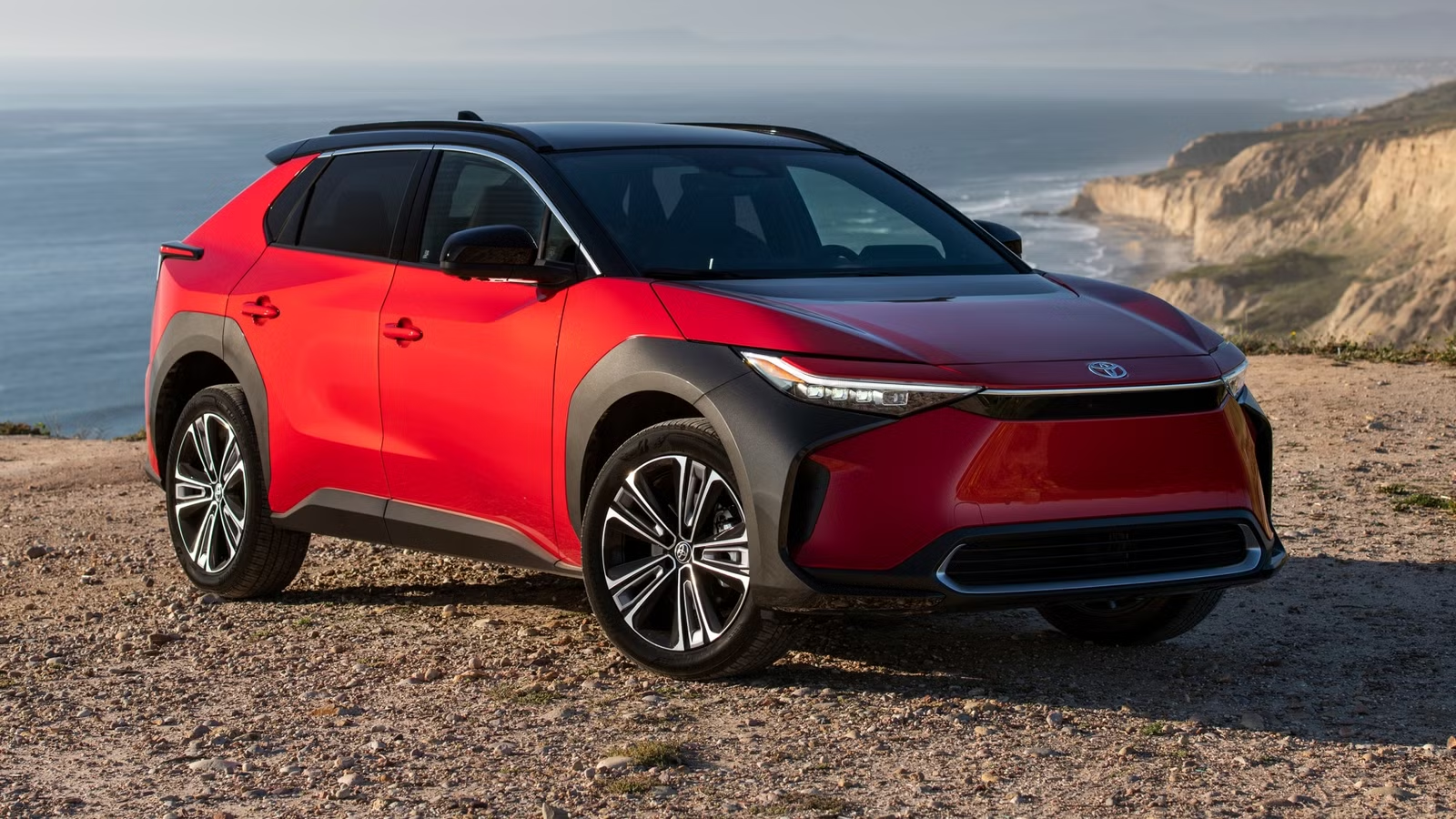
Battery anxiety is real — and for Toyota bZ4X owners, it’s a legitimate long-term ownership question worth answering clearly. The bZ4X remains Toyota’s primary fully electric offering in the U.S. market, and while the brand has taken a famously measured approach to electrification, that doesn’t make the eventual battery replacement question any less pressing for current and prospective owners. Whether you’re buying one today or already have one in the driveway, knowing what a battery replacement actually costs — and how to delay it as long as possible — is essential homework.

If you’re planning to purchase a bZ4X with long-term ownership in mind, you’re inevitably going to have the battery pack modules exchanged once they reach the end of their lifespan. Lithium-ion battery cells degrade with time and use, resulting in a chemical instability that prevents them from maintaining the same level of charge compared to when they were new. Here’s how much you can expect to pay for a battery replacement if you need to conduct the repair today.
The Toyota bZ4X Only Has One Battery Option
Toyota offers the bZ4X with a choice of two drivetrain configurations, available for both XLE and Limited trims. The standard front-wheel drive option produces 201 horsepower and 196 pound-feet of torque, resulting in a 7.1-second claimed 0–60 mph time. Toyota is somewhat conservative with this figure, as independent tests have recorded times as fast as 6.7 seconds. Toyota limits the single motor’s top speed to 99 mph.

All bZ4X models share the same 71.4 kWh lithium-ion battery pack. The front-wheel drive XLE is the most efficient model of the lot, with an impressive 119 MPGe EPA combined energy consumption estimate. The Limited’s slightly larger wheels bring that down to 114 MPGe. The all-wheel drive variants see a more significant drop in efficiency — 104 MPGe for the XLE and 102 MPGe for the Limited.
Performance Specifications
| Front-Wheel Drive | All-Wheel Drive | |
| Price | $43,070 | $46,545 |
| Powertrain | Single Permanent-Magnet Motor | Dual Permanent-Magnet Motors |
| Transmission | Single-Speed Automatic | Single-Speed Automatic |
| Horsepower | 201 HP | 214 HP |
| Torque | 196 LB-FT | 248 LB-FT |
| Driveline | Front-Wheel Drive | All-Wheel Drive |
| Battery | 71.4 kWh Net | 71.4 kWh Net |
| Range | 246-252 Miles | 246 Miles |
| Fast Charging Time | 30 Minutes | 35 Minutes |
| Energy Consumption | 28-30 kWh/100 Miles | 31-32 kWh/100 Miles |
| 0-60 MPH | 7.3 Seconds | 6.7 Seconds |
| Top Speed | 100 MPH | 100 MPH |
| Towing Capacity | 1,500 Pounds | 1,500 Pounds |
The Toyota bZ4X is the Japanese brand’s first mass-produced fully electric crossover, but despite Toyota’s longstanding history in automotive electrification, the model suffered from a rocky market launch. Toyota remains committed nonetheless, and has continued to refine the bZ4X with incremental updates each model year.
The bZ4X rides on Toyota’s e-TNGA platform and competes in the increasingly crowded electric compact crossover segment. Toyota continues to take a measured approach to the electric car market until the industry and global infrastructure make the technology more broadly viable. In the meantime, the bZ4X remains its primary competitor in the battery-electric arena, with ongoing updates aimed at addressing early criticisms.
How Much A New Toyota EV Battery Costs
Toyota’s U.S. online parts catalog is a genuinely useful resource, but it stops short of disclosing the cost of a complete battery pack. It does, however, list prices for all the auxiliary components, including the onboard charger, inverter, and voltage sensors, with prices ranging between $7,338.40 and $14,380.78. You’d only need to consider these components if they were damaged in a collision or due to a manufacturer defect. A third-party retailer lists two bZ4X battery packs from recent model years. Based on that data, you can expect to pay around $19,831.50 for the full pack before labor costs, which will add several thousand dollars to the final repair bill.
Once your EV’s battery reaches the end of its lifespan, you won’t necessarily need the full pack replaced — only the affected modules. The bZ4X’s 71.4 kWh battery pack consists of eight modules. Estimates suggest that a full module replacement will cost between $8,000 and $10,000, excluding labor. Toyota’s official EV battery supplier is Panasonic, and the two companies collaborate through a joint venture called Prime Planet Energy and Solutions.
Toyota also sources batteries from other companies like CATL and BYD to meet increasing demand. The company plans to introduce next-generation battery technologies, including solid-state batteries, with the promise of faster charging times, improved safety, and longer range. Toyota has also announced plans to reduce battery costs significantly through innovations in materials and production processes. The automaker aims to achieve carbon neutrality by 2050, with these advancements playing a key role in scaling up its EV lineup.
How Long The bZ4X’s Battery Lasts

Toyota has stated that the bZ4X’s battery will retain 90 percent of its capacity after 10 years of regular use, provided owners follow recommended maintenance and care practices. To extend the lifespan of your bZ4X’s battery, there are a few habits worth building.
Maintaining a strict and balanced charging procedure is the most effective way to extend long-term battery life. This means keeping the battery’s state of charge between 20 and 80 percent during everyday use. Regularly cycling the battery from 100 percent down to empty will accelerate chemical degradation and bring forward the point at which module replacement becomes necessary.
How Toyota Conducts An EV Battery Replacement
- Toyota technicians diagnose the battery to confirm module degradation or defects.
- They then remove the high-voltage battery pack from the bZ4X for detailed inspection.
- The faulty or degraded modules within the battery pack are identified using specialized diagnostic tools.
- Technicians replace only the defective modules, rather than the entire battery pack, minimizing waste and cost.
- After replacing the modules, the battery is reassembled and thoroughly tested to ensure it meets performance standards.
- Finally, the reinstalled battery undergoes additional tests to verify proper integration with the vehicle’s systems.
It’s also wise to use DC Level Three fast chargers sparingly, as frequent exposure to high-voltage DC fast charging can degrade battery cells more quickly than standard AC charging, primarily due to the elevated heat generated during the process. Overnight charging via a Level 1 or Level 2 AC charger in a shaded or climate-controlled space is the ideal scenario for preserving long-term battery health.
Preconditioning to warm up the battery before driving in cold weather is also a valuable habit to adopt. Most modern EVs include a battery heater as standard equipment, or offer one as an option. If you plan to use the bZ4X infrequently, it’s best to keep the state of charge at around 50 percent and store the vehicle in a cool, dry environment.
Toyota’s Battery Warranty For The bZ4X

Toyota’s standard warranty package includes 36-month/36,000-mile basic coverage, a 60-month/60,000-mile powertrain and corrosion perforation warranty, and a 120-month or 150,000-mile coverage for all-electric drive components.
Toyota covers scheduled maintenance within a 24-month or 25,000-mile period, along with roadside assistance for 24 months over unlimited miles. The battery warranty covers any defects in materials or workmanship related to the lithium-ion battery and guarantees it retains at least 70 percent of its original capacity during the coverage period. If the battery’s capacity falls below that threshold, Toyota will repair or replace it. The warranty also covers performance degradation that arises under normal driving conditions.
| Type | Length |
|---|---|
| Full Warranty | 36 Months/36,000 Miles |
| Powertrain Warranty | 60 Months/60,000 Miles |
| Battery Warranty | 10 Years/150,000 Miles |
| Maintenance Warranty | 24 Months/25,000 Miles |
| Roadside Warranty | 24 Months/Unlimited Miles |
| Corrosion Warranty | 60 Months/Unlimited Miles |
It’s important to follow Toyota’s recommended maintenance practices to keep the warranty valid, including proper charging habits and avoiding misuse. If the vehicle is sold within the warranty period, coverage transfers to the new owner — a meaningful benefit for resale value. The battery warranty is separate from the standard vehicle warranty, providing dedicated protection for the high-voltage system.
Toyota’s comprehensive battery coverage reflects its confidence in the durability and reliability of the bZ4X’s battery pack, offering genuine peace of mind for owners making the transition to electric driving. Toyota’s extensive service network is also on hand to handle any warranty-related battery concerns efficiently.
Sources: Toyota, EPA

Related posts





Latest Post


No Comments