
The High-Revving Mazda V6 Hiding In Two Coupes Cheaper Than A Used Civic
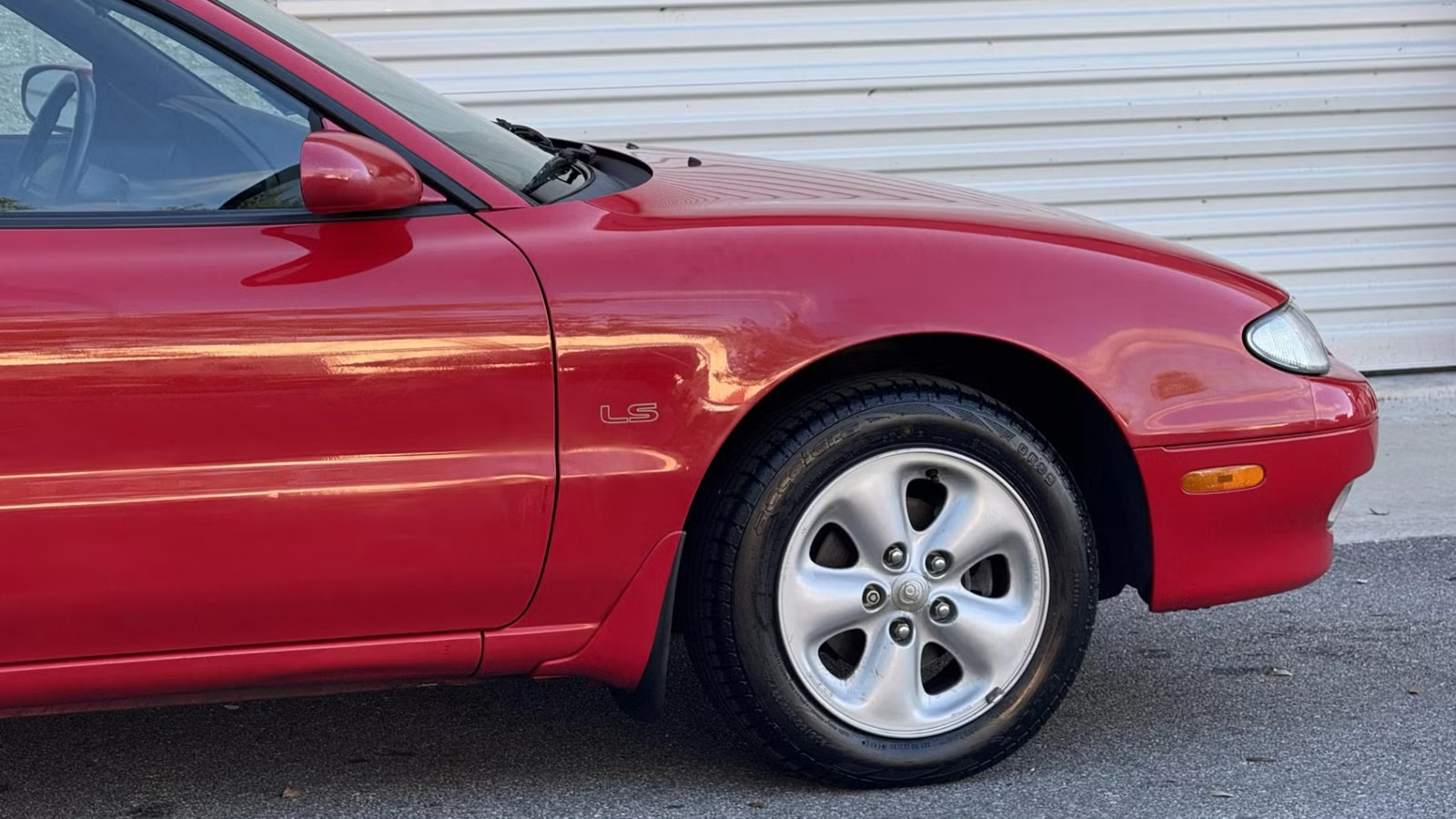
In the early 1990s, Mazda built an all-aluminum V6 that revved to 7,000 rpm, featuring a three-stage variable intake and a forged steel crankshaft. To fit under short hoods, engineers packaged it tightly.

Yet this engine never powered a collector favorite. It spent its life largely associated with two front-drive coupes—the MX-6 and Ford Probe GT—that the market dismissed quickly. Though Mazda shared the V6 with sedans like the 626, these coupes were meant to showcase its high-revving nature. Today, clean examples cost less than a used Civic, remaining entirely overlooked by enthusiasts.
Mazda’s High-Revving V6 Was Better Than Its Job Required
Mazda’s KL-series 2.5-liter V6 belonged to the K-series engine family, a clean-sheet design built around a short-stroke 60-degree layout with belt-driven dual overhead cams and 24 valves. The block was an aluminum split-crankcase design with four-bolt main bearings, and the crankshaft was forged steel rather than the cast units common in this price class. According to Mazda’s own SAE engineering paper, the whole package was deliberately compact so it could slide under the short hoods of front-wheel-drive cars.

The clever part sat on top. Mazda’s Variable Resonance Induction System, or VRIS, used three intake chambers tuned to specific resonant frequencies, opening and closing butterfly valves to keep the torque curve full across the rev range. It achieved much of what variable valve timing promised without touching the valvetrain at all.
The engine redlined at 7,000 rpm with a limiter at 7,500 rpm, and the internals were strong enough that enthusiasts consider even those figures conservative. In US trim, the KL-DE produced 164 hp and roughly 160 lb-ft of torque, enough to run with the Acura Integra GS-R and Honda Prelude VTEC of the era. Japan kept a higher-compression version rated at roughly 200 hp for itself, and American showrooms never saw it.
The Mazda MX-6 And Ford Probe GT Were Twins Under The Skin

The engine lived in the 1993–1997 Mazda MX-6 LS and its mechanical twin, the second-generation Ford Probe GT. Both cars sat on Mazda’s GE platform and shared nearly everything underneath, with Ford’s contribution limited mostly to the Probe’s body and interior design. They were even built side by side at the AutoAlliance joint-venture plant in Flat Rock, Michigan, rolling down the same line for the North American market.
The Probe carried heavier baggage than its badge suggested. Ford originally developed the car as a front-wheel-drive replacement for the Mustang, and the reaction from Mustang loyalists was hostile enough that Ford reversed course entirely. The company kept the rear-drive Mustang alive and repositioned the Probe as an import-style rival to the Honda Prelude and Toyota Celica, a role it never fully escaped.
On the engine front, the numbers deserve precision because they are often confused. Every US-market MX-6 LS and Probe GT left the factory with the 164-hp KL-DE, and no domestic buyer could order anything stronger. The roughly 200-hp KLZE was a Japan-only variant that American enthusiasts discovered later, prized because it bolts into these cars with minimal modification as an imported swap rather than a factory option.

That swap-friendliness is a big reason the community around these coupes survived at all. The engine bay that held a 164-hp commuter V6 could accept Japan’s best version of the same architecture, which kept owners wrenching long after the market moved on.
Four-Wheel Steering Proved How Serious Mazda Really Was

The clearest window into Mazda’s ambition for these cars is the four-wheel-steering system the MX-6 offered. An electronically controlled rear rack turned the rear wheels opposite to the fronts below 22 mph, tightening the turning circle for parking and city maneuvering. Above 50 mph, the rear wheels turned in the same direction as the fronts, sharpening lane changes and improving high-speed stability.
Mazda capped the rear steering angle at five degrees, the threshold its engineers determined was mechanically significant but still transparent to the driver. The system was also smarter than its main rival, because unlike Honda’s purely mechanical Prelude setup, Mazda’s 4WS sensed vehicle speed electronically and adjusted its behavior accordingly.

Four-wheel steering reached the US market only on the first-generation turbo MX-6, where it was offered briefly for the 1989 and 1990 model years. No second-generation US car ever came with the option. Shoppers hunting for a domestic 4WS second-gen coupe are hunting for a car that does not exist.
What did cross the Pacific was the engineering culture behind it, baked into the GE chassis both coupes shared. Car and Driver praised the Probe GT’s balance in period testing, and its MacPherson struts and tuned sway bars let it carry enough corner speed to walk away from a same-year V8 Mustang GT on a winding road.
Why Enthusiasts Dismissed Two Genuinely Good Cars

The MX-6’s biggest problem was that Mazda dealers in the mid-1990s could point a buyer toward the rear-drive Miata or the twin-turbo RX-7, and next to those two, a front-wheel-drive coupe sharing its bones with a Ford looked like a compromise. The engineering underneath never got a fair hearing because the layout disqualified it before the conversation started.
The Probe carried a different wound to the same effect. It entered the world as the car that almost replaced the Mustang, and Mustang loyalists never forgave the attempt. Even after Ford repositioned it against the Prelude and Celica, the Probe wore that origin story like a scarlet letter at every enthusiast gathering.

The RWD halo cars absorbed the magazine covers, the club attention, and eventually the collector money, while their platform-mate quietly depreciated into beater territory. Badge snobbery, not engineering failure, wrote the market’s verdict.
Enthusiasts have seen this exact blind spot before. Through the late 2000s, the NA Miata was dismissed as a hairdresser’s car and traded for pocket change, right up until the market noticed what it had been ignoring. The MX-6 and Probe GT sit in the same position today, competent machinery hiding behind an unfashionable reputation, waiting for the reassessment that history suggests will eventually arrive.
Clean V6 Coupes Are Still Affordable For Now

According to Classic.com sales data, the average MX-6 changes hands for $7,250, with second-generation cars averaging $6,980, and clean manual V6 examples trading between $6,000 and $10,000. That buys a high-revving aluminum V6 coupe for less than most used Civics, while RX-7 values have climbed out of reach and even rough NA Miatas command real money.
An informed buyer should know the one genuine weak point. The KL engine’s distributor houses its ignition coil internally, and heat kills it, producing a car that stalls without warning and refuses to restart until the engine cools. The community fix is an HEI retrofit or a quality OEM replacement, and it should be the first job on any new owner’s list.

The playbook here is the one Miata buyers wish they had followed a decade ago. Find the cleanest manual V6 car available, favor an unmodified KL-DE over a tired KLZE swap of unknown history, and budget for the distributor before anything else. At current prices, the cost of being early is a few thousand dollars, and the cost of being late is watching another overlooked 1990s Mazda become somebody else’s smart buy.
Sources: UPI, Classic, Car and Driver, SAE

Related posts



Latest Post


No Comments