
6 Detroit Prototypes That Somehow Escaped The Crusher Yard
When the designers and engineers at Ford launched their Vette-hunting Mustang I concept in ‘62, they didn’t have the heart to see it go to the crusher when its promotional duties were over. Instead, it was smuggled out of Ford’s design center and hidden away from the big bosses. It now resides in a place where all gearheads can savor and reminisce about the good times of concept cars. Most US show cars of the period, like those from the General Motors Motorama during the ’50s and early ’60s, were ordered to be disposed of to prevent exposing trade secrets.

But not all concepts met gruesome ends. Thankfully, some were rescued and preserved by private individuals, heritage vehicle fleets operated by the manufacturer or donated to museums by the teams who worked on them. These six prototypes from Detroit, created between 1955 and 1970, were supposed to be destroyed under the makers’ prototype destruction strategies of the period, yet somehow lived to tell the story. From the smuggled Mustang to barn finds that rewrote history, these six cheated the crusher, played their game against death, and won.
6
AMC AMX/3
1970
At the start of the 70s, European exotics from Lamborghini and Ferrari were making the ultimate poster cars. AMC wanted a piece of the action to rival the De Tomaso Pantera marketed by Ford in the US, so in 1968, they developed their own world-class halo car to boost its image into one capable of hunting Ferraris. Only 30 of these ultra-exclusive Lambo-beaters were planned for production, but the project was canceled after just five officially commissioned, pre-production prototypes were built as the company’s financial pressures hit hard, and vehicle regulations became stricter.

Rather than being crushed, the few prototypes built were secretly saved and sold off by their engineers Giotto Bizzarrini and co-worker Salvatore Diomante. Chassis #1 was found in a barn-find state after being hidden for decades in a Michigan barn before being put through restoration by its current owners. Meanwhile, chassis numbers 2–5 also found their way into collections. Four subsequent chassis were also constructed but not completed: chassis #6 and #7 were assembled from leftover parts, while chassis #8 turned into the Iso Rivolta Varedo concept, and the last chassis, #9, turned into a one-off Spider. Today, they have become multi-million-dollar collectible pieces that have survived to tell the story.
5
“Little Red” Shelby GT500 EXP
1967
With a vision to create a Mustang which married Ford’s engineering with Shelby’s street-legal, track performance, two in-house experimental Mustangs were built between ‘67 and ‘68 by engineers at Shelby and Ford. They served as rolling laboratories for the firm’s advanced performance technology. The only red GT500 notchback coupe known as “Little Red” became a test bed for dual-quad carburetors, independent rear suspension, and a supercharged 428 V8. A year later, it was joined by a standard green Mustang notchback coupe running a GT500 drivetrain, known as “Green Hornet,” which showcased 428 Cobra Jet engine parts along with an experimental Conelec electronic fuel injection system and independent rear suspension.
While the “Green Hornet” was sold to a Ford employee after narrowly being crushed in ‘71, and passed through collectors since, Little Red’s fate was believed to not be so fortunate. Long believed to have been destroyed, Little Red actually managed to escape destruction before being traced down and discovered in 2018 by Craig Jackson, Chairman and CEO of the Barrett-Jackson Auction Company, after it sat for 20 years rotting in a Texas field. After Shelby was done with the one-of-a-kind Mustang, it was sent to Courtesy Ford in Littleton, Colorado, where it was purchased by a Vietnamese veteran who sold it to a Texas buyer, where the car was put into storage. But due to a break in, it was brought to a family member’s yard where it was laid up before being discovered by Jackson. Today, the Candy Apple Red Mustang has been fully restored to become a proud piece of Shelby heritage.
4
Ford GT40 MK IV J-5
1967

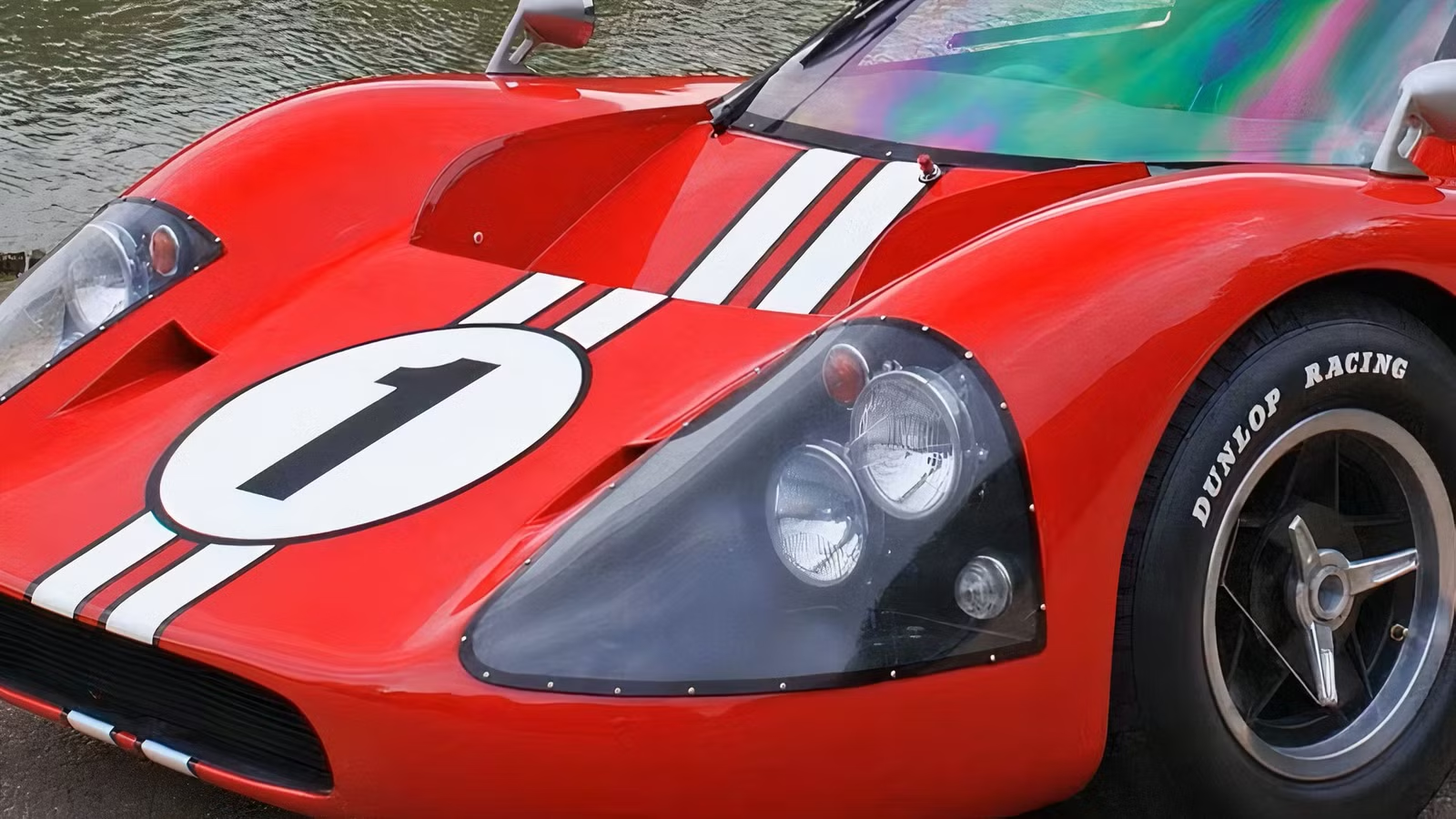
When it comes to the best Ford time capsules, though, the GT500 EXP was left in the shadow of Ford’s GT40 J-5 MK IV. Part of an advanced development series of cars, it was an experimental prototype developed under the “J-Car” program, designed to push the physical limits of the original GT40’s formula further. Powered by a 427 V8 and built to conquer the grueling 24-hour endurance race, the J-5 was driven to victory at the 1967 24 Hours of Le Mans by Dan Gurney and A.J. Foyt. Instead of a heavy steel monocoque chassis, this Detroit marvel featured a ‘shaped’ lightweight honeycomb aluminum construction to reduce weight and increase aerodynamics.
Aside from its victory at the ’67 race at Le Mans, it also became the first all-American car to be designed, engineered, manufactured, and raced at the event, with the previous GT40s having foreign influence in one way or another. Because it cemented its place in motorsport history, it was too valuable for Ford bosses to send to the scrap heap. So instead, Ford preserved and donated it in 1972 to the Henry Ford Museum in Michigan, where it now sits with the Mustang I concept.
3
Corvette CERV II
1964
Ford’s glory at Le Mans with the GT40 sparked GM to come up with its own endurance killer, the Chevrolet Engineering Research Vehicle (CERV) II—not to be confused with its Indy-car-racing CERV I. Designed by Corvette’s Chief Engineer Zora Arkus-Duntov, this high-performance, mid-engined racing experiment tested the capabilities of all-wheel-drive technology to maximize traction and speed through corners. Powered by a 377 cubic-inch aluminum V8, and later a larger 427 big block, the CERV II could hit 60 mph in under three seconds. Despite its performance, though, it never made it to the track due to GM’s strict racing ban that came into force in ’64, as GM feared the financial and political issues associated with a direct racing war with Ford at Le Mans. So engineers repurposed it as a prototype for an upcoming “Super-Vette” project, but the top dogs at the highest corporate level canceled the program due to costs being unjustifiable.
GM executives ordered the CERV II prototype to be scrapped, but due to the swift intervention from Zora, who advocated for its preservation, GM was persuaded to donate it to the Briggs Cunningham Automotive Museum in Costa Mesa, California. Since leaving the museum, which closed its doors in 1986, it’s been preserved by several collectors and has crossed the auction block for seven figures.
2
Ford Mustang I
1962

Ford’s goals to change the brand’s image into one that was youthful and exciting during the ’60s saw it test the viability of low-cost, two-seat sports cars. The first output from this idea was the mid-engined Mustang I concept. Overseen and developed by design chief Eugene Bordinat and his team, it became a rolling marketing tool and test laboratory for what would eventually become the first production Mustang in 1964. Unfortunately, there was limited interest in two-seat, mid-engined roadsters at the time, and the Mustang I Concept’s radical, complex design features like the hand-fabricated aluminum body and tubular space-frame chassis made it unviable for mass production.
Touring American colleges and racing events across the US, the Mustang I Concept lived a great promotional life as per Ford’s intent. And it even starred in its own promotional film upon its debut, demonstrating how concept cars could influence passenger models of the future. But once these were over, the Mustang I Concept was set for one fate—the scrap heap. Instead, though, the running prototype was hidden away in different warehouses by the team who created it, most notably Bordinat and lead engineer Roy Lunn—the same man who worked on the GT40 J-5. Today, the Mustang concept can be viewed at the Henry Ford Museum.
1
Chevrolet Biscayne
1955
GM’s Motorama has to be one of the most glamorous events there has ever been for prototype cars. With their extravaganzas showcasing all the latest models from GM’s divisions, including their revolutionary “dream cars”, the 1955 show became the launchpad for the Chevy Biscayne concept. It debuted their 265 small block V8, a pillarless four-door hardtop construction, swivel front seats and suicide doors, transforming the brand’s image overnight. This single concept greatly influenced GM’s later production cars, like the indented side scoops that inspired the side coves on the first-generation Corvette. The silhouette turned into the 1960 Corvair, and the wraparound windshield made it to production between 1959 and 1960.
Once its glitzy show life was over, GM consigned the Biscayne to Warhoops Junkyard in Sterling Heights, Michigan, in 1958 to be destroyed, and sent an executive to oversee the car’s disposal at the premises. But they left before witnessing its complete destruction due to the approaching Christmas vacation period at the time. As a result, Harry Warholak, the yard’s owner, didn’t kill the car’s one-of-a-kind past, but instead scattered its broken-up fiberglass body sections around the site where they sat in a neglected state for decades. It was later chased down by its current owner, Joe Bortz in the 1980s, who was fascinated with GM’s Motorama concepts, and wanted to purchase as many survivors as possible. He meticulously restored the Biscayne to the correct specification using GM’s original factory blueprints. The Biscayne’s uniqueness and pioneering features helped it remain one of the best concepts to come from the Motorama series, and it stands as a testament to a period when GM was reveling in success.
Sources: Barrett-Jackson, CorvSport.com, Motorsports Hall Of Fame, MotorCities.org, Hemmings, Shelby

Related posts


Latest Post


No Comments