
7 Boss 429 Mustangs With Kar-Kraft Docs Still Intact Today
In the late 1960s, Ford wanted to homologate its 429 cubic-inch Cobra Jet V8 for NASCAR competition, which it hoped would be a Hemi killer. Ford could have met the requirements by installing the engine in the Torino, which was its race car, but instead decided to drop it into some fastback Mustangs, which became the legendary Boss 429s. The problem was, the 429 didn’t actually fit in the Mustang’s engine bay, so they contracted Kar-Kraft, a specialized engineering and manufacturing company, to do the shoehorning. The Mustangs were built at Ford’s Dearborn, Michigan plant without engines or transmissions and then sent to Kar-Kraft’s facility in Brighton for modifications and final assembly.

Kar-Kraft had to alter the front shock towers, redesign the front apron and engine mounts, clear out some space in the engine compartment, and relocate the battery to the trunk to get the massive 429 big-block to fit. Produced from 1969–1970, every Boss 429 received a Kar-Kraft number that was separate from the VIN, with KK no. 1201 being the first produced and KK no. 2558 being the last. With only 1,358 Boss 429s produced in two years, the rabid popularity of the Mustang, and the enduring appeal of this Golden Age classic, it has become a major collectible that sells in the six figures, even if it’s a rusted hull with a mature tree growing up through the engine bay. If, however, a Boss 429 has Kar-Kraft documents like original build sheets and invoices, it can sell for well over a half-million at auction.
7
1969 Ford Mustang Boss 429
KK #1238
The 1969 Mustang Boss 429 was available in Raven Black, Wimbledon White, Royal Maroon, Candyapple Red, and Black Jade, but for some reason Ford never kept track of production numbers of each color. KK no. 1238 claims it was the first Candyapple Red Boss 429 ever made, and who are we to disagree? The gorgeous example had a rotisserie restoration in 2012 and a 2025 refurbishment that brought it up to Concours condition. With only 44,057 miles on the odometer, most of which were pre-restoration, this is as clean of a Boss 429 as you could hope to find.
Documentation

This Boss 429 has some added attractive features in that it has two Kar-Kraft invoices as well as two build sheets, plus all the original glovebox paperwork and manuals. Then, it has the added provenance of being originally delivered to Tasca Ford, which was a high-volume dealership that specialized in high-performance upgrades, and also accidentally invented the 428ci Cobra Jet big-block. Having no flaws and all the documentation, this Boss 429 rocked Mecum Indy 2025, crossing the block at $500,500 which, as weird as it sounds, may have been a bargain price.
6
1969 Ford Mustang Boss 429
KK #1492

Ford only offered five exterior colors on the 1969 Mustang Boss 429, and in a bit of insanity, two of them were black. There was Raven Black, which is a true natural black, and then Black Jade, which is actually a really, really dark green. Ford didn’t keep track of how many ’69 Boss 429s were ordered in each color, but it is believed that Black Jade is one of the rarer paint options. KK no. 1492 is a Black Jade numbers-matching 429ci 820-S NASCAR V8, four-speed, so it’s an exceptional Boss 429, but it has one more qualifier that makes it elite. There are only 1,287 miles on the odometer, so this thing is practically new.
Documentation

This ’69 was also extensively restored to original specs by marque expert Bob Perkins, so it really is factory fresh and in showroom condition. This Boss 429 came with the original window sticker affixed on the driver’s side window and a build sheet. The Mecum listing also notes that the auction includes an “original newspaper ad from…when the family bought the car, substantiating the mileage.” Needless to say, this is a pretty amazing ’69 Boss 429, which is why it sold for $522,500 in 2023.
5
1969 Ford Mustang Boss 429
KK #1570

KK no. 1570 is that Wimbledon White beauty pictured above that appears flawless and has some great documentation, but for some reason sold rather cheaply at Mecum Harrisburg 2022. It dropped the gavel at $220,000, which is a ton of money for a car, but kind of a bargain for a pristine Boss 429. The only thing we can conclude is that its 429ci V8 was a replacement engine. The listing doesn’t specifically mention it is the original drivetrain, nor is it described as a numbers-matching ride, so that’s probably why this went for a little less.
Documentation

The engine replacement theory is the only thing that makes sense here, because this baby came loaded with original paperwork. With a trunk full of broadcast sheets, owner’s manuals, the window sticker, and a Kar-Kraft warranty card, it’s about as documented as a Boss 429 can be. It also includes judging forms, which are sort of retroactive Kar-Kraft documents, as they show that the Kar-Kraft work was done properly, including correct welds and engine bay modifications.
4
1969 Ford Mustang Boss 429
KK #1798

This Candyapple Red ’69 Boss 429 is another one that seemingly underperformed at auction, selling on Bring a Trailer for only $202,000 in 2021. According to the listing, it underwent an extensive multi-year refurbishment in 2010 down to even recreating the Kar-Kraft grease pencil marks on the modded components. This one, however, is not a mystery because it did in fact receive a replacement 429ci V8. Originality matters in classic muscle cars, and with the Boss 429 it can be a three or four hundred thousand dollar swing.
Documentation

It’s a shame they couldn’t save the original engine because KK no. 1798 has some great documentation, including the window sticker and sales invoice showing this car was built on May 13, 1969, and delivered from Kar-Kraft to Cook Whitehead Ford of Panama City, Florida. It also came with a deluxe Marti report, which is official documentation from Ford’s database showing exactly how this car left the factory.
3
1970 Ford Mustang Boss 429
KK #2100

The distribution of Mustang Boss 429s was not equal across its two-year run, with 859 in 1969 and 499 in 1970, so the latter is rarer and more desirable. Also, there are actually some differences, including the elimination of two headlights in ’70, a blackout scoop, and smooth quarter panels with no side scoops. In addition, there were five new exterior colors, and this time around, Ford kept track of how many. KK no. 2100 is a Grabber Blue ’70 Boss 429, which was actually the most common color with 273 units. This particular car was completely restored, but it seems they may have left some parts original as there are shots of the engine bay and suspension components that show slight oxidation but also Kar-Kraft grease pencil markings.
Documentation

This ’70 is well documented with an owner’s manual, a detailed Marti report, as well as a Kar-Kraft warranty card and invoice. The excellent condition and crucial paperwork added up to a $363,000 sale in 2023 for what is otherwise a relatively common ’70 Boss 429 paint code. While there’s no word on the actual mileage of this car, the listing claims that only 427 miles have been put on it since it was restored, which tends to support the originality of the KK grease pencil markings, since there’s little chance that there would be signs of rust after less than 500 miles of use.
2
1970 Ford Mustang Boss 429
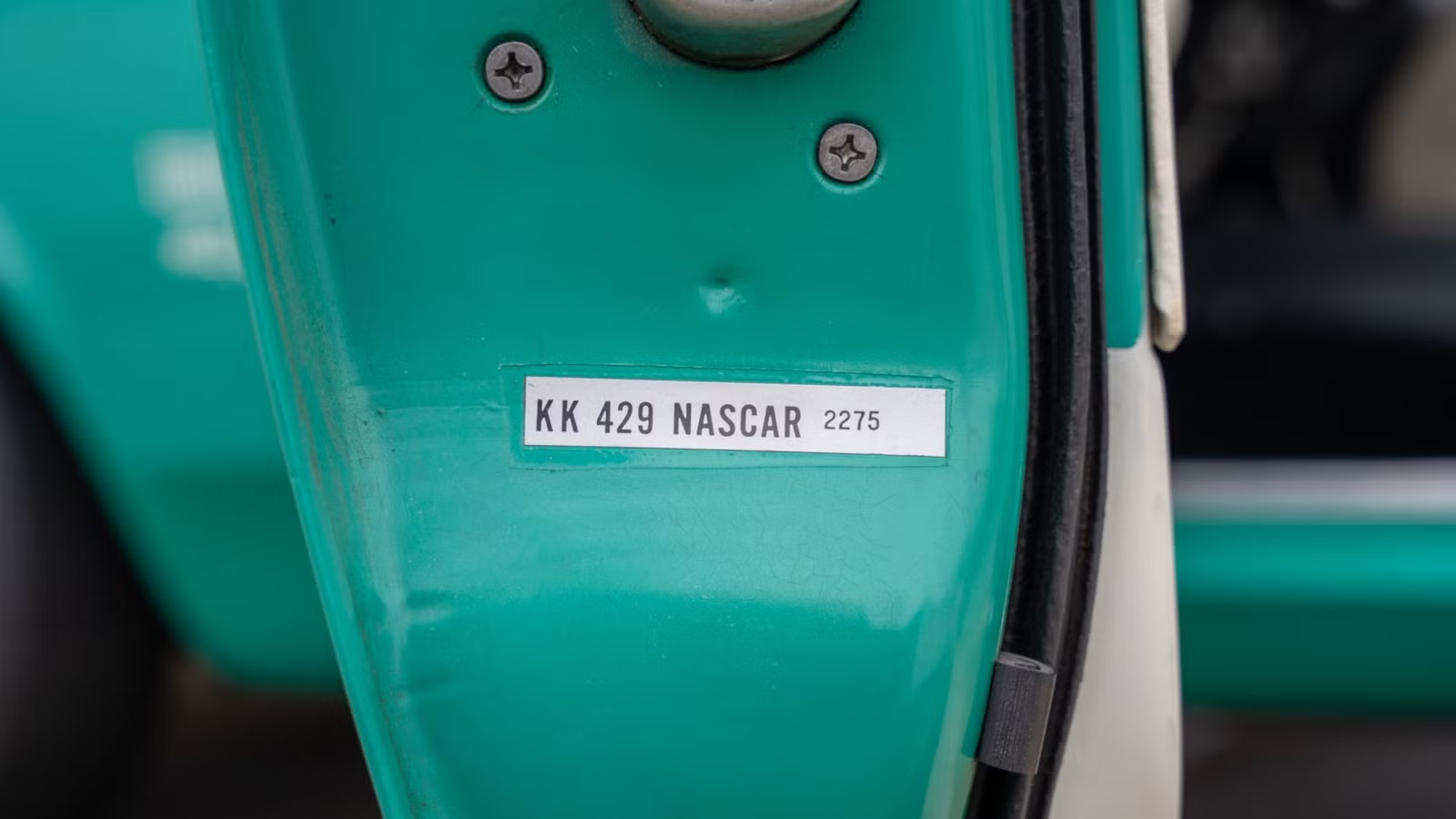
KK #2275

Even though the photography isn’t spectacular, you are looking at the most expensive Boss 429 ever sold at auction. That Grabber Green Goblin pictured above blew up Mecum Indy 2026, selling for an astounding $660,000, which is a solid $100k more than the next highest auction sale for a Boss 429. There were only 52 Grabber Greens in ’70, and according to the auction listing, just 9 with a white interior like KK no. 2275. The Boss 429 also appears to be an unrestored survivor car with just 4,899 original miles on it, so it’s almost shocking that it didn’t come close to the million-dollar mark.
Documentation

This special ’70 Boss 429 also has a build sheet, Marti report, and Kar-Kraft warranty card, which is another reason why it’s odd that it didn’t go seven-figures. There have been some single-digit classic Mopars that have sold in the millions, and while the Boss 429 seems positively common with 1,358 units, it really is poised to be the next million-dollar muscle car. The Mustang has a much larger fan base than Dodge or Plymouth, and sooner or later, a no-mileage, unrestored Concours condition Boss 429 is going to come along and completely rewrite the record books.
1
1970 Ford Mustang Boss 429 Competition Car
KK #2413

In one of the last batch of Boss 429s built, KK no. 2413 is extra-special because it was a bona fide race car. The listing claims it is one of only two cars that have been known to road-race in International Motor Sports Association (IMSA) races. It also ran in the Sebring 12 Hours of Endurance and the 24 Hours of Daytona, with no report on how it performed, but even simply competing is an accomplishment for endurance racing. This car also underwent a rotisserie restoration which, when combined with its racing history, should make this a top-seller.
Documentation

The thing is, collectors don’t really want race cars, famous or otherwise, and so they don’t get the same kind of prices an all-original classic muscle car fetches. Richard Petty’s actual race-driven 1970 Plymouth Superbird and 1971 Road Runner have both come up for auction and, while reaching some impressive bids, failed to sell. This ’70 Boss 429 Competition Car, despite having build sheets, invoices, and race results, was only bid up to $140,000 in 2023 before things stalled, and it failed to meet the reserve. It would actually be more lucrative to restore the car to original specs and just mention that it was at some point a race car.
Sources: Bring a Trailer, Mecum

Related posts


Latest Post


No Comments