
The Plain-Looking Luxury Car That Came With A Big-Block V8
In the late 1960s, luxury and speed were mutually exclusive, and you had to sacrifice one for the other. If you wanted to go fast, you went for the loud, temperamental, and somewhat uncomfortable big-block muscle car. If you wanted ultimate comfort, you picked a big full-size luxury car. But around that time, GM changed a rule that allowed it to stuff one of the biggest V8s into a luxury cruiser that allowed it to keep up with the fastest muscle cars at the time.
Luxury Cars Weren’t Supposed To Be Fast

By the late 1960s, the American automotive landscape had clearly defined segments. If you wanted to go fast, you bought a muscle car. These were intermediate or compact vehicles like the Pontiac GTO, Plymouth Road Runner, or Chevrolet Chevelle. They were loud, stiff, often short on creature comforts, and built for one primary purpose: going fast in a straight line. If you wanted status, comfort, and an effortless ride, you moved up to a full-size luxury car like the Lincoln Continental, the Cadillac Eldorado, or the Buick Riviera. These were the kind of cars rich people bought. They were heavy, packed with sound-deadening material, and designed to look elegant rather than aggressive.
Comfort and Speed Weren’t A Thing

For the traditional luxury car buyer, all they cared about was comfort and smoothness. A premium luxury car was expected to isolate the occupants from everything happening outside. The engines stuffed under their massive hoods were usually big V8s tuned specifically for low-end torque rather than high-rpm power. They were meant to move these luxury barges effortlessly without lighting up the rear tires.
Combining the raw, unrefined power of a true muscle car engine with the soft, isolated chassis of a luxury cruiser seemed controversial. Muscle cars were rough, while luxury cars were meant to float over the pavement. To the Detroit executives, merging both into one seemed like an unnecessary combination that would appeal to no one.

Automakers Decided To Give Buyers Both

As the 1960s drew to a close, consumer tastes began to shift. A new segment began to explode in popularity: the personal luxury coupe. Cars like the Pontiac Grand Prix, Ford Thunderbird, and Buick Riviera proved that buyers were willing to pay a premium for a vehicle that offered high-end styling and comfort but still delivered great performance. These cars began to blur the lines, proving that an older buyer could enjoy a powerful engine without sacrificing comfort or dignity.
A Full-Size Cruiser With Muscle-Car DNA

Chevrolet product planners closely watched this trend. While the personal luxury segment was thriving, Chevy realized there was a specific subset of buyers looking at traditional full-size cars who wanted something similar. These were buyers who still wanted the massive cabin space and prestige of a full-size luxury cruiser, but were still true muscle car enthusiasts at heart.
They didn’t want the loud stripes, the hood scoops, or the high insurance premiums that came with owning a dedicated muscle car. They wanted effortless, substantial power hidden beneath a sophisticated exterior. To cater to this demographic, Chevrolet decided to offer an engine option in their flagship model that most people would never expect to find in a luxury vehicle.
The Chevrolet Caprice Hid One Of GM’s Biggest V8s

The Caprice was first introduced in mid-1965 as an upscale trim package for the Impala and quickly became its own model in 1966. By 1969 and 1970, the Caprice became the pinnacle of Chevrolet luxury, designed to compete directly with entry-level premium brands like Oldsmobile, Buick, and even Chrysler.
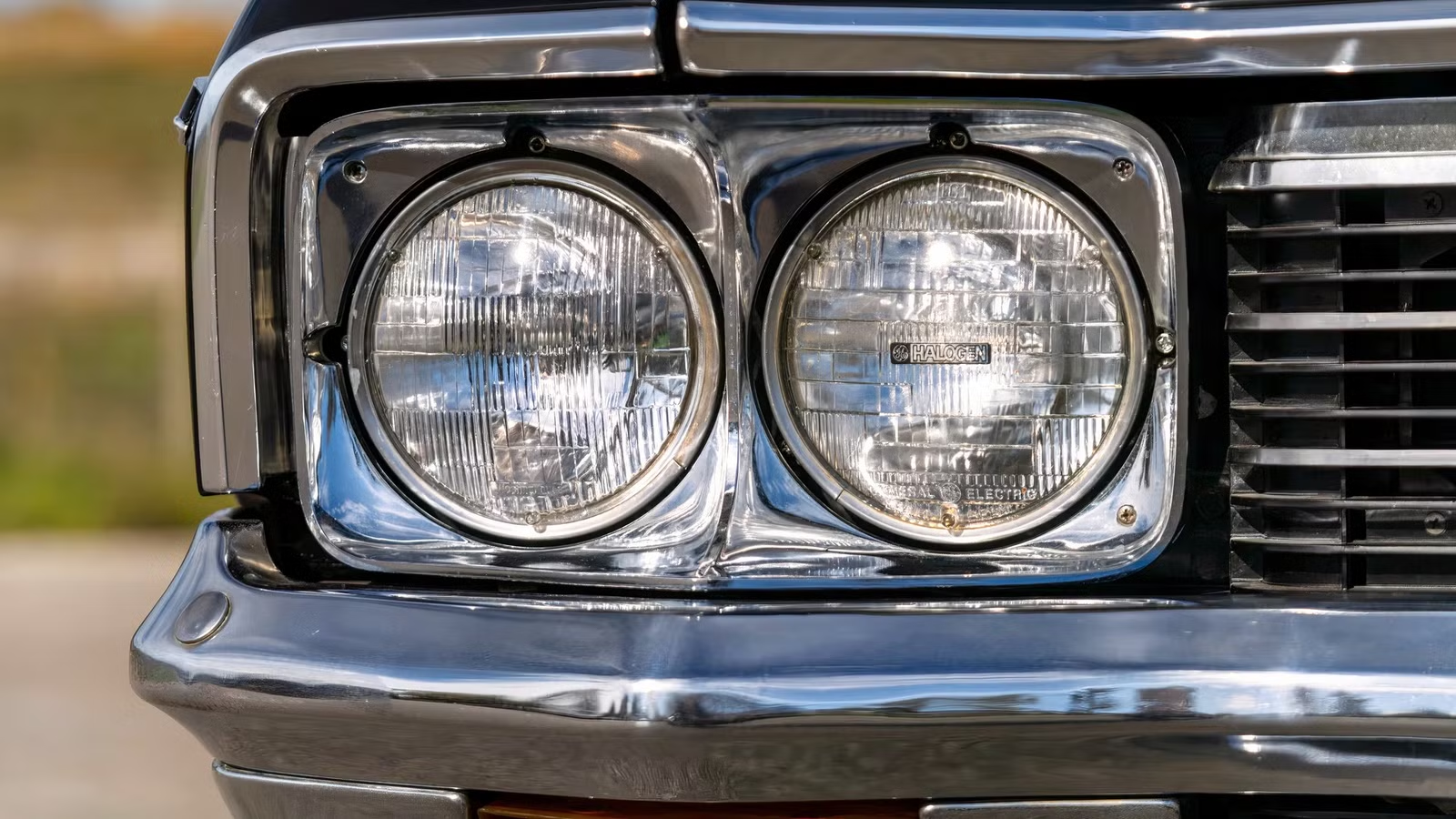
For 1969 and 1970, the Caprice received several styling updates. With a squared-off roofline, a massive chrome grille that wrapped around the front end, and hidden windshield wipers, the car was long and elegant. Inside, it still had some luxury features like wood-grain accents, deep-twist carpeting, and extra-thick foam seats upholstered in rich fabrics or vinyl. It was a heavy luxury vehicle designed for high-speed interstate cruising. But while the car was focused on comfort, there was a secret option that would change everything. Chevrolet was about to phase out its famous 427 big-block and replace it with a new, bigger engine.
The Optional 454 LS5 Turned An Executive Cruiser Into A Bruiser

In 1970, General Motors lifted its self-imposed corporate ban that restricted passenger cars from carrying engines larger than 400 cubic inches. Chevrolet wasted no time, boring and stroking their legendary big-block to create the massive 454 cubic-inch (7.4-liter) V8. This was a brand-new engine for that year named the LS5, which found its way onto the Caprice’s option sheet.
The LS5 454 was a masterclass in effortless power. It featured a 10.25:1 compression ratio and a Rochester Quadrajet four-barrel carburetor, producing 360 hp and a monumental 500 lb-ft of torque at just 3,200 RPM. To put that in perspective, that was more torque than almost any dedicated muscle car on the market, delivered at low rpm, which was perfect for moving a heavy luxury car.
This massive big-block was paired with GM’s bulletproof three-speed automatic transmission (TH400), sending power to a heavy-duty 12-bolt rear axle. Despite the Caprice tipping the scales at well over 4,200 pounds, the LS5 transformed it into an absolute juggernaut. In a straight line, a 1970 454 Caprice could sprint from 0 to 60 mph in under 7 seconds and clear the quarter-mile in the mid-14-second range. These performance numbers were on par with standard muscle cars of the era.
Big-Block Power Was Only Half Of The Story

Dropping a massive, high-torque V8 into a large car is one thing; making it behave like a luxury vehicle is another issue. If Chevrolet had simply bolted the engine in without any modifications, the car would have twisted its frame, vibrated the cabin, and shredded its tires at every stoplight. To prevent this, Chevrolet made a few necessary changes.
The 454-equipped Caprice had its heavy-duty frame reinforced and new rubber body mounts tuned to isolate the cabin from the engine’s vibrations. The suspension was a sophisticated full-coil design for a smooth, comfortable ride, but models ordered with the big-block got stiffer springs, heavier shocks, and a thicker front stabilizer bar. This kept the car level and composed under hard acceleration and cornering without destroying the smooth, cloud-like ride quality the Caprice was famous for. The mufflers were also quieter to ensure that under normal driving conditions, the 454 merely whispered, only emitting a deep, authoritative roar when the driver buried the throttle.
Performance Without The Compromise

This careful engineering created a completely different driving experience compared to Chevy’s traditional muscle cars. A Chevelle SS or a Camaro SS was a visceral experience. They were stiff, loud, shook at idle, and constantly reminded you of their performance capabilities. They required effort to drive and were not suitable for long road trips. The Caprice 454 offered similar performance without a single compromise.
It didn’t overheat in traffic, the power steering was effortless, and the powerful brakes brought this massive machine to a halt with ease. You could cruise at 80 mph down the highway in near-total silence, with the air conditioning blasting, while listening to the radio or talking to your passenger. Because of this unique blend of immense high-speed stamina, total comfort, and long-distance capability, the 1969–1970 454 Caprice stands out as one of Chevrolet’s earliest true grand tourers. It was a car built to cross continents at high speeds without wearing out its occupants.
It Became One Of Chevrolet’s Most Overlooked Big-Block Cars

Despite its incredible capabilities, the 454 Caprice is rarely mentioned in the same breath as the Chevelle, Camaro, or Nova when classic big-block Chevys are discussed. There are a few reasons why this magnificent sleeper became lost to automotive history. First, very few buyers actually checked the box for the LS5 engine on a Caprice. Production numbers aren’t available, but estimates suggest between 500 and 1,000 cars were made. It was an expensive option, around $250, while the standard Caprice would have been around $3,500. Most luxury buyers were perfectly okay with the standard 350 or 400 cubic-inch V8s.
Second, the car’s conservative styling worked against its legacy. Without hood pins, broad racing stripes, or “SS” badging, it blended perfectly into the background of American suburban life; people simply saw them as big luxury cars and nothing more. Once these cars hit the used-car market in the late 1970s and 1980s, many were bought as cheap family transportation, and rundown examples were popular in demolition derbies, meaning few pristine survivors remain.
Why This Big Body LS5 Caprice Deserves More Attention Today

Today, the 1969–1970 LS5 Chevrolet Caprice is finally starting to earn the respect it deserves from discerning collectors. In a hobby dominated by replicas and brightly colored muscle cars, a big-block Caprice is different. It represents a brief, beautiful moment in automotive history when fuel economy regulations and insurance companies hadn’t yet killed off high-compression, large-displacement engineering.
For the modern enthusiast, it is the ultimate classic sleeper. It offers the exact same mechanical pedigree, reliability, and big-block punch as the most famous muscle cars of the era, but wrapped in a package that allows you to cruise with five of your friends in complete comfort. Best of all, because it lacks a muscle car badge, current market values for these full-size luxury cruisers remain very affordable compared to six-figure Chevelles. It is a monument to an era when luxury meant having more power than you would ever need, hidden completely in plain sight.
Sources: General Motors, Chevrolet, Classic.com.

Related posts

Latest Post


No Comments