Kia K5 GT: 290 HP Sport Sedan Punching Above Its Price
12 minutes reading
Monday, 13 Jul 2026 17:30 0 92 autotech
The affordable sports sedan market is disappearing. Marques keep replacing them with SUVs or pushing prices north of $40K. Kia somehow missed the memo. It may not be the first brand you think of when you think of sport sedans, but the Kia K5 GT is something special, balancing usability, fuel efficiency, performance heroics, and surprisingly low prices.
We are taking a look at the Kia K5 GT and will break down who should buy one, its performance specs, how it stacks up against its closest rivals from the likes of Toyota and Hyundai, how it behaves on the road, if its price is worth it, and why it is a rare breed of sports sedan in 2026.
Front 3/4 action shot of 2026 Kia K5 GT in white drivingKia
The affordable sport sedan market has become increasingly difficult to define. Prices continue to climb, yet real performance is often reserved for top trims or premium brands.
Then there is the Kia K5 GT, which breaks that trend by offering a 290-horsepower turbocharged engine with a DCT at a starting price of under $35,000, undercutting the original price of the Camry TRD by nearly $1,000.
Close-up shot of Kia K5 GT rearKia
The Kia K5 GT’s horsepower from the Smartstream 2.5T engine doesn’t make it a track-focused sedan, and the Sonata N-Line may be the better option there. Still, it delivers strong acceleration and effortless highway passing power, and its strengths lie more in torque-rich performance than razor-sharp handling.
Smartstream 2.5T Engine: Power On Paper vs. Boost In Motion
Close-up shot of Kia K5 GT front endKia
There is just one 2026 Kia K5 GT engine: a 2.5-liter turbocharged Smartstream mated to a dual-clutch transmission. The Kia K5 GT Smartstream turbo is good for 290 horsepower at 5,800 rpm and 311 pound-feet at 1,650 rpm.
The Kia K5 GT specs sheet is just one thing, though. The headline Kia K5 GT horsepower figure of 290 is impressive, but the real standout is the 311 pound-feet of torque, which arrives at low rpm and is the best in class. That low-end torque makes the GT feel great for everyday driving. Rather than waiting for the engine to climb through the rev range, the Kia K5 Smartstream turbo delivers a strong surge, providing a satisfying pull at junctions or when overtaking on the highway.
Close-up shot of Kia K5 GT engine bayKia
It should be noted, though, that like many modern turbocharged engines, there is a moment of turbo lag if you demand full throttle from very low revs, but it is short-lived. Once boost builds, the engine pulls hard through the mid-range before tapering off near the redline. Kia says the Kia K5 GT 0–60 is 5.4 seconds. The broad torque band spans from 1,650 rpm to 4,000 rpm, and while 5.4 seconds is not typically German-sports-car fast, for under $35,000, it is very impressive.
Also, this is where the Kia GT vs Camry TRD vs Sonata N Line argument gets interesting. Toyota’s naturally aspirated 3.5-liter V6 in the TRD offers instant throttle response and a smoother power delivery, but needs more revs before it pulls strongly; it takes around 5.6 to 5.8 seconds to hit 60 mph. The K5 GT hits hard from standstill around town thanks to the turbo motivation, while the Hyundai Sonata N Line shares the same Smartstream turbo engine, and 0–60 times have been clocked at around 5.3 seconds.
Front 3/4 action shot of 2026 Hyundai Sonata N Line in silver drivingHyundai
For those who want a little more from the K5 GT, there is another advantage: the Smartstream 2.5T has already proven to be a capable platform for modifications. You get both direct injection and port injection, and thermal management is controlled by an advanced coolant management system, so the building blocks are there.
Some owners have reported fitting piggyback ECU tuners, cold air intakes, and cat-back exhausts for better exhaust flow on older K5 GT models. While horsepower is never going to be in the ballpark of high-end sports cars, there have already been owners pushing what the GT can really do.
DCT Transmission: Shift Quality And Highway Manners
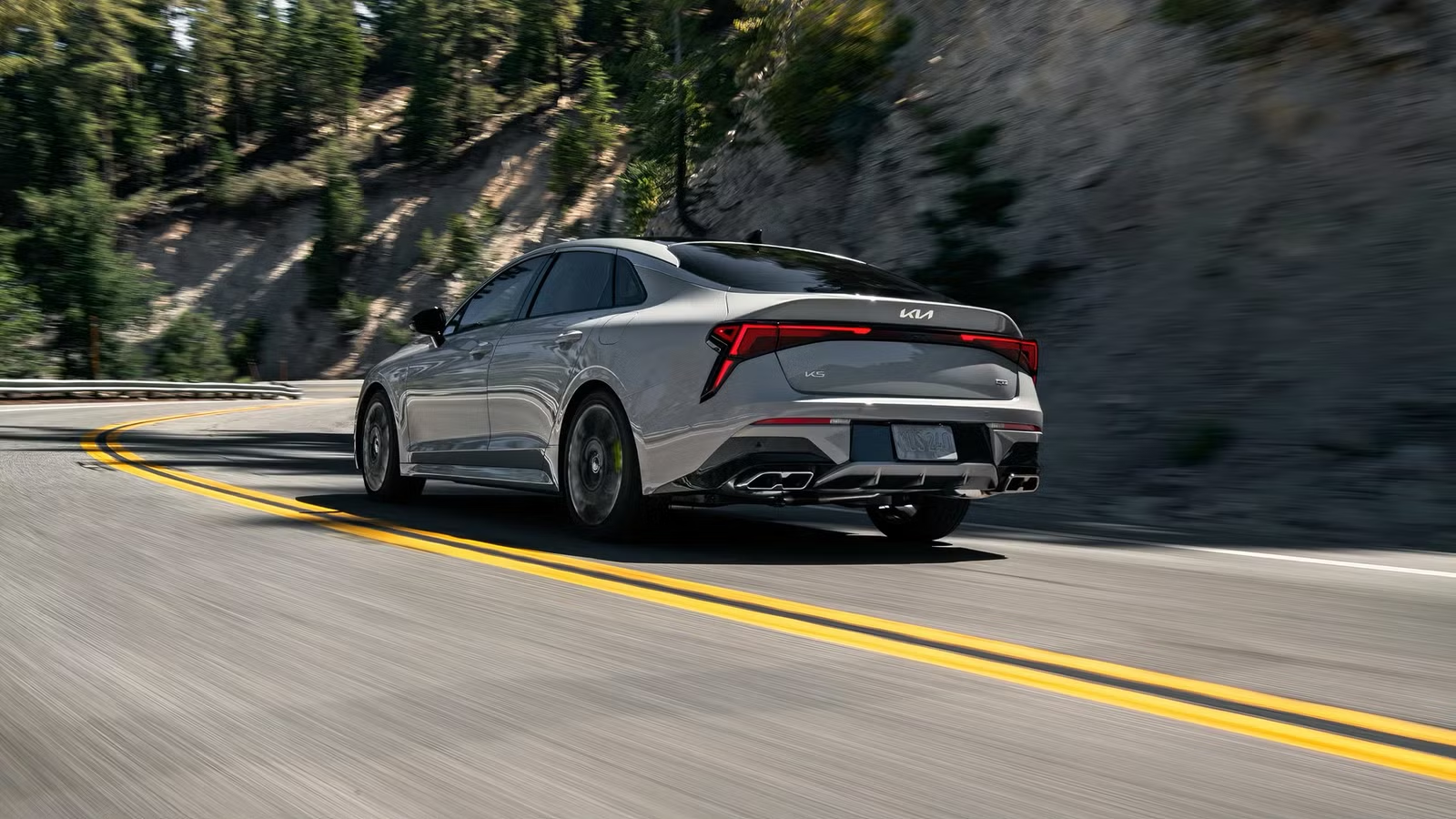
Rear action shot of 2026 Kia K5 GT driving on roadKia
Kia K5 GT reviews on Kelley Blue Book rate it (as part of the wider K5 lineup) 4.1 out of 5 overall. This includes ratings of 3.9 out of 5 for performance, 4.0 out of 5 for quality, 4.1 out of 5 for value, 4.2 out of 5 for reliability, 4.3 out of 5 for comfort, and 4.6 out of 5 for styling. The perky turbo-four is good for sprinting around town, and the real sporty addition, the dual-clutch transmission, makes gear changes seamless.
Unlike the torque-converter automatic found in most midsize sedans, the Kia K5 GT DCT uses two oil-cooled clutch packs: one controlling the odd-numbered gears and the other controlling the even-numbered gears. While one gear is transmitting power, the next ratio is already pre-selected on the opposite shaft. This means a virtually uninterrupted torque delivery, allowing the transmission to swap ratios in a matter of milliseconds instead of waiting for hydraulic pressure.
Close-up shot of Kia K5 GT gear shifterKia
Under hard acceleration, the gearbox snaps through the ratios with very little interruption to boost pressure, keeping the Smartstream 2.5T in its torque sweet spot. It is one of the reasons it feels quicker than many rivals with similar outputs, especially during rolling acceleration, where maintaining boost is just as important as peak power.
There are trade-offs, though. Because there’s no fluid torque converter masking clutch engagement, low-speed movements can feel less polished. Owners have reported a slight hesitation when crawling in traffic or inching into parking spaces.
Close-up shot of 2026 Kia K5 GT headlightKia
On the highway, however, the DCT comes into its own. Eight gears keep engine speeds low for refinement and decent fuel economy, while a quick stab of the throttle results in an immediate multi-gear downshift rather than the drawn-out kickdown typical of torque-converter autos. Sport Mode also adjusts shift points (holding gears longer at higher rpm), tightens steering, and sharpens throttle response. While this can be useful around town, on the highway it allows for easier passing.
Because the K5 GT has only been on the U.S. market since 2021, long-term reliability data on the DCT is still limited. However, reliability has been a bit stronger than some expected. Earlier dry-clutch Hyundai-Kia DCTs have a mixed reputation, but the 2026 K5 GT’s wet-clutch unit is designed to cope with the Smartstream torque output quite well. There have been some reports of software-related hesitation, and models up to 2023 are subject to a recall, but there are currently no widespread reports of fundamental weaknesses.
Chassis, Handling And Real-World Performance
Close-up shot of Kia K5 GT rearKia
The Kia GT chassis is built around a independent MacPherson strut front suspension, paired with an independent multi-link rear suspension. This layout gives the K5 GT decent control over camber changes during cornering, and helps the tires maintain a good contact patch while improving composure over potholes. Firmer springs, revised dampers, and a quicker steering calibration than the standard K5 lineup also mean there is a noticeable difference behind the wheel.
The K5 GT is still front-wheel drive only, though, and physics dictates how it acts. With 311 pound-feet of torque channeled through the front axle, aggressive launches can produce mild torque steer and wheelspin. Push harder into tighter bends and owners report that the nose begins to push wide before the rear becomes unsettled. Something to consider.
Profile shot of Kia K5Kia
Braking is handled by 13.6-inch ventilated front discs and 12.8-inch solid rear discs, providing a solid foundation. While Kia says that 0–60 mph times are 5.4 seconds, Car and Driver recorded a 0–60 mph of 5.2 seconds, a 13.7 quarter mile at 106 mph, and a 70–0 mph stopping distance of 163 feet.
We can see why the 2026 K5 is rated 92 out of 100 for driving experience on J.D. Power. The K5 GT is fast in a straight line, but it is ultimately a fast, composed sport sedan rather than a genuine canyon carver. It knows its limitations.
Kia K5 GT vs. Camry TRD And Sonata N Line: The Real Comparison
2025 Kia K5 GT front 3/4 action shot driving on the road.Kia
A static front-quarter shot of a silver 2026 Hyundai Sonata N-LineHyundai
The affordable midsize sport sedan market is not just for the K5 GT; models like the Toyota Camry TRD and Hyundai Sonata N Line also make for good, affordable choices.
The K5 GT sits at the top of the K5 lineup in terms of performance, but it is not the most expensive model available in 2026 (that distinction belongs to the EX). Compared to both the N Line and the TRD (which was discontinued after 2024), new prices are slightly lower. The new Kia K5 GT price is $33,590, while a 2024 Camry TRD had an original starting price of $34,580, and a Sonata N Line has a starting price of $36,050.
Front 3/4 action shot of 2024 Toyota Camry TRD driving on roadToyota
While the GT is cheaper to buy, there is more to consider. The N Line shares the same turbo-four and eight-speed DCT, but Hyundai prioritizes refinement. Cabin insulation is a bit better, the suspension is more compliant, and the overall driving experience is arguably more premium for a similar price. Performance here is near-enough identical, though, so choosing between the two is down to styling preference and how much you are willing to pay.
The Camry TRD takes a different approach. Its much-missed-in-2026 3.5-liter V6 delivers smooth, linear power with no turbo lag, and Toyota’s eight-speed automatic is predictably seamless. More importantly, though, is that the TRD benefits from chassis upgrades that make it feel sharper through corners, with firmer suspension tuning, additional body bracing, and steering that is a bit more confidence-inspiring.
Side action shot of the 2024 Toyota Camry TRD driving on roadToyota
The K5 GT wins in terms of hefty torque output, which arrives low in the rev range, paired with lower purchase prices than similarly equipped competition. Despite their differences and respective strengths, the 2026 Kia K5 GT, 2024 Toyota Camry TRD, and 2026 Hyundai Sonata N Line all earn a rating of 83 out of 100 overall on J.D. Power.
For straight-line pace at a value-conscious price, the K5 GT is the clear choice. For naturally aspirated reliability and the best handling balance, the Camry TRD still deserves considerable respect, while those seeking the same performance wrapped in a slightly more refined package should look to the Sonata N Line.
Ownership Reality: Costs, Reliability & Resale
Front 3/4 shot of Kia K5 GT Sedan in silver driving on roadKia
The prices are competitive and the performance is strong, but ownership costs are also worth considering. According to data on Edmunds, “True Cost To Own” estimates for a K5 GT are $45,040 over five years. This includes $7,631 in maintenance, $5,084 in insurance, $2,043 in repairs, and $9,091 in fuel.
FuelEconomy.gov says a K5 GT can achieve 27 combined mpg, costing you $2,300 a year for gas. This equates to $500 more than the average modern car over five years. So, not bad for its prowess. However, it is noticeably more expensive for things like insurance and maintenance (thanks to its higher performance potential) compared to the base-model K5.
Close-up shot of Kia K5 GT headlightsKia
Edmunds says a base-model K5 will cost you $38,387 over the same time, which includes $4,659 for insurance, $6,213 for maintenance, $524 for repairs, and $8,176 for fuel.
Depreciation also hits the GT harder, with a five-year value loss of $14,165, compared to $11,792 for the standard K5 over the same period. While long-term reliability data on the Smartstream turbo is still emerging, it is already considered far more reliable than the older 2.4-liter Theta II engine, despite some reports of oil dilution from frequent short trips.
Verdict: Who Should Buy the Kia K5 GT?
High-angle shot of Kia K5 GT interior showing cabinKia
The Kia K5 GT fills a gap that very few cars can fill anymore. Performance sedans are getting more expensive every year, yet Kia manages to build one that delivers proper acceleration without pushing prices into premium-brand territory. If your idea of fun is feeling turbo spool and riding a big wave of torque, the 2026 K5 GT is a solid choice.
You get 60:40 split-folding rear seats, 15.6 cubic feet of cargo space, 46.1 inches of front legroom, and 35.2 inches of rear legroom, so it makes for a practical and fun sedan to own. The engine has plenty of bite off the line, the DCT gives it a sporty edge, and the chassis is composed enough for long journeys. It is not trying to be a track-day hero, and that is perfectly fine.
Front 3/4 action shot of Kia K5 GT driving on roadKia
If handling is the priority, the Camry TRD certainly still has the edge, and for those seeking a little more refinement, the Sonata N Line is the model to choose. Neither, however, delivers quite the same value as the GT, especially given that the discontinued Camry TRD is holding its value very well.
The Kia K5 GT isn’t the sharpest driver’s car in the class, and it never pretends to be. Instead, it delivers something arguably more valuable: genuine performance at a price that is becoming increasingly rare. In a market where affordable sports sedans are disappearing, that’s enough to make the K5 GT one of the most overlooked sleeper performance sedans today for budget-conscious buyers.
Base Trim Engine
2.5L I4 ICE
Base Trim Transmission
8-speed automatic
Base Trim Drivetrain
Front-Wheel Drive
Base Trim Horsepower
191 HP @6100 RPM
Base Trim Torque
181.5 lb.-ft. @ 4000 RPM
Base Trim Fuel Economy (city/highway/combined)
26/37/30 MPG
Make
Kia
Model
K5
Segment
Compact Sedan
Sources: Kia, Toyota, Hyundai, Fuel Economy.gov, and Kelley Blue Book.











No Comments