
The Rare Ford Muscle Car Most People Don’t Remember
In 1971, Ford built a four-door sports sedan that could outrun anything wearing a Mustang badge. It won the biggest race in its home country, claimed a world speed title, and stirred up a scandal so serious that politicians threatened to ban cars like it from the road.

Yet most American enthusiasts have never heard of it. Only 300 were built, fewer than 100 are believed to survive, and the best examples now trade for close to a million dollars. Strangest of all, it never turned a wheel on American soil as a production car.
The Horsepower War Ford Fought On The Other Side Of The World
While Detroit fought its horsepower war with big-block coupes, Ford was fighting a different battle on the other side of the world. Australia’s touring car scene ran under Series Production rules, which meant race cars had to be sold to the public essentially as they raced. If a manufacturer wanted to win, it had to put that winner in showrooms first.

The prize was the annual 500-mile enduro at Mount Panorama, the country’s premier motorsport event. Ford, Holden, and Chrysler all built homologation specials to chase it, because victory there virtually guaranteed strong advertising and even stronger sales. It was “win on Sunday, sell on Monday” taken as literally as the rulebook allowed.
Ford escalated first in 1969, when it introduced the HO package, short for Handling Option, on its XW range, creating what amounted to a road-registerable racing car for production touring car teams. A Phase I came first, then a faster Phase II, and then a third evolution so potent that it would end the arms race entirely.
The 1971 Ford Falcon GTHO Phase III Was A Race Car With License Plates

The third evolution was the 1971 Ford XY Falcon GTHO Phase III, built by Ford Australia. It was a homologation special in the purest sense, produced only so Ford could race it, and just 300 examples left the factory between May 1971 and November 1971.
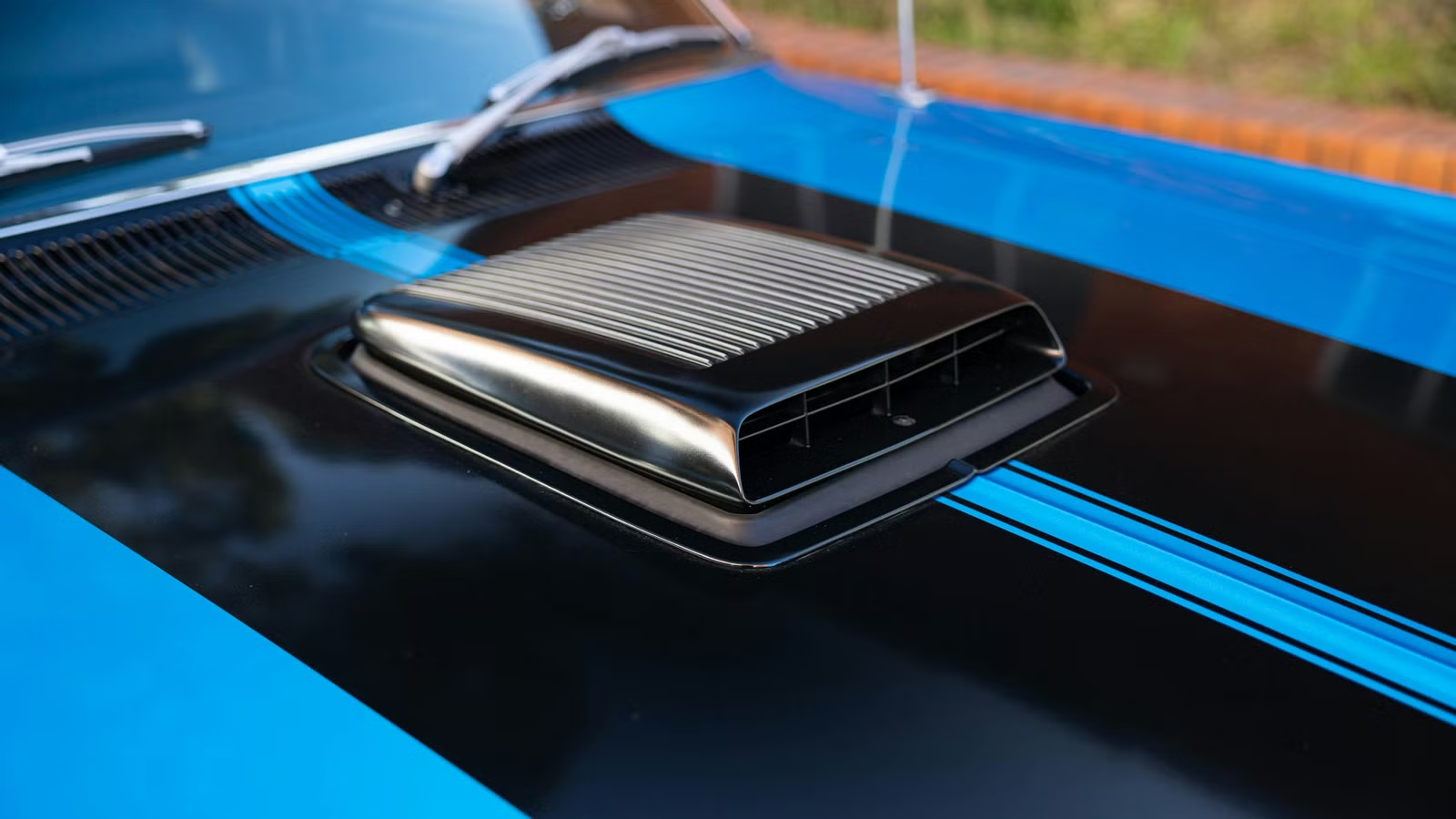
At a glance, the Phase III looked almost identical to the standard Falcon GT it was based on. Only a front air dam and an adjustable rear wing gave it away to a curious pedestrian, and both cars shared the shaker hood scoop that pulsed above the engine. The disguise was part of the appeal, because underneath sat a very different machine.

The Phase III carried a heavily upgraded engine, a four-speed top-loader gearbox, and a locking 9-inch rear differential. Ford added a special brakes and handling package along with a 36-imperial-gallon (164-liter) fuel tank designed to cut pit stops during endurance racing. Every one of those parts had to appear on the road car for the race car to be legal.
The pricing made it one of the great performance bargains of the era. The HO package added less than $340 (AUD 300) to a car that cost roughly $5,900 (AUD 5,250) new. Around 20 buyers paid an extra $280 (AUD 250) for a “virtually hand-built” Quality Control engine, and these QC-equipped cars went on to dominate the top finishing positions for Ford in the 1971 enduro.
351 Cleveland Almost Made The Falcon GTHO The Fastest Four-Door On Earth

|
Engine |
Transmission |
Power |
Torque |
|
5.8-Liter Cleveland V8 |
Four-Speed Manual |
300 hp |
380 lb-ft |
Under the shaker sat a 5.8-liter Cleveland V8 that Ford officially rated at 300 hp. That number was deliberately understated, with most accounts saying the low figure was meant to satisfy insurers. Ford engineer Ian Stockings later wrote that company policy was simply to understate power and keep competitors guessing.
The real output is generally accepted to sit between 350 hp and 380 hp, backed by 380 lb-ft of torque. Ford fitted a rev limiter set at 6,150 rpm, and with the limiter disabled, the engine reputedly pulled past 7,000 rpm even in fourth gear.

Then there is the claim that made the car a legend. In October 1971, Which Car’s Wheels magazine clocked a full-street-trim Phase III at 142 mph on the Hume Highway, and on the strength of that single test, the “world’s fastest four-door production car” tag stuck. Half a century later, Australians still repeat it.

The truth is murkier, and enthusiasts who know the car know it. The 1969 Dodge Polara Pursuit, running the 440 V8, was officially clocked at 147 mph by Michigan State Police, and because equivalent civilian four-door Polaras were never tested, the title can never be truly settled. The crown was contested in period, but the legend has only grown since.
The Phase III ran 0-60 mph in 6.4 seconds and covered the quarter-mile in 14.4 seconds with the standard 3.25:1 differential, while the optional 3.9:1 ratio reputedly dropped that figure to 13.9 seconds.
The Falcon GTHO Won Bathurst, Then A Newspaper Killed Its Successor

Thirteen Phase IIIs fronted the grid for the 1971 Hardie-Ferodo 500 at Mount Panorama. Allan Moffat took pole with a lap of 2:38.9, a full 10 seconds quicker than his time in the Phase II the year before. When the checkered flag fell, Phase IIIs filled five of the top six positions, with Moffat winning outright before the car later carried him to the 1973 Australian Touring Car Championship.
That dominance set the stage for a national scandal. On June 25, 1972, Sun-Herald motoring editor Evan Green published a front-page story titled “160mph Super Cars Soon,” revealing that Ford, Holden, and Chrysler were all preparing even faster models for public sale. NSW Transport Minister Milton Morris branded them “bullets on wheels” and threatened to ban them from the road.

The collapse that followed swept the entire industry rather than Ford alone. Racing authority CAMS scrapped the Series Production rules on June 29, Holden abandoned its V8 Torana the following day citing government concern, and within days Ford announced it would not continue GTHO production while Chrysler dropped its V8 Charger program.
The planned successor, the XA Falcon GTHO Phase IV, was never officially released. Only four were built, three race cars and one road car, and Ford initially denied the model existed, with marketing manager N.D. Schryver writing to dealers that no such option ever would. That decision made the Phase III the last homologation Falcon ever sold to the public.
Fewer Than 100 Survive, And The Prices Prove Its Worth

Of the 300 Phase IIIs built, fewer than 100 are understood to survive today, according to estimates tied to the official Phase III register. That scarcity, layered over the Bathurst legend, has turned the car into Australia’s ultimate blue-chip collectible.
The receipts tell the story. A Phase III sold through Bonhams & Goodman for about $540,000 (AUD 683,650) in March 2007, and another brought roughly $630,000 (AUD 750,000) that June. The ex-Jeff Thomson car then became the first Australian production car to break the million-dollar barrier in its home currency, selling for about $760,000 (AUD 1,030,000) at Lloyds Auctions in Bathurst.

Prices kept climbing from there. Another example fetched around $885,000 (AUD 1.15 million) in February 2021, and the current record stands at roughly $950,000 (AUD 1.3 million) plus fees, paid for a Yellow Glo car — one of just 12 finished in that color — at Lloyds in September 2021. A Phase IV prototype reportedly changed hands for close to $1.45 million (AUD 2 million), underscoring the blue-chip status of the entire GTHO bloodline.
Color rarity drives value at the top of the market too. According to the register, just 11 Phase IIIs were finished in Electric Blue Metallic, and only seven of those carried black vinyl trim. It remains the ultimate forgotten Ford — a Falcon that outran the Mustang’s mythology everywhere except the history books Americans read.
Sources: Wheels magazine, The Age

Related posts




Latest Post


No Comments