The U.S. new-car market is defined by a stark polarization of affordability that is dividing consumers into two distinct purchasing pathways. The average new-vehicle transaction price is hovering near $49,000 in 2026, while the average sticker price has remained above $50,000 for nearly a year. Economic factors like elevated interest rates and strict credit requirements are driving price-sensitive, mass-market buyers to delay purchases or turn to leasing and off-lease pre-owned options to avoid payment shock.
Conversely, affluent buyers continue to demonstrate resilience, sustaining strong demand for high-end SUVs, trucks, and premium segments. This emphasis on financial viability is paired with shifting preferences under the hood. While traditional gas-powered internal combustion engines still command the largest market share, a growing portion of mainstream consumers prioritize efficiency by favoring hybrid vehicles, whereas the initial surge in electric vehicle demand has faced headwinds due to shifting federal incentives, infrastructure gaps, and higher upfront costs.
In 2026, Volkswagen continues to adopt a demand-driven approach to its electrification strategy in the U.S. The German marque has pivoted to navigate a cooling American EV market and shifting government subsidy landscapes. The structural centerpiece of this realignment occurred in the spring of 2026, when VW ended production of its ID.4 electric SUV at its Chattanooga, Tennessee plant to reallocate production capacity toward higher-volume, combustion-powered family vehicles, specifically the next-generation 2027 Atlas.
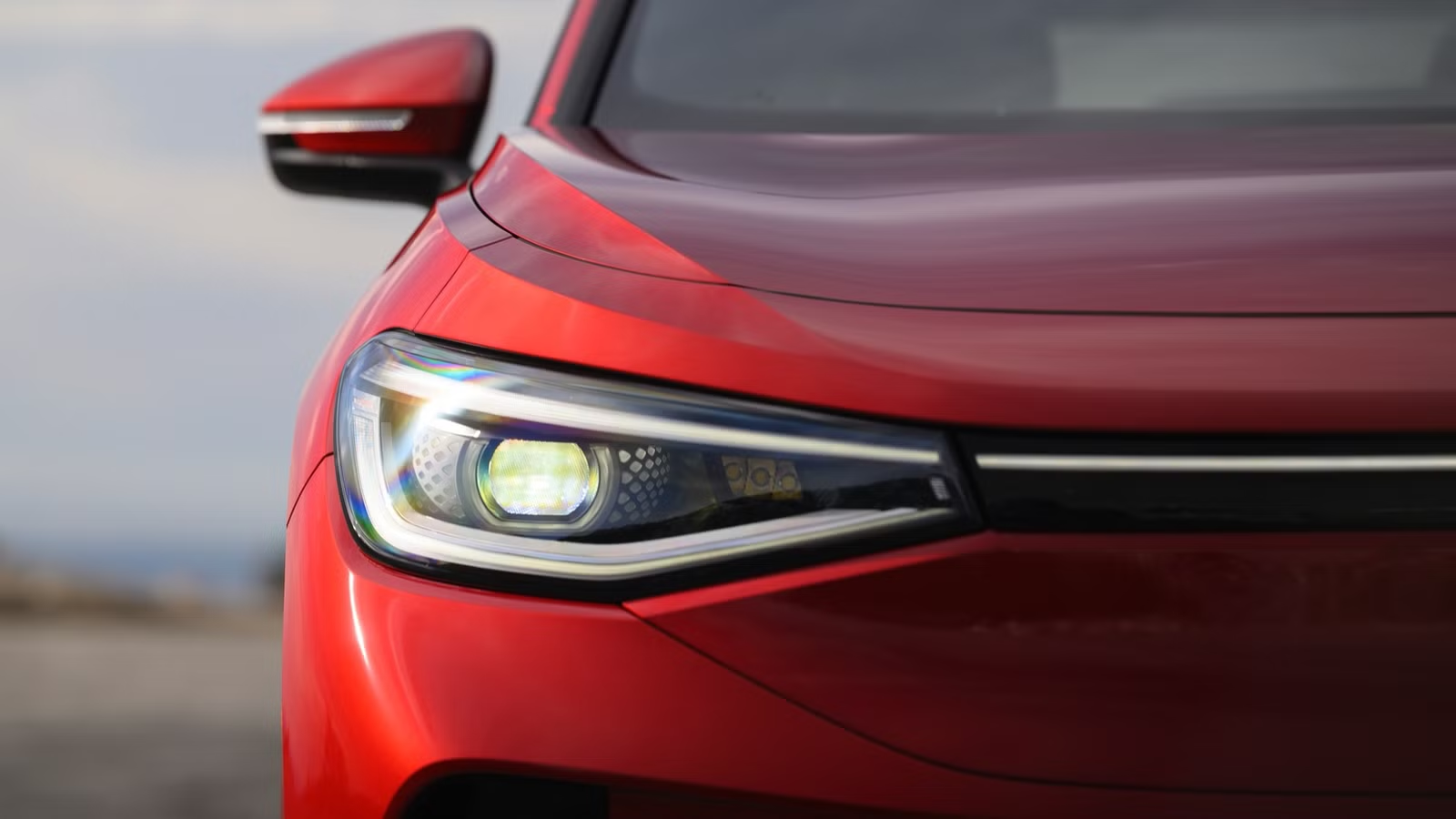
2024 Volkswagen ID.4 exterior close-up photo of headlightVolkswagen
Rather than forcing an aggressive all-electric transition, Volkswagen is treating its electrification rollout as a flexible, long-term ecosystem. The brand is balancing its core internal combustion engine products with lifestyle-forward electric offerings, including imported vehicles like the retro-inspired ID. Buzz. Plans to introduce the premium ID.7 sedanhave officially been shelved. Prioritizing short-term agility and shifting manufacturing resources to mirror actual customer adoption rates allows VW to protect its market share and sustain financial robustness while keeping its broader global electric roadmap active in the background.
The Volkswagen ID.4 Is The Smart Buyer’s EV
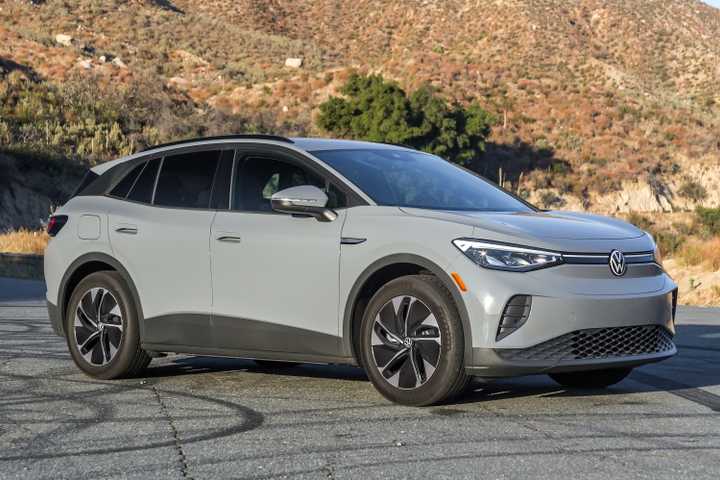
2025 Volkswagen ID.4 Front Three-QuarterVolkswagen
The 2026 Volkswagen ID.4 is built to occupy the vital compact crossover segment, serving as the high-volume, pragmatic counterweight to lifestyle niche offerings like the ID. Buzz EV van. It primarily targets the mass-market demographic of practical suburban families, daily commuters, and tech-conscious buyers transitioning away from traditional internal combustion engine vehicles like the Tiguan into their first electric vehicle.
However, the crossover faces an unprecedented uphill battle in the U.S. According to Volkswagen of America’s Q1 2026 sales report, ID.4 sales suffered a staggering 95.6 percent collapse, plummeting from 7,663 units in Q1 2025 to a mere 338 units in the first three months of 2026 due to the ending of local manufacturing and the expiration of federal incentives. Despite this poor performance, the 2026 model year sits in the broader EV market as a considerably appealing option for those looking for a truly smart EV from remaining dealer inventory.
Reasonable Reception From The Niche Consumer
2024 Volkswagen ID.4 Rear Three-QuarterVolkswagen
According to J.D. Power, the Volkswagen ID.4 sits with a consumer-verified 68/100 overall score, which is partly due to a disappointing 54/100 quality and reliability rating. Bringing the score up is 75/100 driving experience, 84/100 resale, and 71/100 dealership experience. These are based on the 2023 model, which is mechanically identical to the current model year.
According to Edmunds, you can expect the base Pro ID.4 to cost you $52,876 over five years and 60,000 miles. You’ll be spending $5,648 of this on maintenance, $794 on repairs, $25,774 on depreciation, and $2,938 on electricity. CarEdge backs this with a $57,577 five-year ownership cost average for the entire range, which includes $32,827 for depreciation, $2,045 for electricity, and $1,651 for maintenance.
iSeeCars awards it 8.0/10 for safety and 6.8/10 for retained value. On the depreciation front, you can expect this model to lose $27,615 or 61.2 percent of its value after five years or 60,000 miles. The ID.4 also holds a 3.8/5 average consumer review score on Edmunds, most of which praise its value, driving experience, and comfort as key strengths.
Comprehensive Standard Features Across Three Trims
Volkswagen
The entry-level Pro trim establishes a robust baseline for tech-centric convenience and essential cabin comfort with a $45,095 MSRP. This trim includes a 12.9-inch Discover Pro Max infotainment touchscreen alongside the compact ID. Cockpit digital instrument display. Entertainment and smartphone utility are driven by wireless Apple CarPlay and Android Auto, integrated navigation, SiriusXM satellite radio, and a seamless wireless device charging pad.
For passenger comfort, the Pro cabin includes Climatronic dual-zone automatic climate control and standard heated, six-way manually adjustable front seats upholstered in cloth with leatherette bolsters. A heated steering wheel, rain-sensing windshield wipers, and advanced keyless access with proximity unlocking complete the standard convenience suite, alongside the intuitive ID.Light bar, which portrays visual notifications that pulse to communicate navigation cues and battery status.
Volkswagen
Stepping up to the Pro S trim significantly elevates luxury for $50,295. The interior is upgraded with full V-Tex leatherette seating surfaces, and the front seats are transformed into 12-way power-adjustable chairs outfitted with massage, ventilation, and memory functions for both the driver and front passenger.
Overhead sits a panoramic fixed glass roof, while the interior styling elements can be customized using an expanded 30-color adjustable ambient lighting system, upgraded from the Pro’s 10-color system. Convenience gets a boost via a hands-free remote power rear liftgate, auto-folding side mirrors with position memory, and a rear-seat center armrest with a dedicated cargo pass-through for versatile hauling.
Volkswagen
The top-tier Pro S Plus trim builds directly upon the premium foundations of the Pro S, packing every available luxury and high-tech accessory into a definitive flagship package starting at $57,695 MSRP. The cabin benefits from an exclusive nine-speaker Harman Kardon premium audio system, complete with a dedicated center speaker and a cargo-area subwoofer for full acoustic depth.
Climatronic Touch three-zone automatic climate control and the addition of heated second-row outboard seats keep rear passengers comfortable. Navigating tight quarters becomes stress-free thanks to an advanced Area View 360-degree overhead camera system and an integrated HomeLink universal transceiver built directly into the rearview mirror. Stylistic side-mirror puddle lights round out the package, projecting light onto the ground to finalize the model’s top-tier approach to utility and luxury.
Balanced Power Outputs
2021 Volkswagen ID 4 profileVolkswagen
The entry-level Volkswagen ID.4 Standard features a single permanent-magnet synchronous motor on the rear axle, affording it a 282 horsepower and 402 pound-feet of power output. The result is an improved 5.9-second 0-60 MPH time and 112 MPH top speed limit. The brand limits towing to 2,200 pounds.
The dual-motor model is only available with the bigger battery, resulting in a 335 hp output and 410 lb-ft combined output. The 112 MPH top speed limit doesn’t change, but you do benefit from a 4.9-second 0-60 MPH acceleration time. The towing capacity also increases to 2,700 pounds.
Impressive Energy Consumption Returns
Volkswagen
According to the EPA, the rear-wheel-drive Volkswagen ID.4 returns 30 kWh per 100 miles on the combined cycle. Using the 82-kWh lithium-ion battery pack, you can expect this model to cover 291 miles on a single charge. This derivative will typically save you $8,750 in fuel costs over the course of five years, cost $650 to recharge every year, and $1.12 to drive 25 miles.
Upgrading to the dual-motor model worsens consumption to 33 kWh per 100 miles, while the range estimate gets knocked down to 263 miles. This model will save you $8,250 in fuel costs over five years, cost you $750 to keep recharged throughout the year, and $1.24 to drive 25 miles. Using a DC Level Three fast charger, limited to 170 kW, you can expect to wait 36 minutes for the battery to recover from 20 to 80 percent.
Prioritizing Safety For All Passengers
Volkswagen
Safety is clearly a priority for Volkswagen, as evident by the ID.4’s comprehensive protective and advanced driver assistance equipment. All cars come standard with eight airbags, ABS with electronic brake distribution and brake assist, electronic stability control with anti-slip regulation and an electronic differential, and a rearview camera with Park Assist Plus and memory parking.
ADAS functions include adaptive cruise control, blind spot monitoring with side assist and rear traffic alert, traffic sign recognition, front collision detection and prevention with pedestrian and cyclist monitoring, and lane keep assist. Thanks to this comprehensive equipment, the model enjoys the IIHS’s Top Safety Pick award and a five-star overall rating from the NHTSA.
Base Trim Engine
EV
Base Trim Transmission
Automatic
Base Trim Drivetrain
All-Wheel Drive
Base Trim Horsepower
335 HP
Base Trim Torque
536 lb.-ft.
Base Trim Fuel Economy Equivalent (city/highway/combined)
108/96/102 mpge
Base Trim Battery Type
Lithium ion (Li-ion)
Make
Volkswagen
Model
ID.4
Sources: Volkswagen, J.D. Power, iSeeCars, Edmunds, and the EPA.












No Comments