
The Big-Block V8 That Won The Horsepower War
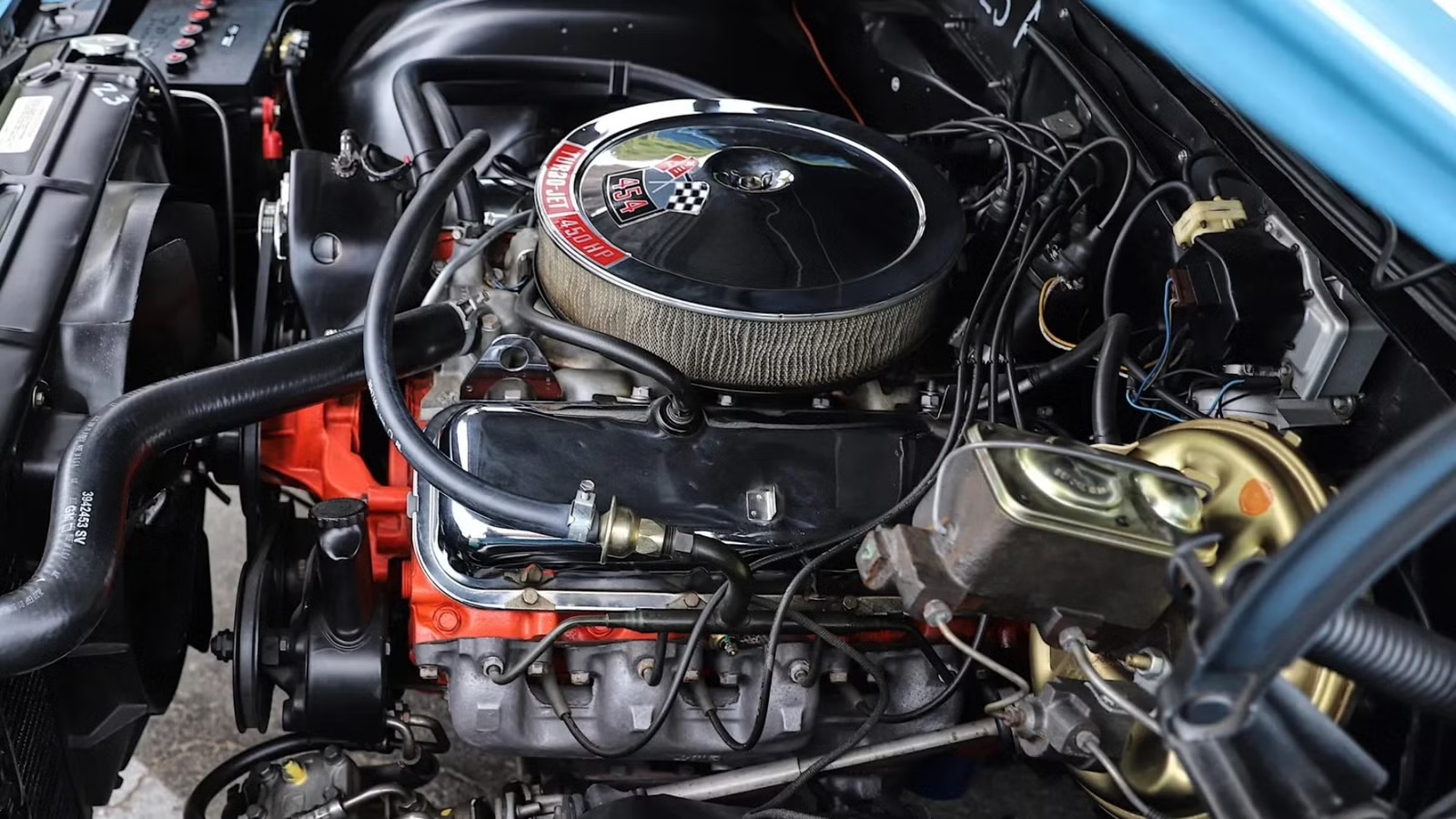
Detroit spent the 1960s locked in an arms race, and the ammunition was cubic inches. Every model year brought bigger engines, bolder ratings, and louder bragging rights, until the escalation finally hit its ceiling in 1970.

Every automaker claimed a king that year, but the spec sheets only crowned one. A single engine carried the highest factory horsepower rating of the entire classic muscle car era.
It held that crown for exactly one year. Then emissions rules, unleaded fuel, and insurance pressure ended the party for everyone, which makes its story worth telling properly.
The Horsepower Arms Race That Took Over Detroit

The 1964 Pontiac GTO launched the Golden Age of American Muscle and ignited a full-blown horsepower war, as rival automakers scrambled to replicate its success with escalating power options. The formula was simple and brutal: take a mid-size car, drop in the largest V8 available, and let the streets decide who built it best. Within a few years, no automaker could afford to sit out.
One of them tried to anyway. With its market share hovering near 50 percent throughout the 1960s, General Motors feared a potential government breakup, and that existential threat led to an internal edict limiting intermediates and pony cars to engines under 400 cubic inches. The corporation with the deepest engineering bench in Detroit had handcuffed itself.
Ford and Chrysler happily filled the vacuum. Chrysler’s legendary 426 Hemi produced 425 horsepower and 490 lb-ft of torque, while Ford rated its Mustang Boss 429 at 375 hp and 450 lb-ft, and both nameplates built reputations that still dominate barroom debates today. For most of the decade, the loudest names in the war wore Mopar and Blue Oval badges.
When the rules changed, GM finally dropped its self-imposed policy in 1970, and its answer arrived swinging harder than anything the war had produced.
The Chevelle SS 454 LS6 Ended The Argument

|
Engine |
Transmission |
Power |
Torque |
|
7.4-liter LS6 V8 |
4-speed manual / 3-speed automatic |
450 hp |
500 lb-ft |
That answer was the 1970 Chevrolet Chevelle SS 454 LS6, and its factory rating of 450 hp and 500 lb-ft of torque remains the biggest number of the classic era. The official rating surpassed the legendary 426 Hemi’s 425 hp and 490 lb-ft, and it easily outclassed the Ford Boss 429’s 375 hp. After six years of watching from the sidelines, Chevrolet had ended the ratings war in a single model year.
The performance backed up the paperwork. Anyone who ordered a 450 hp Chevelle SS 454 with the LS6 could claim the title of King of the Streets, with the car posting quarter-mile times of a shade over 13 seconds, a few hundredths faster than the competition. In 1970, that was as close to a knockout as a spec sheet could deliver.

Getting one required a real commitment at the order desk. The mandatory Z15 SS 454 option cost $503.45, the LS6 package added $263.30, and the M22 four-speed manual ran $221.80, stacking $988.55 onto a base Chevelle price of $2,809. All-in, an LS6 Chevelle pushed toward $5,000, which was Corvette territory at the time.
That comparison stung more than usual inside GM. The Chevelle LS6 stood alone as the only vehicle in history to take GM’s top horsepower rating over the Corvette, whose 454 LS5 was rated at just 390 hp that year. For one season, the affordable mid-size family car outgunned the flagship.
What It Took To Build 450 HP In 1970

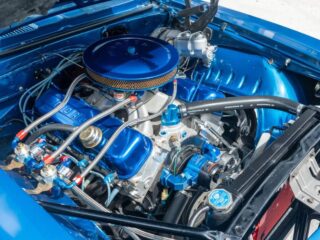
The LS6 started with the 427’s 4.25-inch bore and stretched the stroke to 4 inches, creating the largest V8 Chevrolet had ever put in a production car. The bottom end was built to survive its own output, with four-bolt main caps, a forged steel crankshaft, forged rods, and forged aluminum pistons squeezing an 11.25:1 compression ratio. This was race-grade hardware sold with a factory warranty.

The top end did the rest. A solid-lifter camshaft worked closed-chamber, rectangular-port cast-iron heads with 2.19-inch intake valves, while an 800-cfm Holley four-barrel sat on a low-rise aluminum intake fed by the Chevelle’s cowl-induction hood. Buyers routed all of it through either the incredibly rare Muncie M22 “Rock Crusher” four-speed or the Turbo Hydra-Matic 400 automatic.

The numbers it produced at the strip depended on who was testing. Period results ranged from the high-13s down to Hot Rod’s bone-stock run of 13.44 seconds, the quickest documented time for an unmodified car. Either way, nothing wearing a factory badge was rated higher.
One caveat matters for context. Like every figure of the era, the LS6’s 450 hp was measured in SAE gross terms, with no accessories and open exhaust, and a documented stock example later produced roughly 335 hp net at the crank on modern equipment. That difference in measurement, not just detuning, is why every automaker’s ratings fell off a cliff after 1971.
Where The LS6 Stood Against The Mighty Hemi V8

The LS6 won the number, but the 426 Hemi won the track, and both things are true. Chrysler’s 425 hp rating was famously conservative, with period independent tests putting real output closer to 435 hp and 515 lb-ft of torque. On paper, the Hemi finished second, and almost nobody who lined up against one believed the paper.

Its competition record began with the 426 Hemi debuting at the 1964 Daytona 500 and sweeping the top three spots, with Richard Petty leading 184 of 200 laps in his Hemi-powered Plymouth. Henry Ford II watched the humiliation from the sidelines and ordered his engineers to build an answer, which became the legendary 427 SOHC Cammer.
The dominance was so complete that NASCAR rewrote its rulebook, requiring race engines to be available in production vehicles. That decision forced Chrysler to build the street Hemi for 1966, meaning the LS6’s fiercest rival only existed in showrooms because it had embarrassed everyone on the track first.
On the streets, the LS6 Chevelle could hang with nearly every Mopar it met, but a well-driven Hemi ‘Cuda or Challenger could still beat it. If winning the horsepower war means fear and trophies, the Hemi has a real claim, but on the spec sheet—the war’s cleanest scoreboard—450 stands alone.
A One-Year Reign Worth $1.2 Million Today

The crown came with a short reign and a small court. Roughly 4,475 LS6-equipped cars left the factory in 1970, and because Chevrolet’s records were lost, nobody knows how many were coupes, convertibles, or El Caminos. The El Camino figure is commonly estimated at around 500, but no documentation survives to prove any split.
The war ended before Chevrolet could escalate further. A planned LS7 version of the 454 never reached a production car, killed by rising gas prices and insurance pressure, and the 450 hp rating itself lasted exactly one year. The LS6 survived into 1971 only in the Corvette, detuned to 425 hp, with roughly 190 built before it disappeared for good.
The market has spent five decades keeping score. Hagerty values a documented LS6 Chevelle 454 with the M22 hardtop in good condition at around $140,300, with the best examples clearing $302,450. The engine that won the horsepower war now wins at the auction block, too.
Sources: General Motors, Hagerty, Barrett-Jackson

Related posts
Latest Post


No Comments