
The Forgotten Italian Endurance Bike That Ended An Era With Just 33 Units
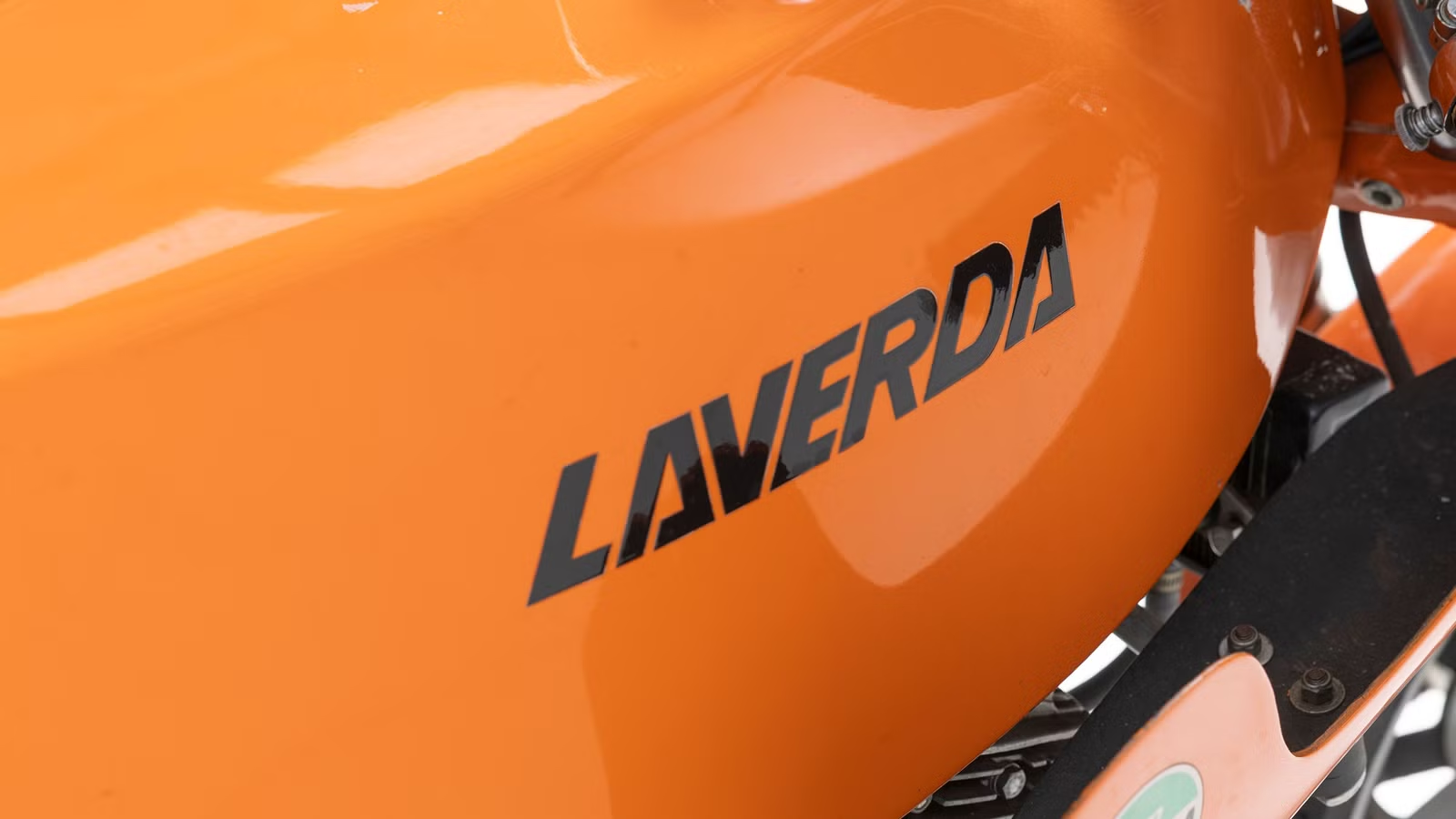
By the mid-1970s, endurance racing was changing. The twin-cylinder engines of the day were starting to give way to bikes with four-cylinders, and Japanese brands were bringing in a new level of reliability that European brands had scarcely seen. This shift saw the Europeans have to change tack, dropping the bikes that had helped make them famous in favor of new designs. But while brands were adapting to the new way of competing, one Italian brand was releasing a final hurrah of a bike to commemorate the end of an era.
How 1970s Endurance Racing Shaped Laverda’s DNA

For as long as bikes have existed, people have wanted to race them. The inaugural Isle of Man TT took place in 1907, while the Bol d’Or — a 24-hour motorcycle endurance race held in France, was first held as far back as 1922. But by the late 1950s interest in endurance motorcycle racing was waning, and the largely European affair struggled to find venues or funding – to the point where the Bol d’Or stopped taking place in 1961 due to venue and funding issues.
As Honda, Yamaha, Suzuki, and Kawasaki expanded into international markets during the 1960s, endurance racing became an increasingly important showcase for manufacturers. Suddenly, endurance racing wasn’t just European brands fighting over a relatively niche trophy, it was a battleground for manufacturers to display both their speed and reliability. The Bol d’Or returned in 1968, as fans flocked back to the circuits.
Laverda, an Italian motorcycle brand founded in 1949, also found its way to endurance racing that year. Entering factory 650 cc and 750 cc bikes in the 1968 Motogiro d’Italia, winning the 650 cc class, and finishing in the top ten of the 750 cc class, Laverda quickly gained a reputation as something of the “anti-Italian Italian bike” thanks to its durability, heavy construction, comprehensive engineering approach, and ruggedness. These were all attributes proven on the endurance circuit, while one other key quality of the Laverdas wasn’t down to their mechanicals at all — it was their paint scheme.

Why Bright Orange Became A Racing Advantage

When you think of an Italian brand, you likely think of red, white, green, or a mixture of all three. Italian brands, and their bikes by extension, are fiercely patriotic, and it seems almost sacrilegious to have a Ducati in anything other than Rosso Corsa red. But despite their Italian heritage, Laverdas raced in bright orange. The reason wasn’t due to a distant Dutch link, but a practical one; orange was easier to spot in the dark.
With endurance races taking place during both the day and night, orange was a practical choice that made them more noticeable in difficult conditions, both for the team and spectators. This came with the added benefit of making them more recognizable and, as Laverda grew in popularity, the orange became an important part of the brand.
In 1976, Laverda unveiled a motorcycle that embodied everything the company had become known for: durability, speed, reliability, and that unmistakable bright orange paint. It would also become the machine that marked the end of an era.
The 1976 Laverda 750 SFC Elettronica Revealed

|
Engine |
Power |
Top Speed |
Wet Weight |
|
744 cc air-cooled four-stroke parallel twin |
75 hp |
~135 MPH |
454 lbs |
Laverda first introduced its 750 SFC (Super Freni Competizione, or Super Competition Brakes) in 1971 as the competition version of the road-going 750 SF. Both the 750 SF and SFC were every bit the rugged, quick endurance machines that Laverda was known for, with aluminum fuel tanks, a fiberglass half-fairing, and robust frames. The SFC rapidly earned a reputation through strong performances and victories across Europe.
From here the bike underwent the usual fettling that race machines do, with tweaks like a fiberglass tank in place of the aluminum and magnesium parts, and, by 1974, it had a partial overhaul to revise geometry, bodywork, and include Brembo brakes, among other things. The one point that remained, though, was the iconic orange paintwork. But all good things must come to an end, and by 1975, the bike had run its course. It had dominated the endurance races of the early to mid 1970s, helped Laverda to establish a strong reputation, and homologated the bike to allow Laverda to compete.
At the same time, the motorcycle industry was moving away from twins. Laverda had proved that the twin could work to devastating effect but, with Japanese bikes like the Honda CB750 Four having already redefined expectations, it was getting harder to justify a comparatively vibration-heavy twin. With so much forward progression in the industry, a twin could have felt like standing still when competitors forged forwards.

Still, Laverda wasn’t happy to simply let the bike that had built its legacy go gently into that good night. The bike had cemented the company’s legacy and deserved a proper send-off. So, with a handful of units left, the company released the 750 SFC Elettronica.
The Elettronica, so named for its cutting-edge electronic ignition, was limited to just 33 bikes. These 33 bikes represented the peak of Laverda’s development at the time and, in addition to the electronic ignition, had dedicated oil coolers to help improve heat control in long races, an engine with a higher compression ratio to push it further towards a full-spec racer, and a few other geometry tweaks to truly send this road-legal endurance racer off with a bang.
What Made The Final Batch Unique

The final 33 bikes stood apart from the other roughly 516 bikes not just because of their electronic ignitions, but because of how complete a package they were. Electronic ignition gave the bike more precise spark timing, improving reliability at higher revs. The factory oil cooler further helped reliability under endurance conditions, ensuring the bike could push for as long as required.
The engine reworks extracted every last ounce of power out of the bike, while cast alloy wheels — a feature reserved for that final run — gave the bike both more rigidity and a more modern look. The Elettronica also used Laverda’s in-house electrical handlebar controls and switches to give the bike an even more distinct look.
The result was a motorcycle that scarcely needed its famous orange paint to stand out, being the most technologically and mechanically advanced machine that Laverda had created.
Why The Elettronica Remains A Collector’s Holy Grail

The Elettronica was the sum of all of Laverda’s endurance endeavors. With just 33 matching-numbers bikes created, it was as rare as it was exciting, and unmistakable in its resplendent orange.
Today, the bike commands prices of $40,000 and upwards, with one 11,000-mile example selling in January 2026 for $66,000. Rather than chasing outright performance with more cylinders, the Elettronica represented the ultimate expression of Laverda’s original endurance racing philosophy. It marked the end of the company’s legendary 750 cc parallel twin and remains one of the purest homologation motorcycles of the 1970s, and a true hand-built race bike that happened to be legal for the road.
Sources: Cycle World, MCNews, Classic.com

Related posts



Latest Post


No Comments