
The 10 Biggest Japanese Engines Ever Made
Japanese car manufacturers are rarely associated with high-displacement engines. Powertrains from the country have often found a replacement for displacement, whether that means pioneering technology for naturally aspirated engines like Honda’s VTEC, or insisting on using turbochargers on their most high-performance models like the A80 Toyota Supra and R-series Nissan Skyline GT-Rs.

Occasionally, though, engineers working for manufacturers from the land of the rising sun resort to the good old route of simply making a powertrain bigger to improve its performance. These are the 10 largest to come out of the country.
10
Nissan VK45DE – 4.5-liter V8
Through the 2000s, you’d find the Nissan VK45DE under the hood of a range of JDM sedans, including the Nissan Cima, Nissan Fuga, and Nissan President. In the case of the Cima and Fuga, those would come to the US as the Infiniti Q45 and Infiniti M45, while the engine would also see action in the Infiniti FX45.

The all-aluminum 4.5-liter V8 wasn’t just a large-capacity engine, but was packed with impressive technology too, including variable valve timing and a forged crankshaft. It produced up to 340 hp in production form, though it is known to be capable of taking more.
It never found its way into a particularly interesting road car, but the engine did have a life in motorsport, forming the basis of Nissan’s Super GT racing engines in its home country as well as LMP2 racers in global sportscar championships.
9
Toyota 1VD-FTV – 4.5-liter V8

This is one of the most important engines that Toyota has ever built. A 4.5-liter twin-turbo diesel V8, the 1VD-FTV has been at the heart of several heavy-duty models, most notably under the hood of the Toyota Land Cruiser 200 Series.
It had big shoes to fill, coming off the back of the legendary, durable 1HD-FTE, but proved itself to be just as capable. It gained a reputation as a smoother and more refined powertrain, while delivering immense levels of torque that meant it could easily push a true 4×4 without breaking a sweat.
Although no longer available in the US, the 1VD-FTV lives on in the Toyota Land Cruiser 70 Series sold in some global markets.
8
Mitsubishi 8A80 – 4.5-liter V8
Indeed, you read that correctly. Mitsubishi has built a 4.5-liter V8 in the past and, more surprisingly still, you could have it in a sedan.
Provided you lived in Japan, and had a lot of cash to spend on a luxury car, that is. This engine was designed exclusively for use in the Mitsubishi Proudia and its longer sibling, the Dignity, a car introduced in 1999 that would compete directly with the famous Toyota Century. Things get more unusual when you realize this was a front-wheel-drive car, pushing the Japanese gentleman’s agreement-bound 276 hp.
Sadly, with its limited use and having been introduced at the tail end of the Japanese economic crash of the ’90s, the Proudia and Dignity didn’t sell very well, and the V8 wouldn’t see action in a Mitsubishi again. However, in another strange twist, the model would also be sold in Korea as the Hyundai Equus (not the one sold in the US) through to 2009.
7
Toyota 2UZ-FE – 4.7-liter V8

Another high-displacement engine built for use in the Toyota Land Cruiser, the 2UZ-FE is a legendary 4.7-liter gasoline V8 engine. Developed from the 1UZ-FE found in its more luxurious, road-focused models, the 2UZ was designed with low-end torque in mind.
It swapped the 1UZ’s block out for a durable cast-iron unit, allowing it to handle poor-quality fuel, which is more likely to be found in remote areas, while improving its capabilities for rock crawling and towing.
The 2UZ quickly gained a cult following, owing to its near-bulletproof reliability reputation and ability to cover hundreds of thousands of miles on basic maintenance.
6
Lexus 1LR-GUE – 4.8-liter V10

This could be the single-greatest engine ever made. The 1LR-GUE has only ever seen action in one car, but what a car it was. The Lexus LFA.
This 4.8-liter V10 was designed solely to be the beating heart of the most advanced model Toyota had ever developed, and was constructed from aluminum, magnesium, and titanium. A diamond coating on its rocker arms showed how sophisticated the engine was, and it even had independent electronic throttle bodies from the factory.
Co-developed with Yamaha, it gained fame for its screaming engine note, quite unlike anything ever heard, while producing a mighty 553 hp and 354 lb-ft of torque. The world has seen nothing quite like it since, and likely never will again.
5
Toyota 1GZ-FE – 5.0-liter V12

If you have a passing interest in Japanese car culture, you surely know of theToyota Century. In case not, though, think of it as the country’s domestic rival to the Mercedes S-Class and Rolls-Royce Phantom, the most luxurious vehicle produced in the country.
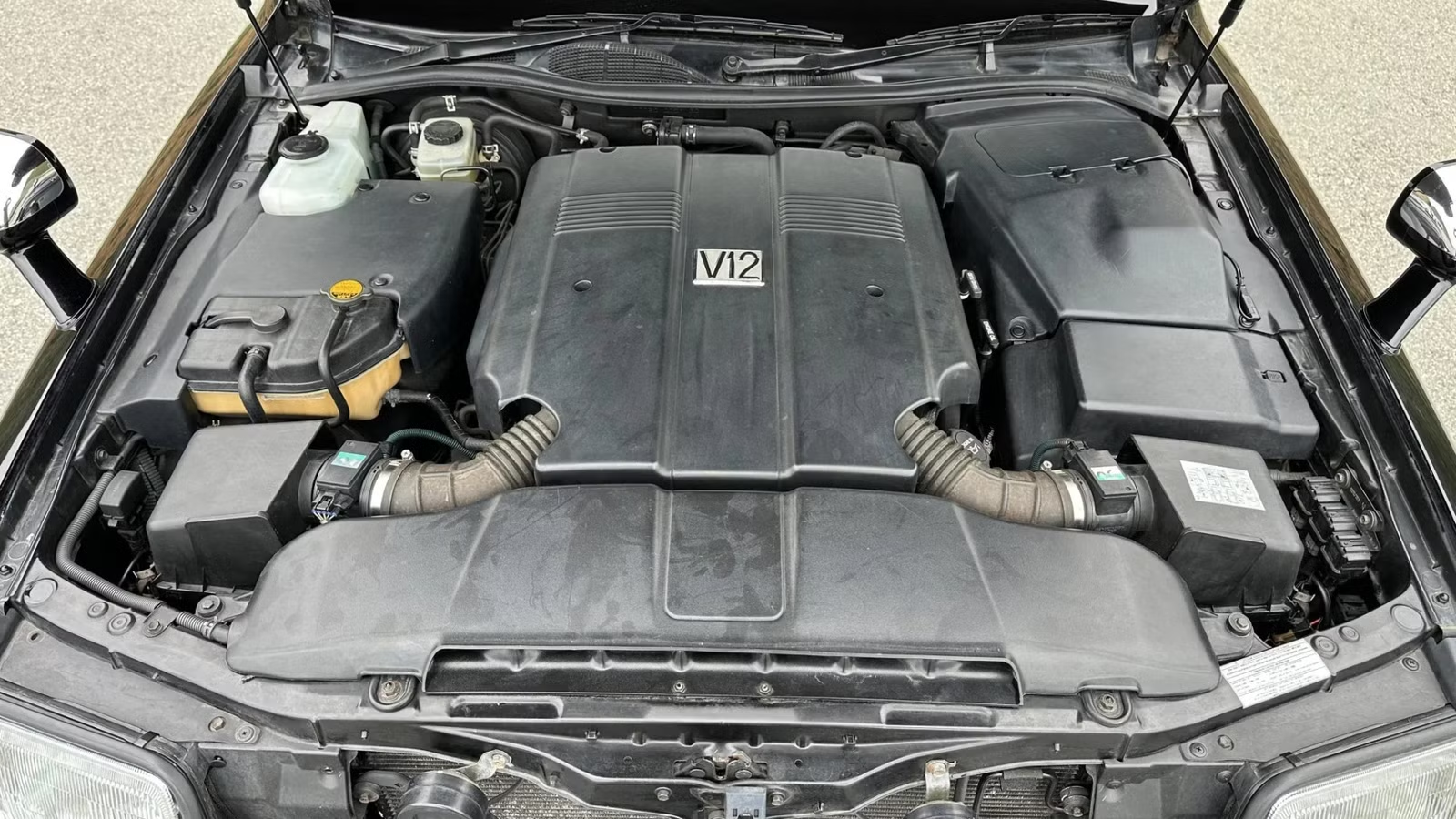
With that in mind, it needs a fitting engine. For the second-generation model sold from 1997 through to 2017, that was exclusively a 5.0-liter V12, the 1GZ-FE, the only Japanese V12 ever made.
This wasn’t a performance-focused engine, producing just 276 hp and 355 lb-ft. However, it was incredibly refined to aid the smooth ride of the Century while being packed with impressive technologies. For example, it had a separate ECU for each cylinder bank.
Sadly, the V12 would be replaced by a V8 for the third-generation Century introduced in 2017, but collector interest certainly hasn’t waned.
4
Lexus 2UR-GSE – 5.0-liter V8

While Toyota-developed V8s will live on with the twin-turbo 4.0-liter found in the GR GT, it won’t hit quite the same as the 2UR-GSE found under the hood of several modern Lexus models.
This 5.0-liter naturally-aspirated V8 showed what a Japanese muscle car engine could be like, powering the likes of the IS F, RC F and the LC500 sports car. It was another case of Toyota teaming up with Yamaha, specifically for the cylinder heads, while other tech included direct/port injection and titanium valves on later models.
Producing as much as 471 hp, its raucous sound and punchy torque delivery left an impression every single time you experienced stabbing the throttle and unleashing it. How long until we see plenty of these swapped into modern Toyotas, like the GR86?
3
Nissan VK50VE – 5.0-liter V8

So, Nissan once designed a high-performance, naturally-aspirated 5.0-liter V8. An engine producing 390 hp and 369 lb-ft of torque. Surely, that went into an incredible car, right?
Not quite. Instead of giving us some incredible GT-R or Z car spin-off with that engine, it found its way into the Infiniti FX50 and later rebranded QX70. That’s right, it only ever appeared in an SUV.
Based on the VK45DE right at the top of this list, it was updated with a larger capacity, and the introduction of a VVEL variable valve timing system to improve throttle response and torque delivery. Unfortunately, the car it found a home in never lived up to the potential of the engine.
2
Nissan VK56DE – 5.6-liter V8

Think of this one as an answer to the Toyota 2UZ-FE, and you can get an idea of what to expect from the Nissan VK56DE. A 5.6-liter V8 engine, it was designed for use in heavy-duty vehicles like the Nissan Patrol, Titan, and Infiniti QX56.
Unlike the 1GZ, it used an aluminum block to keep weight down, but that didn’t hinder its durability, proving itself an engine that could handle towing easily, cover huge miles with just basic, routine maintenance, and even sound pretty good.
In some ways, you could think of it as a Japanese LS. Now, if someone wants to swap one into a Corvette, we’d pay to see that.
1
Toyota 3UR-FE – 5.7-liter V8

Here we have it, the largest-displacement production car engine that Japan has ever produced. Only, it wasn’t built in Japan. Rather, it was assembled in Alabama. Assembled in America.
When you consider it was designed exclusively for the American-market Toyota Tundra initially, that doesn’t come as a shock. It would later be used for the Sequoia and US-market Land Cruiser.
It was designed with durability in mind first and foremost, allowing it to be capable of heavy-duty towing without breaking a sweat and covering miles that other engines couldn’t get remotely close to.
Such is its reliability, it’s even gained a huge aftermarket following with enthusiasts often strapping a supercharger to it for big power figures. TRD even offered a supercharger kit for it.

Related posts


Latest Post


No Comments