
The Honda Sports Car With 580 HP On Tap And A 10,000 RPM Redline
The Honda S2000 was never supposed to be a numbers car. When it debuted at the turn of the millennium, it didn’t bully sports car rivals with massive torque or sheer displacement; it completely captivated drivers by being perfectly honest, incredibly communicative, and pure to drive — qualities that have virtually vanished from modern performance vehicles. For decades, the collective automotive consensus accepted that the S2000 was a masterpiece of momentum: a purist’s tool that intentionally traded outright straight-line speed for surgical precision and a high-revving atmospheric symphony.

Yet, treating this iconic roadster as merely a lightweight, modest-power relic of the past ignores a staggering engineering truth hidden beneath its skin. While typical mainstream retrospective coverage frames the S2000 as a delicate classic to be preserved in amber, its underlying mechanical architecture possesses a structural ceiling far beyond anyone’s wild expectations.
Modern Performance vs. Classic Purity
To appreciate the true depth of this engineering foundation, one must look at the tragic trade-off defining the modern sports car market. Today, performance enthusiasts are spoiled for choice when it comes to raw horsepower numbers. Modern sports cars routinely leave showrooms pumping out 500, 600, or even 700 horsepower, but that speed comes at a high cost. It is a world governed by heavy turbochargers, numbing electronic power steering, automatic dual-clutch gearboxes, and computer algorithms that manage traction before the driver even realizes a tire has slipped. These vehicles are violently fast, but they are increasingly digital, isolated, and heavy.

Conversely, the automotive industry has all but abandoned the recipe that made turn-of-the-century icons legendary. True analog cars — those that rely on high-revving, naturally aspirated engines, mechanical limited-slip differentials, and standard three-pedal manual gearboxes — are almost universally restricted to low-to-moderate power brackets. Enthusiasts have long been forced to make a definitive choice: do you want the visceral thrill of a pure, communicative mechanical connection, or do you want the brutal acceleration of high-horsepower forced induction?
The Blueprint Of The BP25: Amplifying Analog Purity

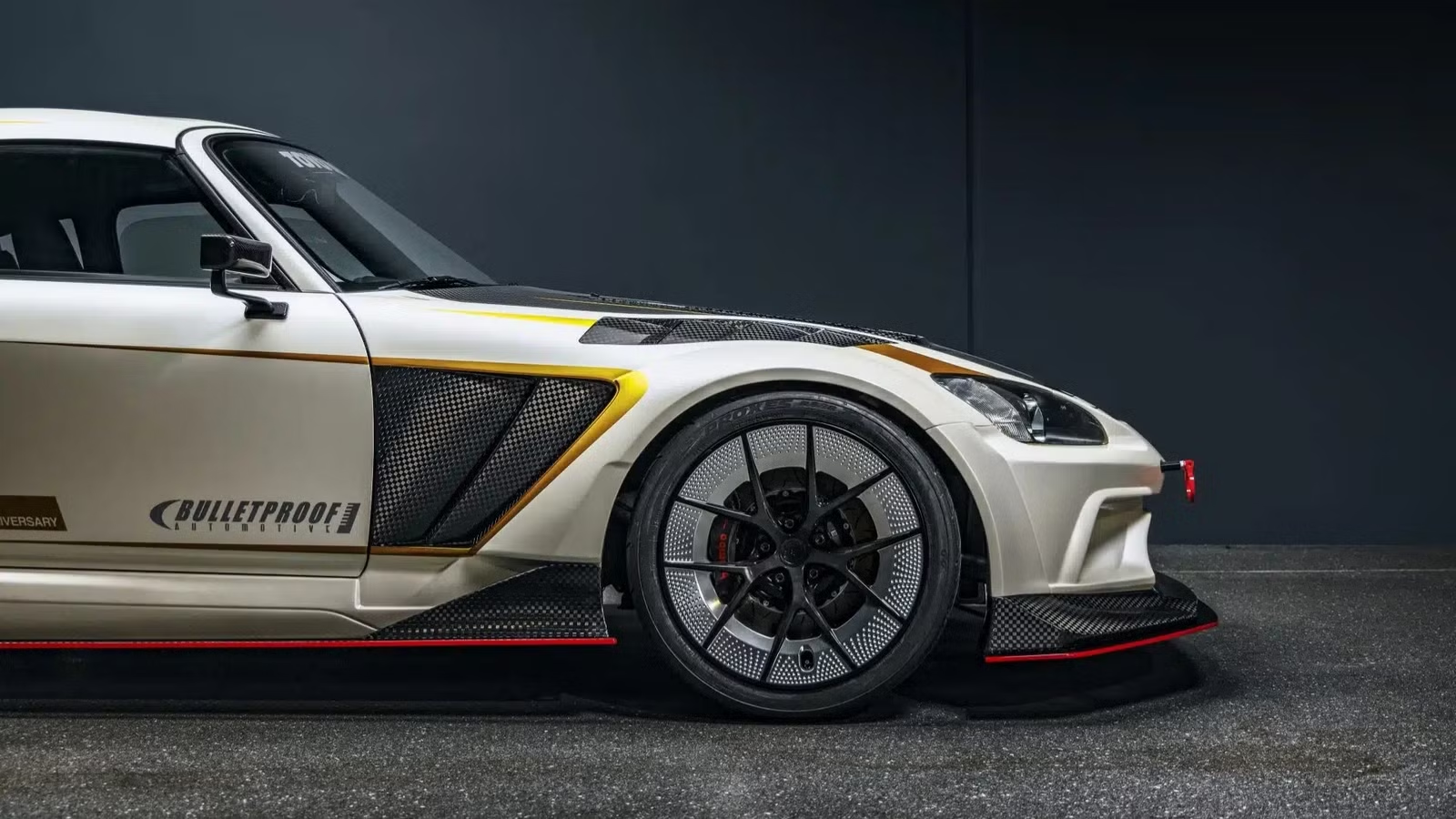
When Bulletproof Automotive decided to celebrate its 25th anniversary at the SEMA Show, they chose to prove that Honda’s pure, analogue roadster possessed a structural ceiling far beyond anyone’s wild expectations. Enter the “BP25.” This is not a modern engine swap or a hollow cosmetic exercise meant to harvest social media clicks. Instead, it is a masterclass in amplifying Honda’s original mechanical philosophy for the S2000, coaxing a staggering 580 horsepower at 9,300 RPM out of a 2.0-liter displacement before finally bouncing off a frantic 10,000 RPM redline.
While a build like this is typically seen as a standalone novelty, the BP25 is actually a lens into a broader automotive phenomenon. Proving that a quarter-century-old sports car can safely triple its factory output on its original block layout is the exact reason why clean, untouched S2000s are quietly skyrocketing in value, leaving other early-2000s Japanese performance icons firmly in their wake.
The Heart Of The Beast: Supercharging The F20C

To unlock 580 horsepower from a four-cylinder engine without entirely destroying its high-revving, linear personality, a massive turbocharger was out of the question. Turbochargers introduce lag and a sudden wave of mid-range torque that can easily upset the balance of a momentum-car chassis like the S2000.
Instead, Bulletproof Automotive bolted a Vortech V2-Si supercharger to the F20C block. Managed by an advanced AEM engine management system, the belt-driven supercharger builds boost predictably and strictly in proportion to engine speed. This approach directly honors the car’s original factory identity. As Ben Schaffer, the founder of Bulletproof Automotive, noted:
We took that core high-revving, analogue purity and amplified it with 580 supercharged horsepower and the finest modern tech.
The result is a power delivery curve that feels like a factory Honda engine amplified many times over — progressive, highly predictable, and violently fast at the top end of the tachometer.
The Mechanical Connection To The Standard AP2

Crucially, the team resisted the temptation to replace the drivetrain with a modern sequential gearbox or an automated dual-clutch transmission. The BP25 retains the iconic AP2 six-speed manual transmission. Widely considered one of the greatest and crispest-shifting gearboxes ever installed in a production car, this transmission serves as the ultimate anchor for the car’s mechanical engagement.
Power is sent through a heavily upgraded clutch and differential to cope with the 580-horsepower surge, but the physical act of rowing through the gears remains unchanged. By keeping the manual box, the build forces the driver to work for the speed, ensuring that the visceral connection between human, machine, and asphalt is never lost to electronic intervention.
SEMA Aesthetics With Heritage Roots
The Dark Panther Meets Lamborghini White
A powertrain this radical requires a visual wrapper that commands attention on the chaotic SEMA Show floor, yet remains firmly rooted in JDM (Japanese Domestic Market) tuning culture. Bulletproof accomplished this by fitting a Varis Dark Panther widebody kit to the roadster. The kit drastically widens the car’s track, allowing for massive rubber to meet the road while introducing complex aerodynamic ducting that manages airflow and cooling for the supercharged internals.
To break up the aggressive carbon fiber elements, the body was sprayed in an elegant, multi-stage Lamborghini Balloon White paint. This specific pearl white is highly significant for the brand, serving as a direct homage to one of Bulletproof Automotive’s earliest, most iconic concept car builds from their 25-year history.
Visual Drama With Track Functionality

The cosmetic changes culminate at the roofline with the addition of a legendary Spoon Sports race hardtop. This component transforms the open-top roadster into a sleek, flowing fastback coupe silhouette.
Every single visual modification on the BP25 serves a dual purpose. The widened fenders are not just for stance; they accommodate high-performance tires necessary to prevent a 580-horsepower, short-wheelbase car from spinning out. The vents in the hood and sides are vital heat extractors, keeping the forced-induction F20C alive during extended track sessions. The BP25 completely avoids the “all-show-no-go” trap, presenting a unified theme where visual drama and track-ready aerodynamics coexist seamlessly.
The F20C Engineering Ceiling: Why the S2000 Was Overbuilt
Formula 1 Thinking For The Road

To understand how the BP25 can reliably survive a 10,000 RPM redline while pushing nearly triple its original factory output, one has to look back at the late-1990s engineering culture at Honda. The S2000 was developed as a rolling celebration of Honda’s 50th anniversary, and their engineers treated the project with the fanaticism of a Formula 1 program.
When the F20C engine debuted, its specific output of 120 horsepower per liter was the highest of any naturally aspirated production car in the world—a record it held for a decade until the Ferrari 458 Italia finally eclipsed it. To achieve this safely, Honda didn’t use standard mass-production parts. They implemented fiber-reinforced metal (FRM) cylinder liners for superior heat dissipation and minimal wear, as well as forged aluminum pistons and internal components treated with friction-reducing materials derived straight from their racing division. Essentially, the F20C left the factory with internal tolerances and material strengths that rivaled those of bespoke racing engines.
The Difference Between Power And Revs

In the modern performance landscape, making 580 horsepower is relatively easy: simply take a large-displacement V8 or a turbocharged V6, crank up the boost, and ride a wave of low-end torque. However, making 580 horsepower that peaks at 9,300 RPM is an entirely different engineering challenge.
As engine speeds climb toward 10,000 RPM, the kinetic energy and physical stress inside the engine do not increase linearly; they scale exponentially. Inertial forces on the connecting rods and wrist pins become extreme, and the valvetrain risks “valve float,” where the valves cannot close fast enough to keep up with the camshaft. The BP25’s ability to comfortably breathe at five-digit engine speeds without throwing a rod through the block is the ultimate proof of how extraordinarily overengineered the base factory Honda engine truly was. Honda built a foundation capable of handling a supercar’s demands, hiding it inside an affordable roadster.
The Dual-Track Market: From Track Toy To Collector Asset
The Sub-$35,000 Legend’s Modern Value Surge

When the Honda S2000 was sitting on dealership lots in the early 2000s, it carried an original MSRP safely under $35,000. For years, it followed the typical depreciation curve of an accessible sports car, transitioning through a phase where it was simply a cheap, highly capable track toy for grassroots enthusiasts.
Today, that reality has fundamentally shifted. The S2000 market is experiencing a massive valuation surge. While clean examples of contemporary Japanese sports cars from the same era have started to plateau or languish, unmolested, low-mileage S2000s are routinely crossing the auction block for double — and sometimes triple — their original sticker price. The market has woken up to the fact that the automotive industry will never build a car like this again. The era of high-revving, naturally aspirated, lightweight mechanical purity is dead, locked away by modern emissions standards and the industry-wide shift toward heavy hybridization and electrification.
The Tuner Paradox Driving Appreciating Values

Intriguingly, ultra-high-end aftermarket creations like the Bulletproof BP25 do not dilute the collector market; they accelerate it. This creates a fascinating “tuner paradox.” When enthusiasts see a masterclass build pushing 580 horsepower at 10,000 RPM on a platform’s original architecture, it serves as a powerful reminder of the vehicle’s incredible engineering ceiling.
As top-tier tuning houses scoop up vehicles to build rolling art pieces, the global pool of pristine, unmodified factory cars shrinks even further. The ultimate winner in this ecosystem is the value of the stock S2000, which rises out of sheer scarcity.
The Bulletproof Automotive BP25 is far more than an exercise in aftermarket excess. By combining modern forced induction with a deep reverence for the S2000’s original six-speed manual and high-RPM soul, it honors a golden era of engineering unlikely to be repeated.
It stands as a loud, 10,000 RPM reminder of what happens when a mainstream manufacturer lets its racing engineers build a passion project without compromise. Whether an S2000 is modified into a 580-horsepower widebody weapon or preserved in a climate-controlled garage in bone-stock condition, its status as an immortal legend of automotive history is officially locked in.
Sources: Bulletproof Automotive, LapMeta Vehicle Index

Related posts


Latest Post


No Comments