
1915 Excelsior Big X: The Bike That Made 1,000cc Real
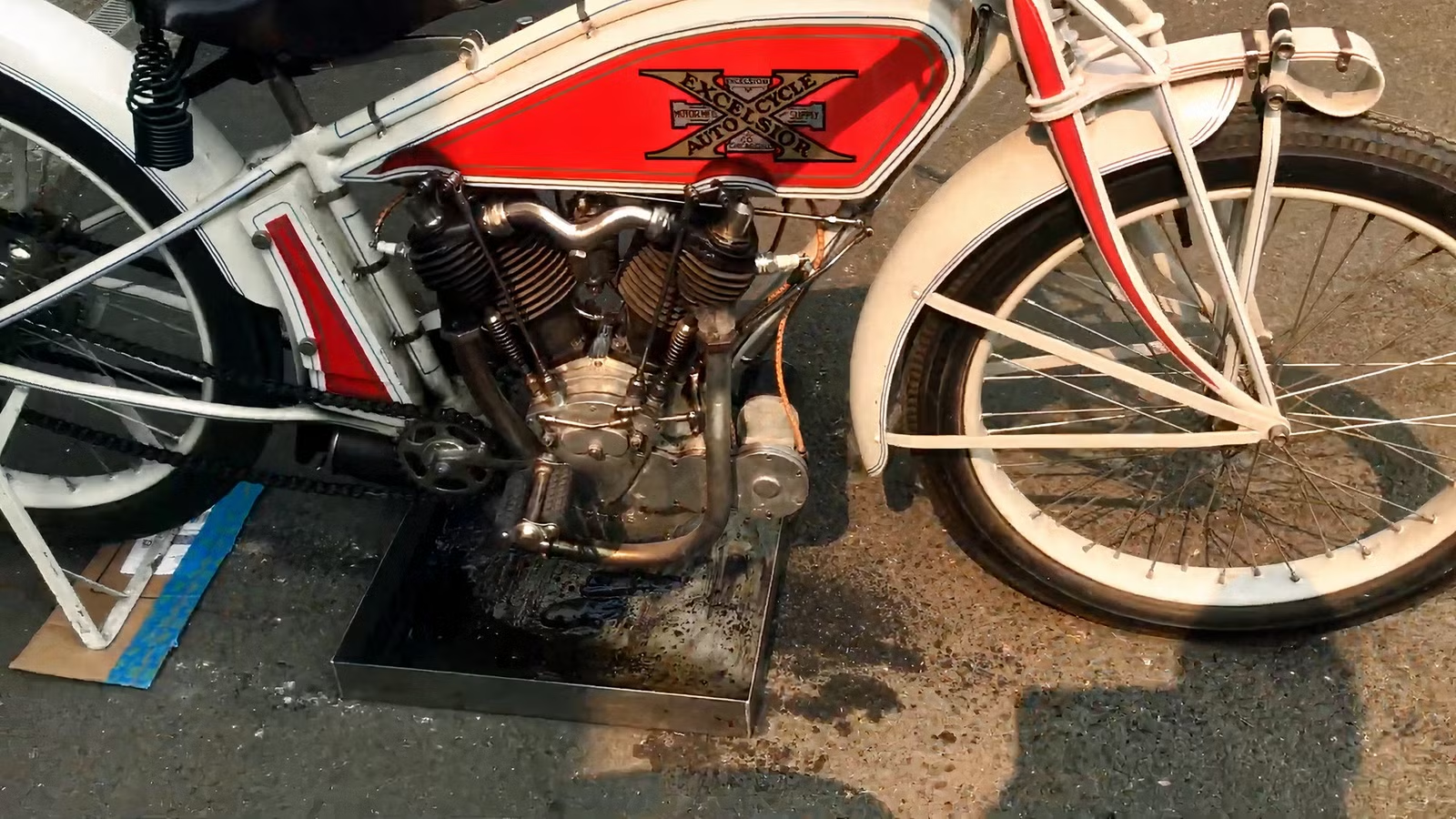
The motorcycle industry has always been in a race to build bigger and better. The high displacement bikes we see today, like most things, have an interesting history of innovation and evolution. Earlier machines were hardly the epitome of power, but they helped carve the path for some of the earliest production motorcycles to approach the 1,000cc mark.
From Modest Singles To Monster Mills

The lack of technology during the production of early small-capacity singles limited the displacement numbers. If we look at late 19th and early 20th-century bikes, they had modest engine capacities ranging from 100cc to 500cc — displacement figures that were not so ‘modest’ for the time. These engines were ideal for the poor road conditions of the era and very feasible to build and maintain without spending an awful amount of money.
But riders wanted more. There was a time when motorcycles were merely mechanical curiosities; that quickly changed and they became practical transportation. Manufacturers then started giving power and long-distance comfort the priority. A small single couldn’t provide the torque that was needed for carrying a passenger, cruising comfortably for hours, or climbing steep roads.
That necessity gave birth to V-twins. Motorcycle engineering was not by any means immune to evolution. With the ground set for future enhancements, the big names in the industry made significant advancements and introduced, rather invented, the iconic big twins and fours, which in turn set the stage for the 1,000cc jump.

With smoother power delivery, never-before-seen durability and much stronger low-end pull, the V-twin layout quickly became popular among both engineers and riders. The road after that has only gone upward, with manufacturers working on higher displacement with every upcoming generation.
The Early 1,000cc V-Twin Era: The Excelsior Big X
Excelsior, however, wasn’t interested in modest progress. The American motorcycle manufacturer helped push production motorcycles toward the 1,000cc class, paving the way for the large-displacement bikes we see today. Excelsior did not just compete with what was going on in the market, it developed an engine that gave a new identity to production motorcycles.
Though Excelsior began the development of its new flagship during 1914, the 1915 Excelsior Big X made entry as part of the company’s 1915 lineup. What made it an astounding marvel was its massive 61-cubic-inch side-valve V-twin, a displacement commonly rounded to about 1,000cc. At a time when many motorcycles were still far smaller, the Big X helped make four-figure displacement feel like a realistic future for production motorcycles.
Today, one might pass by a 1,000cc bike without much thought, dismissing it as relatively ordinary. But in the 1910s, a motorcycle of that size was closer to an engineering moonshot. The power output of 15 hp, combined with the abundant low-end grunt, made the Big X one of the most powerful bikes during that era.
That torque transformed the riding experience. The Big X gave riders effortless pulling power and tackled steep inclines without much effort. And most importantly, it was perfect for the primitive roads of the era that posed challenges to motorcycles and automobiles alike. The manufacturer gave a lot of importance to torque and power, sure, but the much-needed practicality was not ignored, either.
Back in those days, roadside assistance was a rarity and reliability became imperative. Thanks to the rugged design of the Big X, rider anxiety was significantly reduced. The bike proved that packing all that power didn’t translate into compromises on the reliability and practicality fronts.
Engineering A New Era Of Power
Of course, a lot of engineering prowess went into making this beast. It was not as simple as bolting a larger engine into a pre-existing frame. Everything had to evolve.
Some of the most crucial challenges faced by the engineers were coming up with better cooling strategies, dealing with stronger crankcases to accommodate a heavier V-twin, building sturdier frames, and making durable components. Increased vibration was also an issue to be dealt with considering the brute power of the engine. These engineering breakthroughs were not forgotten for decades to come, and they played a pivotal role in the evolution of motorcycles as we know them today.
Effortless performance is what riders were looking for, and that is exactly what they got with the large-displacement V-twins. They made long-distance travel smoother and less troublesome with the usable torque.
With this new concept, motorcycles ceased being lightweight alternatives to bicycles and became a mode of transportation by providing utility, capability, and endurance.
It’s fair to say that this is where the modern blueprint of American heavyweight motorcycles was established.
Legacy Of The Liter Barrier

With manufacturers now building motorcycles with engines exceeding the 2,000cc mark, it is very easy to look at a 1,000cc bike today and overlook all the engineering that went behind it. Compared to today’s sportbikes that produce more than 200 hp, the Big X looks almost quaint.
But its significance goes beyond sheer performance. It helped prove that larger-displacement motorcycles could be practical, durable, and desirable, while also shaping the heavyweight V-twin formula that remains relevant today.
Sadly, the Big X doesn’t get the recognition it deserves today. But history remembers it as a stepping stone to greater heights. Rather than being remembered simply as a performance milestone, the Big X deserves credit as one of the early production motorcycles that helped establish the 1,000cc class. More than a century later, modern heavyweight motorcycles can still trace part of their character back to machines like this, which proved that large V-twins had a real future on the road.
Source: RoyalEnfield, thevintagent

Related posts





Latest Post


No Comments