
Baldwin-Motion Chevy Vega: The Muscle Car the DOJ Banned
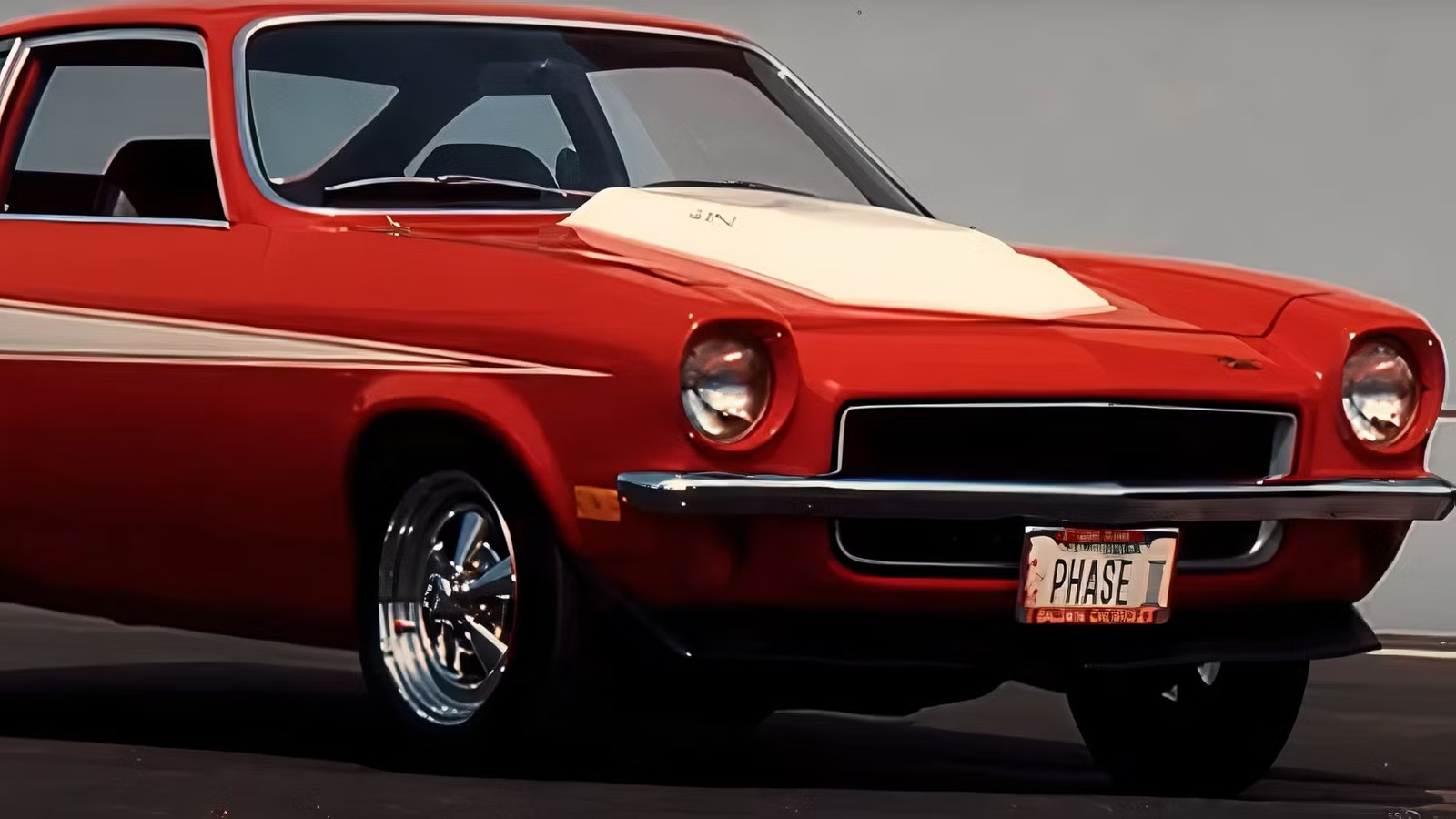
1970 was the year the muscle car, as a concept, bounced off the redline. The Detroit horsepower wars had reached their peak, and there was no other place to go but down. But these lead-fueled, pushrod-pumping, boulevard brawlers would not go gently into the night. After 1970, muscle cars weren’t just battling for the fastest quarter mile. These big block warriors were fighting a war against insurance companies, geopolitical turmoil, the Environmental Protection Agency, Ralph Nader, and even the Department of Justice.

Even NASCAR tried to tone down the muscle by banning giant wings from its super speedways to keep stock cars under 200 mph. Yet, even with the writing on the wall signaling the end of this short but bright era of automotive design, the Big Three kept pushing to make these high-powered machines. By 1971, Chevrolet 454 and Chrysler Hemi 426 big-block V8s were claiming over 400 hp from the factory. Meanwhile, Buick was unleashing its own torque monster, the GS 455 Stage 1.
Yet, when it comes to power, some people always want more. There was a market for people looking to buy a muscle car with something extra under the hood. Back then, they called them supercars, and some of them came with a warranty.
Baldwin Motion Phase III Super Muscle Cars

Most V8 fans will recognize names like Carroll Shelby, Jack Roush, and Don Yenko as dealer-based supercar builders. But few may know the name Joel Rosen, founder of Motion Performance, and the mastermind of the Chevrolet Baldwin-Motion muscle cars. This partnership began in the mid-1960s, when Ed Simonin, the general manager of Baldwin Chevrolet, a family-run New York-based dealership, struck a deal.
Car buyers looking for a Chevelle, Nova, Camaro, or Corvette could order one from Baldwin Chevrolet and have it delivered to Rosen’s Motion Performance speed shop for conversion into a Baldwin-Motion Phase III supercar. From 1967 to 1974, Rosen created an army of around 500 made-to-order custom muscle cars, each backed by a Baldwin Chevrolet warranty with available financing.
Most of the Baldwin-Motion muscle cars started out as factory-fresh Chevrolet SS models and fed a protein diet of dyno-proven speed parts. Performance upgrades included Holley three-barrel carburetors with aluminum high-rise intakes, Sun Super Tachometers and gauges, magnesium wheels, chrome side exhaust systems, suspension components, and the option for an overdrive transmission. These upgrades were in addition to exclusive badging, paint schemes, and optional fiberglass body kits.
But the muscle car that pushed the muscle era past its breaking point was the last variant of the Baldwin-Motion supercar, built in 1974. A wolf in sheep’s clothing that howled loud enough to get the attention of the U.S. Department of Justice.
1974 Baldwin Motion Big Block Chevy Vega

The Chevrolet Vega was designed as an economy car, a rush job to get to market and compete against Toyota, Mazda, and Honda. It was never meant to be a streetlight brawler. Not a muscle car. Of course, when the Chevy Vega debuted in 1970, it didn’t take long for people to start shoving modified V8 engines into its narrow hood bay. Among those doing these V8 swaps was Joel Rosen, aka Mr. Motion.
From 1970 to 1974, Rosen built several Chevy Vegas with 350ci V8 swaps. But the real challenge was fitting a big block 454ci V8. To put that in modern terms, a big-block V8 Chevy Vega is like a Hellcat Hemi-swapped Mitsubishi Mirage.
Some of the extensive modifications needed to build a Baldwin-Motion Super Vega included a heavy-duty cooling system, a shorter prop shaft, and the stock brake discs drilled to a five-lug pattern to fit the larger 14-inch Cragar S/S wheels and a thick set of N50-15 Goodyear tires.
A Muscle Car So Powerful The Government Banned It

Veteran auto writer Ro McGonegal recalls driving a Baldwin-Motion Phase III Chevy Vega in its heyday in an article for MotorTrend in 2019. McGonegal states the superpowered Vega was loud, didn’t stop, and ran hot. But apart from that, the car was, as advertised, a monster.
McGonegal would write the story “The King Kong of Long Island” for Car Craft Magazine in January 1974. What neither McGonegal nor Rosen would expect was the U.S. government getting wind of the story and learning about Mr. Motion’s less-than-subtle modifications. The EPA and Department of Justice issued Joel Rosen a Cease and Desist order to stop production on all specialty vehicles with non-factory powertrains or risk costly fines.
The issue was building a Baldwin-Motion supercar meant removing mandated emission devices. Under the Cease and Desist, Rosen would be fined $10,000 per emission device removed from a vehicle. So, on a Motion Super Vega, the fines could easily reach $50,000.

The Ford Muscle Car That Was Rarer Than A Boss 429
Technically this rare car is a failed project, but collectors still throw insane amounts of money at it’s massive Big Block V8 power.
The Downfall Of The 1970s Muscle Car

Did you know the EPA (Environmental Protection Agency) was established by President Richard Nixon on December 2, 1970? Nixon would end the year by passing the Clean Air Act into law on December 31, 1970. The same year the muscle car era peaked, it ended with the law that signified the beginning of its downfall.
The Clean Air Act aimed at reducing air pollution by establishing emission standards for vehicles using unleaded fuel. This forced automakers to engineer new methods to meet these new standards. By 1972, the way horsepower figures were being reported had also changed.
Prior to 1972, American automakers used the SAE (Society of Automotive Engineers) “gross” measurement to record engine horsepower ratings. This meant running an engine on a test stand free of any external systems, such as the air cleaner assembly, exhaust, and alternator. This allowed engines to run freely and achieve higher ratings, but now they had to report “net” figures by running an engine with everything connected to simulate real-world driving conditions.
As a result, the performance numbers were lower. Suddenly, a 1972 Chevelle SS 454 was making far less than the claimed 450 hp of its 1970 predecessor. “Now with less power” doesn’t make for engaging advertising.
Insurance Premiums and Oil Prices Spike Against Muscle Cars

The government was putting a tight leash on muscle cars. At the same time, insurance companies were putting a financial squeeze on the people driving them. When high performance becomes affordable, it stands to reason that accidents are going to occur. By 1970, insurance premiums for anything with a V8 and rally stripes were skyrocketing to a point that young drivers couldn’t afford them.
The final straw that broke the muscle car’s back occurred with the Petroleum Exporting Countries (OPEC) oil embargo in 1973. This caused fuel shortages and gasoline prices to spike. Those owners of big-block V8s getting less than 10 miles per gallon found themselves unable to find fuel or afford insurance to keep driving them. The muscle car never truly died, but the horsepower wars ended by 1974.
The Dodge Muscle Car That Was Too Extreme For The Streets
This seven-second Dodge is for the drag strip only.
The Baldwin-Motion Legacy, Mr. Motion

Joel Rosen settled in 1975 for a $500 fine under the condition that Motion Performance would stop producing specialty vehicles with non-factory powertrains for the street, thus ending the shop’s saga of dealer-supported supercars.
However, this didn’t close Rosen’s shop for good. After the legal ordeal, super-modified Motion Performance muscle cars built and sold were invoiced as “for export” or for non-street-legal use. But track-only muscle cars meant not everyone could spare the expense of buying a car they couldn’t drive on the street.
Joel Rosen passed away in 2023 due to illness, leaving behind a legacy built and dyno-tested one quarter mile at a time. Today, original Baldwin-Motion Chevrolet supercars are highly sought after by car collectors. But while the Corvettes, Chevelles, and Camaros get all the attention, it’s ironic that the one muscle car powerful enough to make the EPA and DOJ angry enough to take legal action, and kill an industry in the process, was a little Chevy Vega with a big old engine.
The Fastest Muscle Cars Over The Quarter Mile In The ’70s
These American icons can lay down some seriously quick quarter times.
Source: Silodrome, Motor Trend, Motion Performance, Hagerty

Related posts



Latest Post


No Comments