
The Cruiser That Quietly Becomes Riders’ Favorite Bike

The cruiser segment has long operated on an unspoken contract: if you want big displacement and serious style, you accept the weight, the heat, and the physical toll. The alternative has always been a smaller machine that’s easy to manage but ultimately underpowered — fine for a year or two, then quietly outgrown. For a long time, that gap in the middle, a genuinely capable liter-class cruiser that didn’t punish its rider, went unfilled. The market has often split riders into two camps: the heavy, traditional stuff that looks the part but demands patience, or the smaller entry-level bikes that are easy to live with but can feel outgrown almost immediately.
The Traditional Cruiser Tax Involves Weight, Heat, And Hard Clutches

Spend a week in city traffic on a traditional American V-twin and the cracks start to show. These engines were designed for highway miles, and they’re happiest on them. Stop-and-go commuting is another matter. The heavy flywheels that produce that signature low-end grunt also make the clutch lever effort substantial, especially in the long, slow crawl of urban traffic.

Do that for forty-five minutes, and it stops being a casual ride; it becomes a workout. Weight compounds everything. Cruiser bikes in the 700–750 pound range demand constant physical negotiation. Tight parking lots, U-turns on inclined surfaces, and low-speed filtering — each requires genuine effort and a degree of confidence that newer riders take time to build.

And when the lean angle runs out on a mild sweeping curve because the floorboards are already touching the ground, the limitations become hard to ignore. None of this is secret. The compromises of classic cruiser architecture — stiff frames, narrow lean angles, air-cooled engines that run hot in traffic, and an almost studied resistance to electronic safety aids — have been baked into the segment since its peak decades. A lot of riders accept them as part of the culture, while others start wondering if there’s a smarter way.

The Honda Rebel 1100 Quietly Becomes Riders’ Favorite Bike
Base Price: $9,699 (Manual) / $10,399 (DCT)

Honda understood that gap a long time ago, and the Rebel 1100 is the bike that slipped into it without making a speech. Its pricing is probably the most underrated part of the Rebel 1100 story. At $9,699 for the manual model, it undercuts a lot of machines that still ask you to accept less performance, less tech, or both. Step up to the DCT model at $10,399, and you are paying for convenience that feels far more premium than the numbers suggest.
The DCT SE at $11,199 adds a custom seat, bar-end mirrors, and a headlight cowl, while the Rebel 1100T DCT at $11,599 layers on a handlebar-mounted fairing, windscreen, and lockable weather-resistant saddlebags for riders who want real overnight usefulness without jumping to a full bagger. It is a clever lineup because every trim feels purposeful rather than padded.

Honda also made the Rebel line feel more like a finished motorcycle and less like a blank canvas that needs immediate upgrades. For 2025, all Rebel 1100 trims gained a thicker seat cushion, with the bars raised and moved back, and the foot pegs moved farther forward for a more relaxed position. This transformed the bike from “good for a short blast” into something much easier to recommend as a daily ride. The revised, roomy rider triangle is one of the reasons the Rebel 1100 disappears into a rider’s routine so easily.
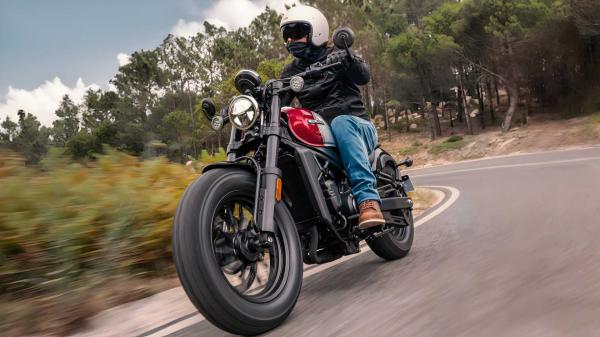
10 Small Cruiser Bikes To Kickstart Your 2025 Riding Goals
The most powerful beginner-friendly cruiser bike on this list produces over 90 horsepower but is still very approachable.

The engine is where the Rebel 1100 story really starts. Honda adapted the 1,084cc liquid-cooled parallel-twin from the CRF1100L Africa Twin — a motor built to handle desert trails, river crossings, and multi-day expedition riding. Transplanting that engine into a low-slung street cruiser sounds odd on paper. In practice, it works better than almost any alternative Honda could have chosen. The key to why it works is the 270-degree crankshaft. Most parallel twins use a 180-degree crank; by phasing this one at 270 degrees, Honda gets a unique, rumbling power delivery that’s easy to modulate and produces a distinctive exhaust note.
|
Engine Displacement |
Engine Type |
Peak Power |
Peak Torque |
Transmission |
|
1,084 cc |
Liquid-cooled, parallel-twin |
87 hp at 7,000 rpm |
72 lb-ft at 4,500 rpm |
6-speed |
The firing intervals are uneven — one cylinder fires earlier than you’d expect, the other later — and the result is something closer to a V-twin’s character than a conventional twin. It doesn’t have the chassis-rattling personality of a V-twin, but the 270-degree crank and uneven firing order give it an engine note and feel that make it genuinely sound incredible. Honda didn’t simply drop the Africa Twin motor unchanged. The engine was tweaked with dedicated ECU mapping, a 20-percent larger flywheel for increased inertia, and revised cam profiles for a distinct power pulse. The result is an engine that trades some top-end horsepower for torque that arrives much earlier in the rev range.
Effortless Acceleration Across the Rev Range

That low-end character is what gives the Rebel 1100 its easygoing magic. The biggest positive is the fact that you don’t need to hunt for a powerband and rev it hard to make things happen. Honda’s automatic Dual-Clutch Transmission (DCT) is another one of those features that sounds technical until you live with it, then it starts to feel like a cheat code for urban riding. There is no clutch lever or foot shifter, and the bike can be put in Drive and ridden like a genuinely modern machine. Riders who prefer more involvement can still switch to Manual mode and use the paddle shifters.
Ergos And Chassis Dynamics That Subvert the Cruiser Stereotype

The Rebel 1100 has a 59.8-inch wheelbase and a 28-degree rake — numbers that belong to a sporty standard more than a classic cruiser. The result is handling that actually rewards a rider who wants to use the full road, not one who’s constantly managing understeer and scraping floorboards. This bike will carve a canyon road; it’s not just willing but capable, too. The ergonomic updates that came with the 2025 refresh have made a real difference. The handlebars are moved rearward and upward, the foot pegs are moved forward, and the seat is made 0.4 inch thicker overall. This updated stance is more relaxed overall.
Low Seat Height Meets High-Spec Suspension

Seat height sits at 27.9 inches, which is low enough that even shorter riders can get both feet down with confidence. That matters for real-world riding more than horsepower numbers do. This is topped with a suspension that’s capable of all duties: front forks with 5.5 inches of travel up front and dual Showa piggyback-reservoir rear shocks with 3.7 inches of travel. That’s suspension tuned for road quality, not just aesthetics. Highway expansion joints, city potholes, uneven surfaces — the Rebel 1100 absorbs them rather than transmitting them directly to your spine.

The Cruiser That Turns Daily Riding Into A Relaxing Ritual
This custom-styled cruiser offers utmost comfort and classic American vibes for under $9,000.
Flagship Electronics That Prove More Useful Than Expected

Honda could have stopped at a good engine, a good chassis, and a fair price. Instead, it gave the Rebel 1100 the kind of electronics package that makes the bike feel far more modern than the average cruiser. The centerpiece is a five-inch TFT display with customizable information, and Honda adds RoadSync smartphone integration for hands-free navigation, music, and local weather. There is also a USB-C terminal near the instruments.
The Safety Net Is Vast, Too

The safety net is just as useful as the convenience tech. Honda’s throttle-by-wire setup supports four HSTC levels, including Standard, Rain, Sport, and a user-customizable option, plus three levels of wheelie control. Cruise control is standard, too. The display shows power, traction, engine braking, and shift-point information depending on mode, so the tech does more than decorate the dashboard.
The Rebel 1100’s quiet brilliance is that it never tries to win by being loud about itself. It just keeps making the right decisions. It is affordable by modern cruiser standards, easier to live with than the heavyweight class, and far more polished than most entry-level alternatives. It has real torque, proper brakes, useful electronics, and a chassis that can entertain a rider instead of merely carrying one. That is why it ends up becoming people’s favorite bike.
Source: Honda Powersports

Related posts




Latest Post


No Comments