
The First Turbocharged Performance Car Sold In America
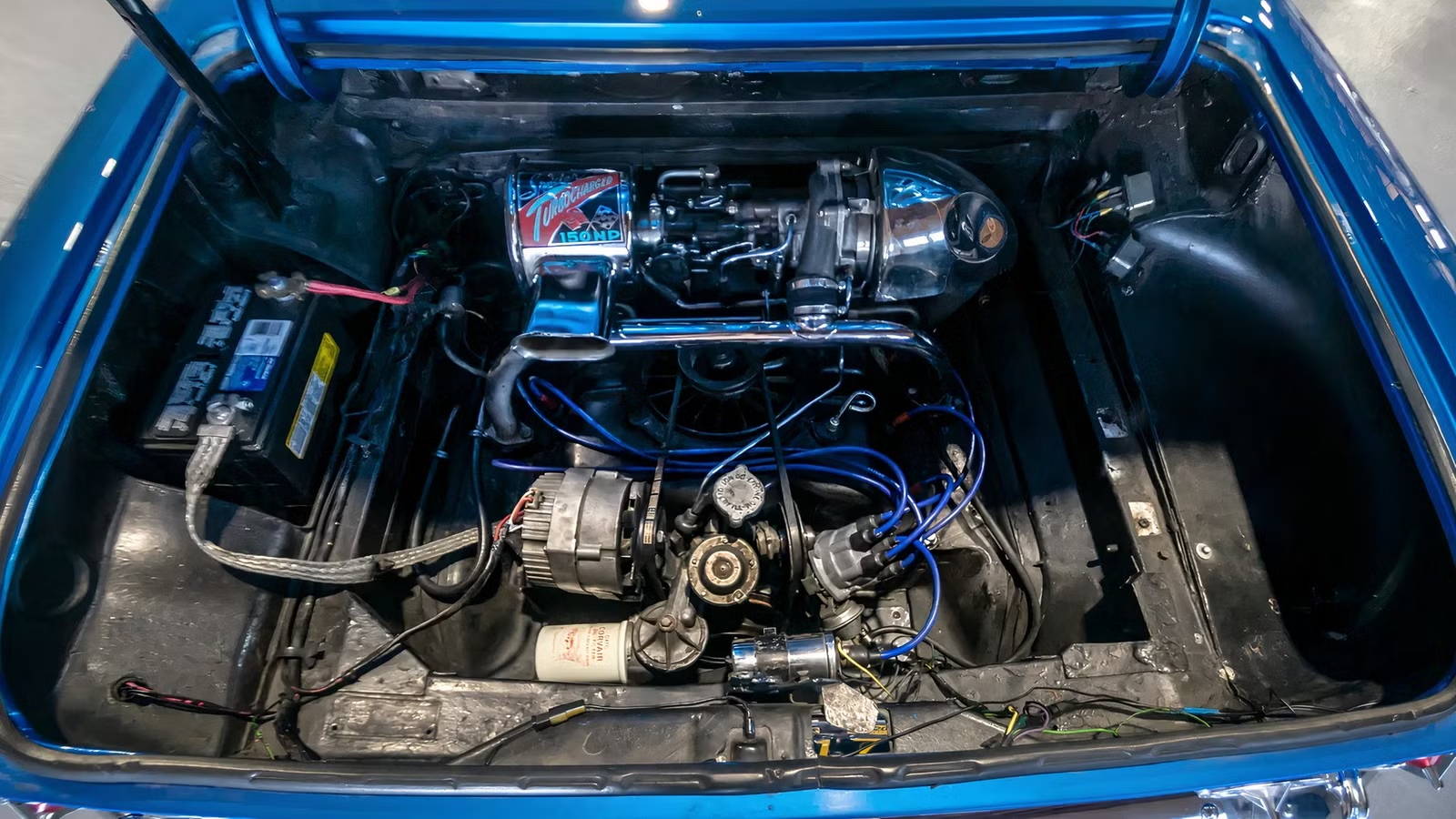
In 1962, General Motors did something no automaker had done before: it put a factory turbocharger on a production car and sold it to ordinary American buyers. What makes this moment stranger than it sounds is that two completely separate GM divisions did it at almost exactly the same time, with different cars, different engines, and radically different approaches to the same engineering problem.

One of them arrived first. One of them actually worked. And the one that worked was a Chevrolet, a rear-engine compact that had spent its first two years being compared, mostly favorably, to the Volkswagen Beetle, and was now about to become something else entirely.
The Year Detroit Discovered Forced Induction
By the late 1950s, turbochargers were a known quantity everywhere in industry except inside passenger cars. Aircraft engines had relied on them since the Second World War. Diesel trucks used them for low-end torque, and racing applications had explored them extensively in pursuit of outright power. What nobody had managed was the adaptation of turbocharger technology to the unpredictable demands of a road car, which needed to respond instantly at idle, survive years of neglect, and work at the hands of drivers who had no interest in understanding what was happening under the hood.

General Motors decided to solve that problem in 1962, and uniquely, two of its divisions arrived at the starting line simultaneously, without meaningful coordination between them. The approaches they took were entirely different from each other. One division pushed its engine hard, kept the compression ratio high, and reached for an aviation-derived fluid injection system to stop the whole thing detonating under boost. The other division took a more conservative line, dropped the compression ratio to suit the turbocharger, and built a system simple enough for any Chevrolet dealer to service. One car was an engineering statement. The other was a performance package.
The Wagon That Quietly Hid A 400-Horsepower Muscle V8
A humble ’60s family wagon hid a 400-hp V8 secret under its long hood, turning grocery runs into muscle-era mischief.
Two Cars, One Idea, Weeks Apart

The first car was announced at an auto show in early 1962. It came from a division that had built its reputation on rear-engine, air-cooled compacts aimed at buyers who found European sports cars appealing but could not stretch to the price. Its turbo system was simple, its boost levels were conservative, and it came with a four-speed manual gearbox, a full instrument cluster including a tachometer and a manifold pressure gauge, and a package price that put genuine turbocharged performance within reach of any buyer who could afford a well-equipped compact.
The second car followed a few weeks later. It came from one of General Motors’ oldest divisions, sat on an aluminum V8, and arrived with its own dedicated reservoir of what the manufacturer called Turbo Rocket Fluid, a name that sounded like science fiction and functioned exactly as advertised, right up until owners forgot to top it up. Dealers handed over bottles of the mixture alongside the keys. The car needed it to run properly under boost. When the reservoir ran dry, a safety valve cut the turbo’s contribution entirely, leaving drivers with a car that felt noticeably sluggish and no obvious explanation for why. More horsepower did not always mean more success.
The Pontiac V8 Built To Bury Chevy’s LS6 454
Tired of losing to the Chevy 454 LS6, Pontiac engineered a V8 so potent it became a rare, hand-built racing legend.
The Chevrolet Corvair Monza Spyder: The First Turbocharged Performance Car America Could Actually Buy

|
Model |
Engine |
Power |
Torque |
0-60 mph |
Top Speed |
|---|---|---|---|---|---|
|
1962 Chevrolet Corvair Monza Spyder |
2.4-liter turbocharged flat-six |
150 hp |
210 lb-ft |
10.8 sec |
100 mph |
|
1962 Oldsmobile F-85 Jetfire |
3.5-liter turbocharged V8 |
215 hp |
300 lb-ft |
9.8 sec |
107 mph |
The Oldsmobile F-85 Jetfire was introduced at the New York Auto Show in April 1962, a few weeks after the Monza Spyder had been unveiled at the Chicago Auto Show in March. It used a genuine exhaust-driven Garrett turbocharger on its 215-cubic-inch aluminum V8, producing 215 horsepower and 300 lb-ft of torque. That was a legitimate one horsepower per cubic-inch, a benchmark that placed it among the most potent engines in America at the time. The problem was its approach to detonation control. Oldsmobile kept the V8’s compression ratio at 10.25:1, which meant the turbocharged intake charge was prone to knock under boost. The solution was the Turbo Rocket Fluid system, a dedicated reservoir of 50 percent methanol and 50 percent distilled water that sprayed into the throttle body whenever the engine ran under boost.
Chevrolet took a fundamentally different path. Rather than spray fluid to suppress knock, engineers reduced the Corvair flat-six’s compression ratio from 9.0:1 to 8.0:1 and let the TRW-supplied turbocharger make up the difference in output. The result was 150 hp at 4,400 rpm and 210 lb-ft of torque at 3,300 rpm, delivered through a mandatory four-speed manual gearbox in a package that required no proprietary fluid and could be serviced at any Chevrolet dealer. Independent testing in August 1962 recorded a 0-60 mph time of 10.8 seconds. That was not a startling number even in 1962. But the car ran reliably, required no specialist knowledge from the owner, and kept selling long after the Jetfire had been quietly discontinued.
The Turbo Setup That Actually Survived

The Jetfire lasted just two model years before the complexity caught up with it. By 1965, its problems had become significant enough that Oldsmobile offered to remove the entire turbocharger and Turbo Rocket Fluid system from any customer’s car, at no charge, and replace it with a conventional four-barrel carburetor. Most owners accepted the offer without hesitation. Of the 9,607 Jetfires built, fewer than 50 are believed to retain a functioning turbocharger today. The Monza Spyder ran through 1966 with nearly 60,000 examples sold, the turbocharger growing to 164 cubic inches for 1964 and output reaching 180 horsepower in its final Corsa form. One car proved the concept. The other proved it could work.
What a Corvair Monza Spyder Is Worth Today

|
Model |
Fair |
Good |
Excellent |
Concours |
|---|---|---|---|---|
|
1962 Chevrolet Corvair Monza Spyder Coupe |
$5,000 |
$8,500 |
$14,000 |
$20,000 |
The Monza Spyder’s wider production run makes it the more accessible of the two historically significant cars. Current valuations put a 1962 Monza Spyder coupe at around $8,500 in good condition, rising to approximately $20,000 in concours trim. Convertible examples carry a meaningful premium, with good-condition drop-tops reaching around $12,500 and concours examples approaching $30,000. Values are broadly consistent across the 1962 to 1964 model years, with convertibles commanding more than coupes at every condition level.
The Jetfire commands considerably more, reflecting both its rarity and its status as one of only two turbocharged production cars ever sold in America in 1962. A 1962 example in good condition trades at $24,900, with the 1963 model reaching $29,900 in good condition. Any Jetfire that still carries its original Turbo Rocket V8 setup, rather than the four-barrel carburetor most received in 1965, commands a significant additional premium over those figures. There are believed to be fewer than 50 such cars left.
The Chevy Engine So Powerful It Came In A Plain-Looking Car
The 2014-2017 Chevrolet SS packed a 415-hp Corvette V8 in a boring-looking sedan that fooled everyone on the road.
Why the Monza Spyder Earned the Performance Car Title

The distinction between the two cars is not simply about reliability. The Jetfire was built on the F-85 Cutlass, a compact sedan with conventional suspension, drum brakes, and steering calibrated for comfortable everyday use. Oldsmobile bolted a turbocharger onto an existing platform and called it a performance car. Chevrolet made a fundamentally different decision with the Monza Spyder. The Monza Spyder package was available only on the Monza, the sporting top-trim line of the Corvair range, and it required the four-speed manual gearbox, metallic brakes, and the heavy-duty suspension option as a bundle. The turbocharger came as part of a performance package, not as an engine upgrade on a family compact.
The enthusiast press of the era understood the difference. Period coverage of the Monza Spyder consistently referenced the European sports car comparison, describing it as a genuine driver’s car in a way that no period Jetfire review managed. Buyers agreed: the Monza Spyder sold at volumes that made the Jetfire look like a concept exercise. The rear-engine, air-cooled, turbocharged flat-six layout that Chevrolet committed to in 1962 for a $317.45 option package would not look out of place in the description of a certain German sports car that arrived thirteen years later. The Monza Spyder got there first and built something that lasted. The Jetfire is the one that needed a bottle of fluid to keep up.
Sources: Hagerty, Chevrolet

Related posts


Latest Post


No Comments