
7 Underrated Detroit V8s That Made More Power Than Claimed
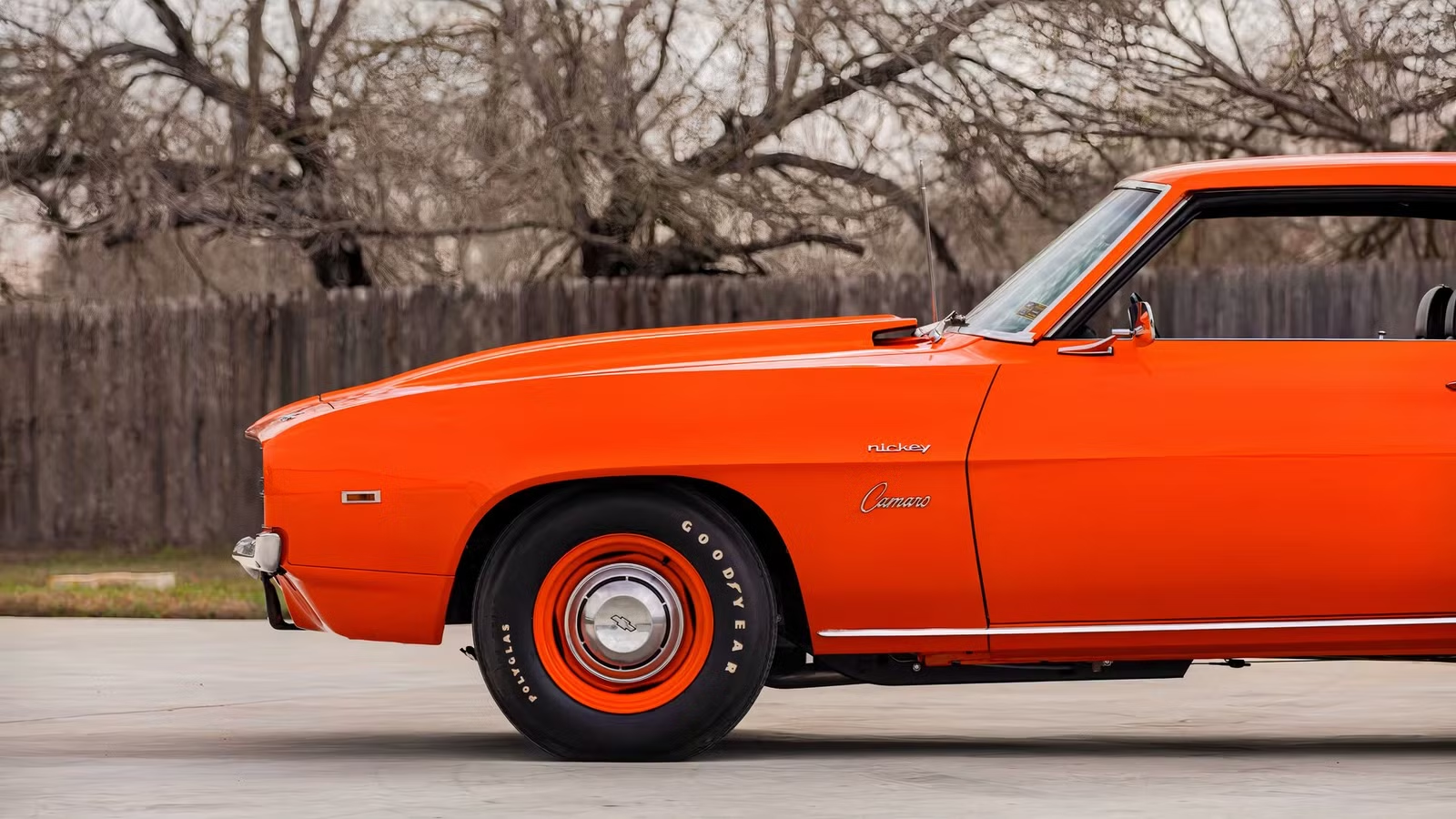
Horsepower is the number automakers love to play with. But when muscle cars were at their peak in the United States, horsepower numbers served more than one purpose. Most, if not all, of those factory horsepower numbers, especially the ones for the V8s, were negotiated numbers more than anything else, not measured for accuracy, just argued over in a boardroom for one corporate reason or another.

Carmakers were actively gaming the system to get the upper hand in marketing and insurance, and a racing class advantage was the other perk they enjoyed because of it. Before the dyno could let the truth out, corporate had already decided what that number should be, and the real number got buried under the paperwork. Today we are looking at 7 of these engines, where the brand claimed less power than the dyno actually proved.
7
428 Cobra Jet, Ford (1968-1970)
The 428 Cobra Jet was Ford’s bread and butter during the peak muscle car era. The engine debuted in 1968, just before the muscle car era hit its peak, and dominated all the way through, winning over the hearts of muscle car enthusiasts everywhere. It was another Ford engine following the grassroots of motorsports from NASCAR. The Cobra Jet made 335 hp and 440 lb-ft straight out of the factory, according to the brand.

That sounded absurd on paper, and the dyno agreed with it. NHRA factored the engine at 335 hp for competition, while the most rigorous dyno test of a stock rebuild landed in the 400–410 gross hp ballpark, well clear of the 335 sticker. It was yet another case of sandbagging: low horsepower numbers meant lower insurance premiums, which meant more cars sold.
10 Muscle Cars With Ridiculously Underrated Factory Horsepower Ratings
What you see isn’t always what you get. In the case of these muscle cars, you get way more than you bargained for.
6
Buick Stage 1 455 (1970-1971)

The Buick Stage 1 is the ultra-high-performance engine from Buick. The story of the Stage 1 is one of the most underrated stories an engine could have. On paper, the Stage 1 455 made 360 hp and 510 lb-ft of torque, just ten more hp than Buick’s standard 455. Even with the numbers the factory put out, the Stage 1 held the record for the highest torque produced by a muscle car at the time, a record that stood until the Dodge Viper finally beat it almost three decades later. A period test clocked the quarter mile at 13.38 seconds at 105.5 mph, with 0-60 mph in 5.5 seconds.
Buick capped the power at 360 hp specifically to land a favorable number in NHRA competition, the same insurance and racing politics every engine on this list dealt with. Word of mouth and drag strip results have long suggested the real number sat north of 400 hp, though period dyno testing never conclusively proved it the way it did for the other engines here. The plan worked out for Buick, but the engine stayed underrated. It only lasted until 1971, after which the compression ratios fell and the horsepower figures went down with it.
5
Olds W-30 455 (1970-1971)

The story of the Olds W-30 455 is the strangest on the list, the numbers changed when the same engine got a different badge. At the time it launched, the W-30 was the ultimate winner’s package, and it is one of the biggest torque machines on this list. The engine churned out 500 lb-ft of torque with 370 hp on paper; that’s what the brand said.
Around the same time, the same block of 455 was put under the luxury Toronado, and there it made 30 more hp at a factory rating of around 400 hp. The proof of the brand’s underrating was the company’s own contradiction, completely internal, not outside speculation. When the W-30 455 was put on the dyno, the test told the same story: the horsepower figures crossed the 400 mark.
4
Pontiac Ram Air IV 400 (1969-1970)

The zenith of Pontiac’s muscle car era, the Ram Air IV 400 was made with one purpose. To dominate the drag strips. This engine was born for the tracks, but the brand underrated it for the same reason most of the other engines on this list are underrated: to get around strict regulations and insurance premiums. Zenith is the right word to use, because the same engine was used in different Pontiac models, and each had different numbers to show for it.
Under the GTO Judge, it made 370 hp and 445 lb-ft; meanwhile, in the Firebird and Trans Am, the same engine was capped at 345 hp and 430 lb-ft, thanks to GM’s policy of capping power-to-weight ratios. Again, the dyno had a different story to tell. Testing found the engine could push over 420 hp, and a 1969 GTO Judge ran the quarter mile in 13.6 seconds at 104 mph, numbers that don’t match either hp figure Pontiac printed.
3
L78 396, Chevrolet (1965-1970)

Making its debut in 1965, the L78 396 is one of the most popular muscle V8 power units made by Chevrolet, popular as the one powering the Corvette. The engine, at its debut, was so popular that it took the space under the hood of the Chevrolet Corvette, Impala, and Chevelle. At its debut, the engine was rated at 425 hp, with two entirely different identities for the same engine according to the car it powered; the Corvette was the only car fortunate enough to get the highest peak power.
As it expanded its presence to the other Chevrolet models, the power output suddenly became 375 horsepower at 5,600 RPM, with nothing changed under the hood. Same internals, lower rpm rating, lower number on paper. When people took the engine to the dyno, it told an entirely different story. The 375 hp rating, and even the original 425 number, were left in the dust: the stock-exhaust dyno reading alone matched that old 425 figure, and a set of headers pushed it to 457.5, breaking every bit of the sandbagging the brand did.
2
426 Street Hemi, Mopar (1966-1971)

The 426 Street Hemi is the heart and soul of Mopar enthusiasts. It made its way to the streets from the tracks of NASCAR, bringing the racing pedigree with it; Chrysler only built the street version to satisfy NASCAR’s homologation rule, which required at least 500 street-legal examples before the race version could compete on Sunday. The 426 Hemi was the power plant under the hood of the Challenger, Charger, and ‘Cuda.
The engine, when launched, was sandbagged with the figures; on paper, it made 425 hp and 490 lb-ft of torque, unchanged from 1966 through 1971. But the dyno told the truth. A correctly restored Street Hemi has measured 459 hp at 5,000 rpm, the exact rpm point Chrysler chose for its own factory rating, and climbed as high as 470 hp further up the rev range. Why underrate an engine that good? Less horsepower on paper meant lower insurance premiums, and lower premiums meant more people bought the car.
12 Big-Block Monsters That Defined The ’60s And ‘70s
Discover 10 legendary big-block muscle cars from the ’60s and ’70s that defined the horsepower wars and America’s golden age of performance.
1
LS6 454, Chevrolet (1970-1971)

This is arguably one of the most popular muscle V8s ever made in the history of America, the LS6 454. The LS6 made its entry to the market with the Chevrolet Chevelle and El Camino in 1970. Under the hood, the LS6 made the most horsepower of the era, or so the brand said, rated at 450 hp and 500 lb-ft of torque. A year later, the LS6 migrated to the Corvette and was limited to it.
Inside the Corvette, it was detuned to make 425 hp, with lower compression and an entirely different state of tune than the one in the Chevelle. That happened because the compression ratios went down by 1971 and Chevrolet had to comply with the new regulations. The drop in performance on the dyno was a harsh reality, marking the definitive end of the true high-compression muscle car era.
Sources: Classic.com, Bring A Trailer, Hagerty

Related posts


Latest Post



No Comments