
Car clubs in the UK: what are your options now?
The car club sector has been on a bit of a roller coaster over the last decade. After a flurry of interest and start-up successes, the segment has contracted in recent years.
The latest hit to the car club sector was the closure of Zipcar at the start of 2026. The market today is smaller and patchier than it was a couple of years ago, but drivers in some towns and cities can still rent a car or van by the hour, day or weekend without owning one.

For the right user, a car club can still be a useful alternative to car ownership. It can work particularly well if you only need a car occasionally, live close to a shared vehicle and don’t want the fixed costs of insurance, servicing, parking and depreciation.
The catch is availability. Since Zipcar left the UK, coverage varies much more by location. In some areas there are still several shared cars nearby; in others, the nearest option may be too far away to be practical.
What is a car club?
A car club is basically short-term car rental by membership. You join a scheme, book a car or van through an app or website, unlock it when you need it and return it when you’re finished.
Some car clubs own or manage their own vehicles, which are usually parked in fixed bays or small local zones. Others use a peer-to-peer model, where private owners list their cars for other members to hire. That version is a bit like Airbnb for cars, with the platform handling bookings, insurance, payment and driver checks.
The advantage is flexibility. You can use a car for a supermarket run, a trip out of town or a day when public transport doesn’t work for you, without paying to own one all year round. The disadvantage is that the car you want has to be available when and where you need it.
What changed after Zipcar left the UK?
Zipcar was probably the best-known name in UK car sharing. It ran operations in London, Cambridge, Bristol and Oxford, before pulling back from the last three cities in 2024 to concentrate on London.
At the end of 2025, Zipcar announced that it was leaving the UK altogether. Its withdrawal removed a large part of the country’s car club fleet almost overnight, especially in London, where it had been the dominant operator.
The company’s exit followed a difficult period for car clubs. Rising operating costs, insurance costs, electricity prices, falling used-car values and weaker customer demand all put pressure on operators. In London, changes to the Congestion Charge also added another complication, as electric cars lost their blanket exemption from January 2026.
Transport for London has introduced a 100% Congestion Charge discount for eligible electric car club vehicles that are picked up and returned to the same dedicated bay inside the Congestion Charge zone. But that does not help every operator or every type of car club vehicle, and it has not replaced the scale of Zipcar’s former London fleet.
Zipcar was not the only retreat from car sharing. Co Cars, which ran electric and low-emission cars in Exeter and across parts of the South West, collapsed in 2023, while the car-sharing platform Ubeeqo also became insolvent. Car-sharing schemes backed by car manufacturers have also had a mixed record, with BMW, Mini and Mercedes-Benz pulling out of shared-car services in Europe several years ago.
That doesn’t mean car clubs have disappeared. It does mean the market is less convenient than it was for many users, and you now need to check what is actually available near you rather than assuming a car will be close by.
The main types of car club
Car clubs generally fall into two main types. The first is the traditional car club model, where the operator provides the vehicles and you collect them from a fixed bay or local zone. These are usually fairly new cars or vans, often with fuel, insurance, servicing and breakdown cover built into the price.
The second is peer-to-peer car sharing, where privately owned cars are listed for hire through a platform. These cars can vary much more in age, condition, price, mileage allowance and collection arrangements. Some are unlocked through an app, while others involve meeting the owner to collect the keys.
Traditional car clubs are usually simpler if you want a predictable, app-based service. Peer-to-peer platforms can offer more choice and sometimes lower prices, but there is more variation between vehicles and owners.
CoMoUK and local car clubs
CoMoUK, the national charity for shared transport, runs an accreditation scheme for car clubs, bike share and e-bike share. Its directory is a useful starting point if you want to check whether there is an accredited operator in your area.
As of July 2026, CoMoUK listed a number of regional and community-run car clubs across the UK, many of them outside major cities. Some are small, local schemes serving rural communities, including several in Scotland.
These smaller car clubs may not work like a national app-based service. Some are run by community groups, some have only a few vehicles, and some links lead to broader local transport or climate groups rather than a conventional car club booking page. They can still be useful, but you may need to do a bit more digging to find out what is actually available.
Co Wheels
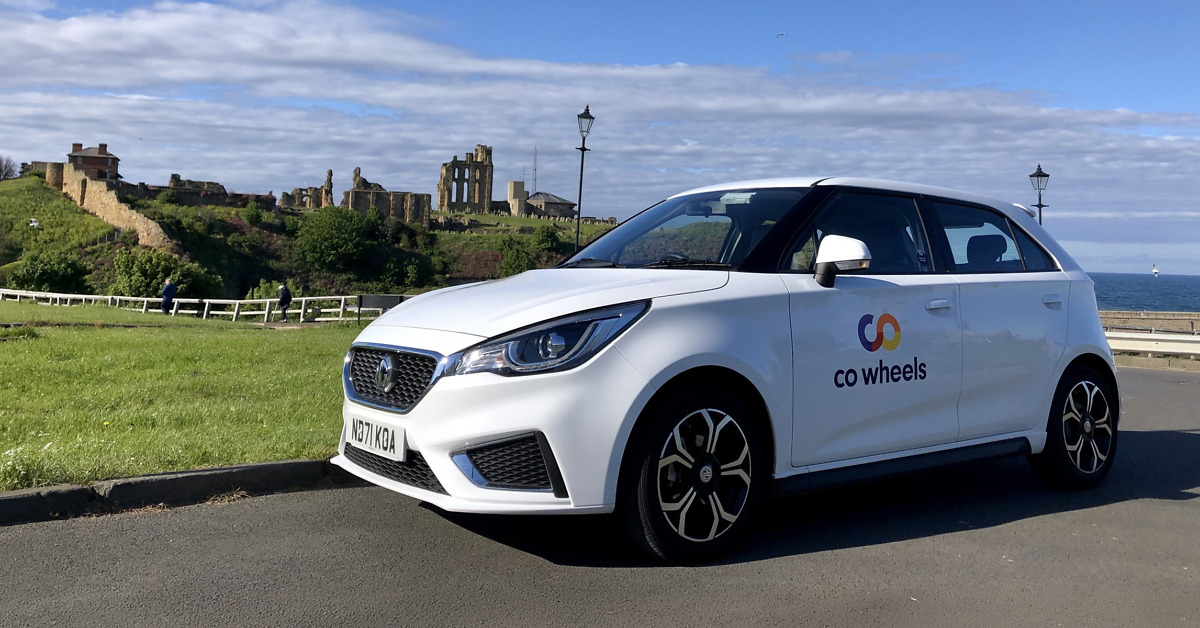
Co Wheels is one of the main remaining car club operators in the UK, and appears to be expanding into some of the gaps left by Zipcar.
The company started as a small pilot scheme in the North East with two cars in 2008, and has grown into a community interest company operating shared cars and vans across the UK. It offers pay-as-you-go car club vehicles, pool car fleet management and franchise operations.
Co Wheels says it has more than 700 vehicles across the UK, with booking and unlocking handled through its app. Vehicles are returned to their parking bay or local zone at the end of the booking.
If there are no cars close to you, Co Wheels invites potential users to complete a location request form. The company says this helps its location managers assess demand in different parts of the country.
Many of the newer Co Wheels cars appear to be MG models, including electric cars and petrol or hybrid models. MG also promotes Co Wheels through its own website, so there appears to be some form of supply or marketing arrangement between the two companies. If you’re considering a used MG, hiring one through a car club could be a useful way to try one in normal use.
Prices vary by membership plan, location and vehicle type. At the time of writing, the basic membership plan had a £10 joining fee, no monthly fee and hourly rates starting from £7.45, with daily rates from £55. Co Wheels also charges by mileage, with rates from 14p per mile for electric vehicles and 24p per mile for petrol or hybrid vehicles.
Regular users can pay a monthly fee for lower hourly and daily rates. As always with a car club, it is worth checking the price for your nearest vehicles rather than relying only on headline “from” prices.
Enterprise Car Club
Enterprise Car Club, run by the global car hire firm Enterprise, continues to operate across the UK. It offers cars and vans that can be booked by the hour or day and unlocked through an app.
Enterprise says it has more than 1,300 self-service cars and vans across the UK, based at on-street bays, train stations, car parks and Enterprise branches. Fuel, servicing, MOTs, breakdown cover and damage protection are included in the membership, rental and mileage fees.
The company has also been adding cars in London following Zipcar’s withdrawal. It has an offer for people switching from another car club, which is clearly aimed at users looking for a replacement service.
Pricing varies by location and vehicle type. At the time of writing, Enterprise’s basic plan cost £10 a year, with economy car rates starting from £9 an hour or £59 a day. Regular users can pay £7 a month or £60 a year for lower rates, starting from £8 an hour or £49 a day for an economy car.
Enterprise also offers a young driver plan for drivers aged 19 to 21, although rates and restrictions are different. As with Co Wheels, the important question is not the national headline price but whether there is a suitable vehicle close enough to be useful.
Peer-to-peer car clubs
Peer-to-peer car sharing works differently. Instead of hiring a car owned by the operator, you hire a privately owned car listed through the platform.
The platform handles the booking, payment, driver checks and insurance arrangements. The owner earns money from renting out the car, while the hirer gets access to a vehicle that may be nearby, cheaper or more unusual than a normal rental car.
The trade-off is variation. One car may be almost new and available through remote unlocking, while another may be ten years old and require meeting the owner to collect the keys. Mileage allowances, collection arrangements, fuel policy and cleanliness can all vary from one listing to another.
Turo
Turo is one of the best-known peer-to-peer car sharing platforms. It operates in the UK, Australia, France, the United States and some Canadian provinces.
In London, Turo was quick to advertise to former Zipcar members after the closure. Its model is similar to Airbnb, with private owners listing their cars as “hosts” and renters leaving reviews afterwards.
You can either collect the car or, depending on the listing, arrange for the host to bring it to you. There are lots of different cars and vans on offer, with many vehicles several years old. In a sample North London search for a one-day Friday-to-Saturday hire in August 2026, there were more than 200 results, ranging from older small cars to newer electric cars.
When you view a vehicle listing, you can see the total distance included in the trip. The owner sets the mileage allowance, and extra miles are charged if you exceed it. In our sample search, many listings included more than 100 miles a day.
Turo trips in the UK include third-party liability insurance, and renters can choose protection plans that affect how much they may pay if something happens to the car. As with any hire, you should read the terms carefully before booking, especially the excess, damage responsibility and cancellation rules.
Hiyacar
Hiyacar is another peer-to-peer car sharing platform, although it also offers some car club-style vehicles that it owns or runs directly.
Bookings include insurance, and Hiyacar carries out eligibility checks before allowing members to hire. Some cars use Hiyacar’s QuickStart technology for keyless access, while others may require meeting the owner.
Hiyacar allows regular users to buy a monthly subscription, which can increase the mileage allowance and booking flexibility. Standard users usually have more limited pick-up and drop-off times, while subscribers can get wider access on eligible vehicles.
In a sample one-day search, prices varied widely depending on vehicle, location and mileage allowance. That is normal for peer-to-peer car sharing, where each car is listed individually rather than priced as part of a uniform fleet.
Hiyacar can be useful if there are private cars available close to you, but it is worth comparing the total cost carefully. Look at the hire price, insurance cost, booking fee, mileage allowance, collection arrangements and any extra-mile charges before deciding whether it beats a conventional car club or rental car.
How much do car clubs cost?
There is no single answer, because car club pricing depends on the operator, membership plan, vehicle type, location, hire length and mileage.
Traditional car clubs usually charge a membership fee or joining fee, then an hourly or daily rental rate, plus a mileage charge. Fuel, insurance and breakdown cover are usually included, but collision damage waivers or lower excess options may cost extra.
Peer-to-peer platforms price each car separately. The headline daily price may look attractive, but you need to check the insurance/protection cost, mileage allowance, booking fee, collection arrangements and late return rules.
For short local trips, an hourly car club can be much cheaper than owning a car. For longer trips, especially over several days or with high mileage, a normal rental car may be better value. The only way to know is to price up the actual journey you need to make.
What to check before joining
Before joining a car club or peer-to-peer platform, check whether the service really fits how you will use it. A car club can look like a good idea in theory, but it is not much use if the nearest car is a 25-minute walk away or is always booked when you need it.
The main things to check are:
- Vehicle availability near your home, not just in your town or city
- Hourly and daily rates
- Mileage charges or mileage allowance
- Fuel or charging policy
- Insurance excess and damage cover
- Late return fees
- Cleaning and vehicle condition rules
- Whether vans are available if you need one
- Young driver restrictions
- Congestion Charge, ULEZ and parking rules
- Whether the car must be returned to the same bay
- How far ahead you can book
- What happens if the vehicle is unavailable or faulty
You should also think about how flexible your journeys are. If you need guaranteed access to a car every Monday morning, ownership, leasing or a longer-term rental may be more reliable. If you only need a car occasionally and can be flexible, a car club may still work well.
Are car clubs still worth considering?
Car clubs are not as easy to recommend as they were when Zipcar had a large UK presence. The market has shrunk, and many users now have fewer vehicles nearby than they did before.
That said, car clubs can still make sense. If you live close to a Co Wheels or Enterprise Car Club vehicle, or have good peer-to-peer options nearby, they can be a practical way to avoid owning a car you only use occasionally.
They are most useful for people who mainly walk, cycle or use public transport, but occasionally need a car for shopping, family visits, weekend trips or carrying bulky items. They can also be useful for households that already have one car but sometimes need a second.
The key is not to assume. Check what is actually available within a realistic walking distance, price up a few typical trips and compare the total cost with normal rental, taxis, public transport and ownership.
Car clubs have not disappeared after Zipcar, but the convenience now depends more heavily on where you live. In the right location, they can still be a very useful service. In the wrong one, they may no longer be a realistic alternative to having your own car.
Read more:

Related posts





Latest Post




No Comments