
2027 Yamaha XSR900 GP First Look: Headed to America?
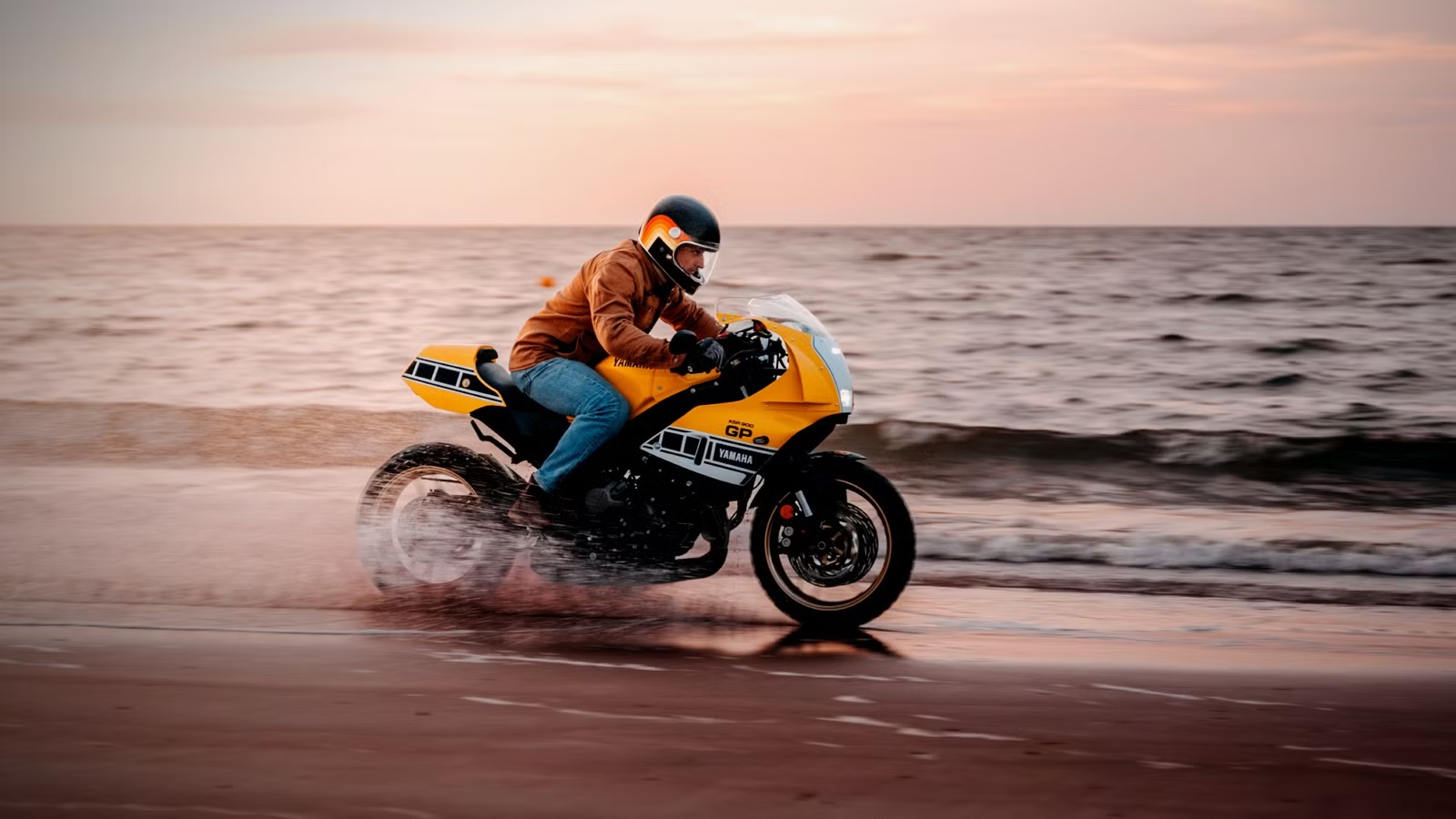
The Yamaha XSR900 GP has spent the past couple of years being one of those motorcycles American riders could admire but not officially buy. Based on the XSR900 but dressed like a Yamaha Grand Prix machines ridden by American roadracing icons such as Eddie Lawson, Kenny Roberts and Wayne Rainey , the GP adds a half fairing, clip-on handlebars, revised ergonomics, upgraded suspension, and a more focused chassis setup around the tried and true 890cc CP3 triple.

That may finally be changing. Yamaha hasn’t officially announced the XSR900 GP for the US, and there is no American MSRP yet. However, the California Air Resources Board (CARB) has certified the model for the 2027 model year, with documentation identifying XSR900 GP variants for California compliance. So while the motorcycle shown here is Yamaha’s global 2026 model, the regulatory trail points toward a possible 2027 US arrival.
The CARB Filing Is The Biggest US Clue Yet
Regulatory certification isn’t the same thing as a model announcement, so it’s worth keeping the distinction clear. Yamaha Motor USA still doesn’t list the XSR900 GP in its current US lineup. The 2026 Sport Heritage range instead centers on the XSR900 and XSR700, with the standard 2026 XSR900 carrying a $10,599 MSRP.

The CARB filing changes the picture because it provides regulatory evidence that Yamaha has prepared the XSR900 GP for California emissions compliance. Reports based on the certification point to multiple XSR900 GP model codes, suggesting more than one color option. Yamaha still needs to announce pricing, availability, and final US-market specifications before any of that becomes official.
The GP Is More Than An XSR900 With A Fairing

The XSR900 GP shares its core architecture with the XSR900, including Yamaha’s 890cc liquid-cooled DOHC inline-three. Output stands at 117.3 horsepower at 10,000 rpm and 68.6 pound-feet of torque at 7,000 rpm. It uses an 11.5:1 compression ratio, electronic fuel injection, a six-speed transmission, and chain final drive.
But Yamaha didn’t simply bolt bodywork onto the standard bike. When the GP was introduced, the company detailed revised chassis rigidity, model-specific front and rear suspension, clip-on handlebars, altered footpeg positioning, and a riding position intended to suit the racier bodywork. Yamaha also revised the brake hoses and incorporated a Brembo radial front master cylinder.
Would-be owners will find fully adjustable KYB suspension at both ends, with 5.1 inches of front travel and 5.2 inches at the rear. Braking comes from twin 298mm front discs and a single 245mm rear disc. The GP rolls on 17-inch wheels wearing 120/70ZR17 front and 180/55ZR17 rear tires, with Yamaha specifying Bridgestone Battlax Hypersport S23 rubber.
Grand Prix Styling Without 1980s Technology

The visual connection is deliberate. Yamaha designed the XSR900 GP around its YZR500 Grand Prix heritage, using a half fairing, separate cockpit-mounted bodywork supports, and an angular tail section inspired by its factory racers from the 1980s and early 1990s. The 2026 model adds Legend Yellow, referencing the yellow-and-black racing schemes associated with Yamaha’s American competition history and Kenny Roberts.
Underneath the nostalgia is a modern electronics package built around a six-axis IMU. It supports lean-sensitive traction control, cornering ABS, slide control, and wheelie control, while riders also get configurable riding modes, cruise control, and a third-generation bi-directional quickshifter. A five-inch color TFT provides smartphone connectivity and navigation functionality through Yamaha’s companion app.
Yamaha Hasn’t Told Us The Most Important US Number Yet
Price is the big missing piece. The regular 2026 XSR900 starts at $10,599 in the US, but the GP’s extra bodywork, fully adjustable suspension, upgraded braking hardware, clip-ons, and model-specific chassis setup point toward a higher MSRP if Yamaha brings it over in essentially global-market specification. The XSR900 GP is already sold across Europe, where pricing averages around €14,200, or roughly $15,900 at current exchange rates. That doesn’t predict a US MSRP, but it does underline that this is an existing production model, not a concept or rumor.
That also explains where the XSR900 GP appears to fit. It isn’t simply a cosmetic edition of the XSR900, nor is it intended to replace Yamaha’s dedicated supersport machinery. Instead, it takes the CP3-powered Sport Heritage platform in a more focused, race-inspired direction, with hardware and ergonomics to back up the YZR500-inspired styling.
2027 Yamaha XSR900 GP Photo Gallery:
2027 Yamaha XSR900 GP Specifications:
Engine:
|
Type |
Liquid-cooled, DOHC inline-three; 4 valves per cylinder; CP3 engine |
|
Displacement |
890cc |
|
Bore x stroke |
78.0mm x 62.1mm |
|
Maximum horsepower |
117.3 horsepower @ 10,000 rpm, claimed |
|
Maximum torque |
68.6 lb-ft @ 7,000 rpm, claimed |
|
Compression ratio |
11.5:1 |
|
Valvetrain |
DOHC; 4 valves per cylinder |
|
Fueling |
Electronic fuel injection w/ throttle-by-wire |
|
Exhaust |
3-into-1 exhaust system |
|
Cooling |
Liquid |
|
Transmission |
Six-speed constant-mesh manual w/ bi-directional quickshifter |
|
Clutch |
Multiplate wet assist/slipper clutch |
|
Final drive |
Chain |
Chassis:
|
Frame |
Aluminum Deltabox-style diamond frame; aluminum swingarm |
|
Front suspension; travel |
Fully adjustable KYB 41mm inverted fork w/ preload, compression and rebound adjustment; 5.1 inches |
|
Rear suspension; travel |
Fully adjustable KYB link-type monoshock w/ remote preload, compression and rebound adjustment; 5.2 inches |
|
Wheels |
17-inch Yamaha SpinForged aluminum alloy wheels |
|
Front wheel |
17-inch diameter |
|
Rear wheel |
17-inch diameter |
|
Tires |
Tubeless Bridgestone Battlax Hypersport S23 |
|
Front tire |
120/70ZR17M/C (58W) |
|
Rear tire |
180/55ZR17M/C (73W) |
|
Front brake |
Dual 298mm discs w/ radial-mount 4-piston hydraulic calipers and Brembo radial master cylinder |
|
Rear brake |
245mm disc w/ hydraulic caliper |
|
ABS |
Standard, front and rear; lean-sensitive cornering function managed through six-axis IMU |
|
Electronic rider aids |
Throttle-by-wire; six-axis IMU; selectable ride modes; lean-sensitive traction control; slide control; wheelie control; cornering ABS; cruise control; bi-directional third-generation quickshifter; five-inch color TFT display w/ smartphone connectivity and navigation integration |
Dimensions & Capacities:
|
Wheelbase |
59.1 inches |
|
Rake |
25 degrees |
|
Trail |
4.3 inches (110mm) |
|
Seat height |
32.9 inches |
|
Ground clearance |
5.7 inches |
|
Lean angle |
Not Provided By Manufacturer |
|
Fuel capacity |
3.7 gallons |
|
Estimated fuel consumption |
47.0 mpg, based on Yamaha’s published 5.0 L/100km figure |
|
Curb weight |
441 pounds |
Price & Warranty:
|
Website |
yamaha-motor.eu |
|
Price |
Not Announced For The U.S. |
|
Warranty |
Not Announced For The U.S. |
|
Service interval |
Oil: 6,000 miles / valve service: 24,000 miles |
|
Color |
Legend Yellow |
Source: Yamaha Motorsports

Related posts

Latest Post


No Comments